

"Justice cannot be for one side alone, but must be for both"
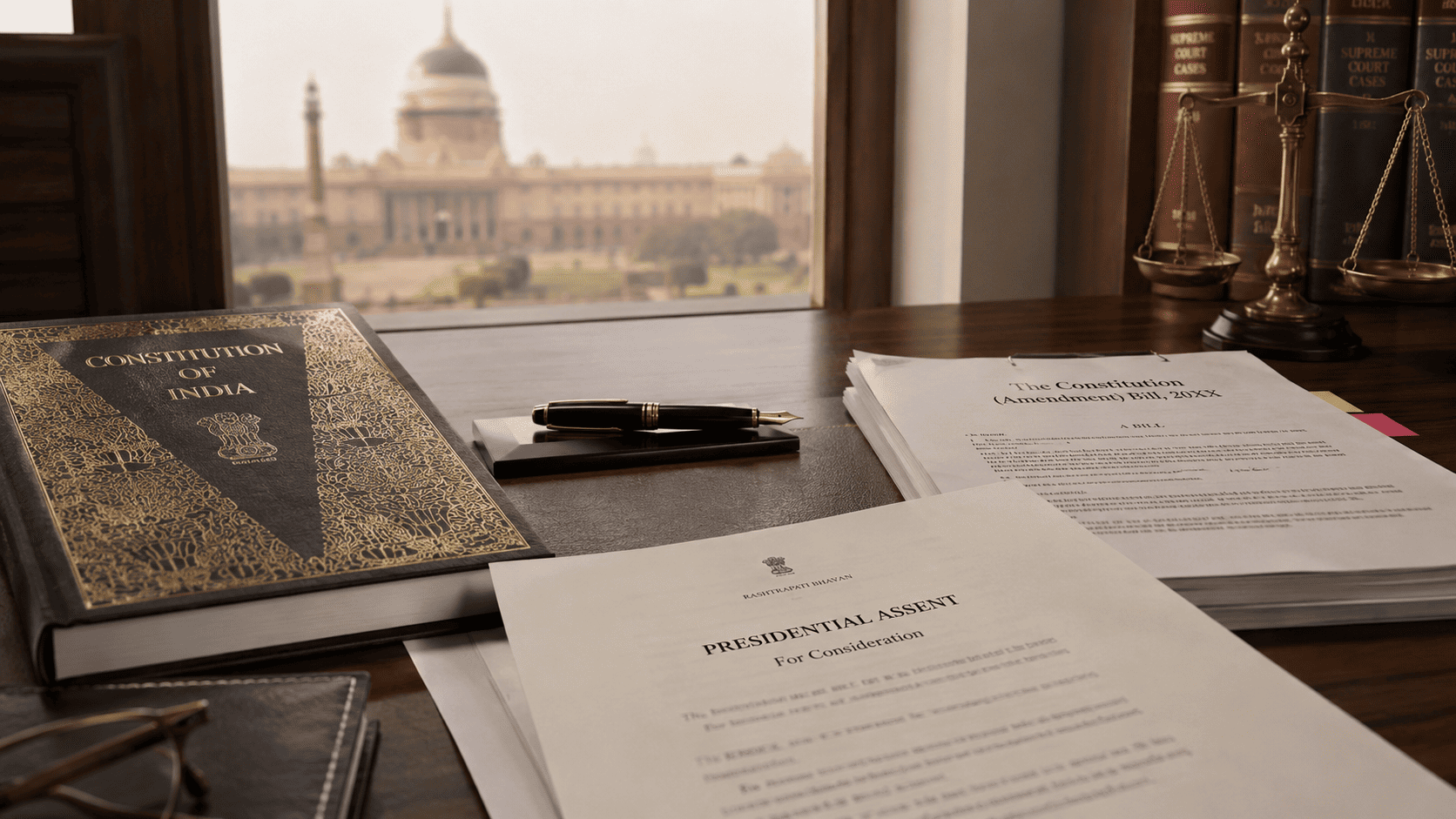
TIMELINE FOR PRESIDENTIAL ASSENT A Constitutional Necessity or Judicial Over-reach?
Published on : 04/06/2026
View Count : (1)
TIMELINE FOR PRESIDENTIAL ASSENT A Constitutional Necessity or Judicial Over-reach?
ABSTRACT
The President of India, our first Indian citizen, as the Constitutional Head of the Union, embodies the nation’s unity and Constitutionalism. The President wields Veto, Ordinance-making, emergency, and pardoning powers to uphold Constitutional Supremacy. In India, a Law becomes a Statute after a Bill passed by the Parliamentary Houses is assented to by the President. Democratic accountability and Federal Balance are safeguarded by this act (i.e., the Presidential Assent).
This current paper outlines the question of the Constitutional Necessity or Judicial Over-reach in the Timeline of Presidential Assent in India. Presidential Assent plays a pivotal role in the Federalism concept, i.e., being a Constitutional distribution of powers between the Union and the States to ensure unity with autonomy. Indian Constitutional frameworks are outlined in Articles 111, 200, and 201. The British Influence, Constituent Assembly Debates, and Earlier practices are being elaborated for analyzing the Historical Origins. Shameswar Singh[1] (1974); Hoechst Pharmaceuticals Ltd.[2](1983), Kaiser-I-Hind Pvt. Ltd.[3] (2002), and many such landmark case laws are examined for finding the Legislative Supremacy and answers for the question raised in this paper. The debate on Constitutional Necessity and Judicial Over-reach for the Presidential assent timeline is scrutinized to further get Constitutional reforms in case of any arbitrariness or over-reach of the powers.
The Comparable-Doctrinal analysis is also done from Australia, Canada, and the UK to understand the adaptation or Constitutional reforms, and recommendations that can be made to answer the Constitutional Necessity and restrict judicial over-reach, so as to empower the Legislative Supremacy along with the Federalism concept.
KEYNOTES: Presidential Assent; Constitutional Necessity; Judicial Over-reach; Federalism; Legislative Supremacy; Constitutional Reform.
“Westminster Principle of Royal Assent”[4] - The UK was taken as a model for the practice of Presidential Assent in India. Royal Assent[5] outlines the structure of the UK's Historical monarchical system, i.e., the head of state, their assenting or approving of the legislation or Bills passed by the Parliament, which will later become a Statute. Articles 111 and 200[6] of the Indian Constitution, 1950, mandate that without Presidential Assent, no bills other than money bills can be transformed into a Law.
Final Constitutional Step, Guard against Unconstitutional Laws, and Federal Balance Maintenance are the core aspects of assents in the Legislative.
Constitutional silence on timeframe, Supreme Court-imposed deadlines, and Tensions over judicial intervention are the contemporary delays and uncertainty in the assent timeline. The main case[8] that highlights the research problem covers the stated contemporary delays and uncertainty, as the Constitutional silence on the time frame through the Articles 111, 200 and 201; and further the tension over judicial intervention has incurred due to the Hon’ble President Murmu’s invocation of Article 143 of the Indian Constitution, 1950, where the Question to court’s authority to impose the timelines in Article 200 & 201 of the Indian Constitution, 1950; and to which in April 2025 - the Supreme Court provided the direction to have a 3 month timeline for Presidential assent (inclusive of requirements & delay reasons).
The Union Level and State Level provisions of the Indian Constitution, 1950, are Articles 111, & Articles 200 and 201,[11] respectively[12].
According to Article 111 of the Indian Constitution, 1950 focuses on the bills passed by both Houses of Parliament, is presented to the President for Assent, may: (a) give assent; (b) withhold assent; or (c) return the Bill [if not a Money Bill] with recommendations for reconsideration[13].
According to Article 200 and 201 of the Indian Constitution, 1950 focuses on the bills passed by the State Legislatures, is presented to the Governor for assent may: (a) give assent; (b) withhold assent; or (c) return the Bill [if not a Money Bill] for reconsideration, or (d) reserve the Bill for the Consideration of the President. Once reserved, Article 201 of the Indian Constitution, 1950, the President will exercise similar powers[14].
The Westminster system - Constitutional assent formality: The Governor and the President have discretion in certain cases, especially when a Bill conflicts with Central law, National Interest, or violates constitutional provisions - exhibits constitutional nuance lies in mandatory vs. discretionary powers.
The Absolute assent; withholding of Assent (Veto Power); and Returning the Bill for Reconsideration are the types of assent under Article 111 of the Indian Constitution, 1950.
At the State Level, the Governor (as a referral of the President), through reservation power under Article 200 of the Indian Constitution, 1950.
Article 111 of the Indian Constitution, 1950, nor Article 200-201 of the Indian Constitution, 1950, features the absence of an explicit constitutional timeframe (i.e., no prescribed deadline for the President’s or Governor’s assent). There is only a phrase “as soon as possible” in Article 200, subject to interpretation, where the judiciary was not implementing any timeline prior, as initiating constitutional functionaries to act reasonably and without delay.
The President and Governors have at times kept bills for an extensive time period, creating a lapse or paralysis, creating federal imbalances. There is always a timely decision-making process required in any organ of the Government (i.e., the Legislature, Executive, and Judiciary). Thus, in recent times, the Supreme Court directions were also aligned as per the timely decision-making requirements.
An absence of deadlines or lacunae in such provisions establishes that the legislative efficiency and cooperative federalism spirit is being threatened.
British Crown’s control over East India Company in India after the 1857 revolt - Legislative councils introduced through the Indian Council Act, 1861, where Bills to become law required the Governor-General’s assent.
The pre-law for the Indian Constitution provided the Governor's Assent (i.e., for Provincial Bills) & Governor-General’s Assent (i.e., for Central Bills) - allowing the Governor to reserve bills for consideration of the Crown [British Government in London]. Articles 200 and 201 of the Indian Constitution, 1950, were inherited provisions from the “reservation for higher assent”.
An “as soon as possible” was replaced with the Debates on the Proposed Presidential Assent, with options of withholding, returning, and approving with strict guidelines[15].
Legislative supremacy was emphasized in this Constituent Assembly debate, asserting the rejection of absolute veto power, by limiting the President to assent, to return once, or to withhold powers on the bills[16].
Articles 111, 200, and 201 of the Indian Constitution, 1950 are the main provisions that underline our paper’s Presidential and Governor’s assent for Legislative Enactment privileges.
Most of the bills’ assent was largely prompted, with minimal controversy, establishing the constitutional formality. For example: The legislative-executive harmony established in - Recognition of States Act, 1956 - where President Dr. Rajendra Prasad assented promptly; The Hindu Marriage Act, 1955 - timely assent received from the President; etc.
Indian Post Office (Amendment) Bill, 1986 - The 1st major Test of Delay by President Zail Singh’s “Pocket Veto”, where it was neither assented to nor returned, by exploiting the constitutional silence on timelines[17].
Indefinite delays by Governors were criticized by Courts, especially stressing that the Assent is not merely a constitutional formality. The same was showcased in the 2002 Supreme Court case[18], “Kaiser-i-Hind Pvt Ltd. and Another vs. National Textile Corporation Ltd.[19]”.
State of Punjab vs. Principal Secretary to the Governor of Punjab[21]; and State of Tamil Nadu vs. the Governor of Tamil Nadu & Anr.[22] were the main Supreme Court cases that reaffirmed the delay in the Governor’s Assent[23].
So the MLAs sent a letter to the Governor to communicate the Speaker’s and the Government’s displeasure. The Governor advanced the assembly session without the CM's advice and also adopted a resolution removing the Speaker”[29].
Articles 111, 200, and 201 of the Constitution provided power for the Presidential and Governor’s Assent in the Indian Parliamentary Democracy. This requirement is essential in the constitutional functioning of the legislative enactments, which is carried out by the Head of the Union as well as the State, representing the responsibility and authority of the constitutional executives. However, an explicit timeline is not provided for the assenting, retaining, or declining of bills - this raised concerns for a paralysis in the Legislature.
The timeline requirements were clearly highlighted in the above judicial interpretation with special reference to the pocket veto[43], etc., on assenting bills, stating the delays or abstains must not obstruct the constitutional morality that is, ‘the Legislative supremacy, democratic efficiency, and Federal Comity’. Thus establishing the constitutional necessity of establishing the timeline for assenting to the Bill.
The ‘Separation of Powers’ is also an implied Constitutional Morality of the Indian Constitution. But in the judicial interpretations like the Punjab Governor’s case, the Telangana Governor’s case have directed the Governor to act within a “reasonable time”. Critiques argue that initially, the judiciary in the case of the Nebam Rabia case[44], acknowledged the Governor’s discretion, without catering to the timelines; but in the Punjab Governor’s case and Telangana Governor’s case, their contrary statements to these Timelines, showcasing the adjudicatory role to be a constitutional supervisor, establishing the Separation of Powers being breached, their judicial over-reach.
The judiciary is given the power to overlook the constitutional violations that are preventing the abuse, excessive interventions that distort the Basic Structure Doctrine. But the judiciary, they themself have breached the Separation of Powers, which is one of the Basic Structure Doctrine. They were constantly breaching the Separation of Powers by interfering in the Legislative and Executive matters, especially in this case of assenting to bills. Even though this Constitutional necessity on the timeline for assenting bills was well-intentioned, they do constitute judicial over-reach.
This paper on the “Timeline for Presidential Assent - A Constitutional Necessity or Judicial over-reach?” has become a contemporary topic, based on the ‘15 reference questions from Hon’ble President Draupadi Murmuseeked from the court based on advisory opinion under Article 143 of the Indian Constitution, 1950, which basically revolves around the assenting bills and their timelines by the President and Governor, as on May, 2025’[45], where the judiciary provided answers subsequently. Those answers resulted in the establishment of the timelines for Governor’s and Presidential assent that don’t cause any harm to the federal dynamics.
These debates are causing a delay in Presidential and Governor’s assent, asserts the pressure between the Constitutional necessity and fear of judicial over-reach. The boundaries that were set between the Indian Government's Organs (i.e., the Legislative, Executive & Judiciary) will be hindered if the Judiciary adjudicates the timeline process for the legislature’s assenting of bills. The Supreme Court decisions in the Punjab case (2023) and Telangana (2024), emphasizing the judiciary’s role in protecting constitutional accountability, will be exaggerating the judicial over-reach. Thus, to have the balance in the governmental organ’s functions, a parliamentary or constitutional amendment providing the legitimate solution, ensuring efficiency while respecting the Separation of Powers and the dignity of constitution
[1] Shamsher Singh & Anr. v. State of Punjab, [1974 AIR 2192, 1975 SCR (1) 814]
[2] Hoechst Pharmaceuticals Ltd. and Others v. State of Bihar and others, [1983 AIR 1019, 1983 SCR (3) 130]
[3] Kaiser-I-Hind Pvt. Ltd. and Ors. v. National Textile Corp. (Maharashtra North) Ltd. & Ors., [AIR 2002 SC 3404]
[4] V. Sudhish Pai, Upholding Constitutionalism and Restoring Constitutional Order, (12 May 2025), SCC Online Times, available at: [https://www.scconline.com/blog/post/2025/05/12/upholding-constitutionalism-and-restoring-constitutional-order/#:~:text=The%20Constitution%20has%20adopted%20the,the%20constitutional%20monarch%20in%20Britain.] accessed on 23 August 2025
[5] Royal Assent, UK Parliament, available at: [https://www.parliament.uk/about/how/laws/passage-bill/commons/coms-royal-assent/], accessed on 23 August 2025
[6] Article 111 in Constitution of India, IndianKanoon.org, available at:[https://indiankanoon.org/doc/158646/], accessed on 23 August 2025
[7] The Role of the President in India’s Legislative Process, India - Democracy and Development, (29 February, 2024), available at:[https://polsci.institute/india-democracy-development/role-president-india-legislative-process/] accessed on 23 August 2025
[8] The State of Tamil Nadu vs. The Governor pf Tamil Nadu & Anr. [2025 INSC 81], api.sci.gov.in; available at: [https://api.sci.gov.in/supremecourt/2023/45314/45314_2023_11_1501_60770_Judgement_08-Apr-2025.pdf], accessed on 23 August 2025
[9] Presidential Reference on Powers of the Governor and President (13 May 2025), SCO, available at: [https://www.scobserver.in/cases/presidential-reference-on-powers-of-the-governor-and-president-re-assent-withholding-or-reservation-of-bills-by-the-governor-and-president-of-india/], accessed on 23 August 2025
[10] Supreme Court Timelines on Bill Assent Under Advisory Jurisdiction (24 July 2025), The Usthadian, available at: [https://www.usthadian.com/supreme-court-timelines-on-bill-assent-under-advisory-jurisdiction/], accessed on 23 August 2025
[11] The Constitution of India, (1 May 2024), available at:[https://lddashboard.legislative.gov.in/sites/default/files/coi/COI_2024.pdf], accessed on 23 Augiust 2025.
[12] What are Articles 200 and 201 of the Indian Constitution?, available at: [https://www.jagranjosh.com/general-knowledge/what-are-articles-200-and-201-of-the-indian-constitution-1820000894-1], accessed on 23 August 2025
[13] Article 111 of Indian Constitution: Assents to Bills - Testbook, available at: [https://testbook.com/constitutional-articles/article-111-of-indian-constitution], accessed on 23 August 2025
[14] Almost all questions in presidential reference have been answered in TN Governor Judgement, SC Observer, available at: [https://www.scobserver.in/journal/almost-all-questions-in-presidential-reference-have-been-answered-in-tn-governor-judgement] accessed on 23 August 2025
[15] Article 325: No person to be ineligible for inclusion in, or to claim to be included in a special, electoral roll on grounds of religion, race, caste or sex, Constitution Assembly Debates, Constitution of India, available at: assessed as on 4th September 2025
[16] Constituent Assembly Debates on 10 December 1948, available at: assessed on 4th September 2025
[17] In which year did the Parliament pass a bill known as Indian Post Office (amendment) bill, that was widely criticised by many for it sought to curtail the freedom of the press?, testbook.com, available at: accessed on 5th September 2025
[18] Doctrine of Repugnancy, iPleaders, available at: accessed on 5th September 2025
[19] Kaiser-i-Hind Pvt Ltd. and Ors. vs. National Textile Corporation (Maharashtra North) Ltd. and Ors., [MANU/SC/0834/2002], available at: accessed on 5th September 2025
[20] Aaratrika Bhaumik, Supreme Court defers hearing Punjab government’s plea over delay in clearing bills, (18 August 2025), The Hindu, available at: accessed on 5th September 2025
[21] State of Punjab vs. Principal Secretary to the Governor of Punjab [2023 INSC 1017], available at: accessed as on 5th September 2025
[22] State of Tamil Nadu vs. the Governor of Tamil Nadu & Anr. [2025 INSC 481], available at: accessed as on 5th September 2025
[23] SC slams TN Governor, Fies Time for Assent - CivilsDaily, available at: accessed on 5th September 2025
[24] Purushothaman Nambudiri Vs. The State of Kerala [(1961 INSC 346:
1961 Latest Caselaw 346 SC], (5 December 1961), latestlaws.com, available at: accessed on 5th September 2025
[25] Kaiser-i-Hind Pvt Ltd. and Ors. vs. National Textile Corporation (Maharashtra North) Ltd. and Ors., [MANU/SC/0834/2002], available at: accessed on 5th September 2025
[26] The Public Premises (Eviction of Unauthorised Occupants) Act, 1971
[27] Presidential Assent under Article 254(2): Supreme Court clarifies its Scope in Kaiser-I-Hind Pvt. Ltd. vs. NTCL (Sep 26, 2002), casemine.com, available at: accessed as on 5th September 2025
[28] Chiranjeev Dubey, O.P. Jindal Global University, Nabam Rebia v. Deputy Speaker [(2016) 8 SCC 1], IJLLR, Volume VI Issue V| ISSN: 2582-8878, available at: accessed as on 5th September 2025
[29] President’s Rule: Judgement Summary (13th July 2016), SCObserver.in, available at: accessed as on 5th September 2025
[30] Supra, fn 32
[31] State of Punjab vs. Principal Secretary to the Governor of Punjab [2023 INSC 1017], available at: accessed as on 5th September 2025
[32] Constitutional Law, Analysis of Supreme Court’s Judgement on Power of Governor, dristijudiciary.com, available at: accessed as on 5th September 2025
[33] State of Tamil Nadu vs. the Governor of Tamil Nadu & Anr. [2025 INSC 481], available at: accessed as on 5th September 2025
[34] Indian Case Law, casemine.com, available at: accessed on 5th September 2025
[35] Gram Panchayat of Village Jamalpur v. Malwinder Singh [(1985) 3 SCC 661], v|lex.in, available at: accessed as on 5th September 2025
[36] Section 8 (2) of Administration of Evacuaee Property Act, 1950 (vs.) Section 3 of Punjab Village Common Lands (Regulation) Act, 1953
[37] Shalmlat-deh lands; & Hasab Rasad Khewat lands in Punjab
[38] Hoechst Pharmaceuticals Ltd. v. State of Bihar [(1983) 4 SCC 45], blog.ipleaders.in, available at: accessed on 5th September 2025
[39] Part XI (Relations Between the Union and the States), available at: accessed as on 8th September 2025
[40] In which year did the Parliament pass a bill known as Indian Post Office (amendment) bill, that was widely criticised by many for it sought to curtail the freedom of the press?, testbook.com, available at: accessed on 5th September 2025
[41] The President Giani Zail Singh
[42] Indian Post Office (Amendment) Bill, 1986
[43] In which year did the Parliament pass a bill known as Indian Post Office (amendment) bill, that was widely criticised by many for it sought to curtail the freedom of the press?, testbook.com, available at: accessed on 5th September 2025
[44] Chiranjeev Dubey, O.P. Jindal Global University, Nabam Rebia v. Deputy Speaker [(2016) 8 SCC 1], IJLLR, Volume VI Issue V| ISSN: 2582-8878, available at: accessed as on 5th September 2025
[45] V. Venkatesan, 15 times the President referred questions to the Supreme Court (28 May 2025), Supreme Court Observer, available at: , accessed as on 10 September 2025
Journal Volume
You should always try to find volume and issue number for journal articles.

Nyayavimarsha
No. 74/81, Sunderraja nagar,
Subramaniyapuram, Trichy- 620020