

"Justice cannot be for one side alone, but must be for both"
The Judiciary's Accountability Deficit: A Case for Structural Reform through an Independent Commission.
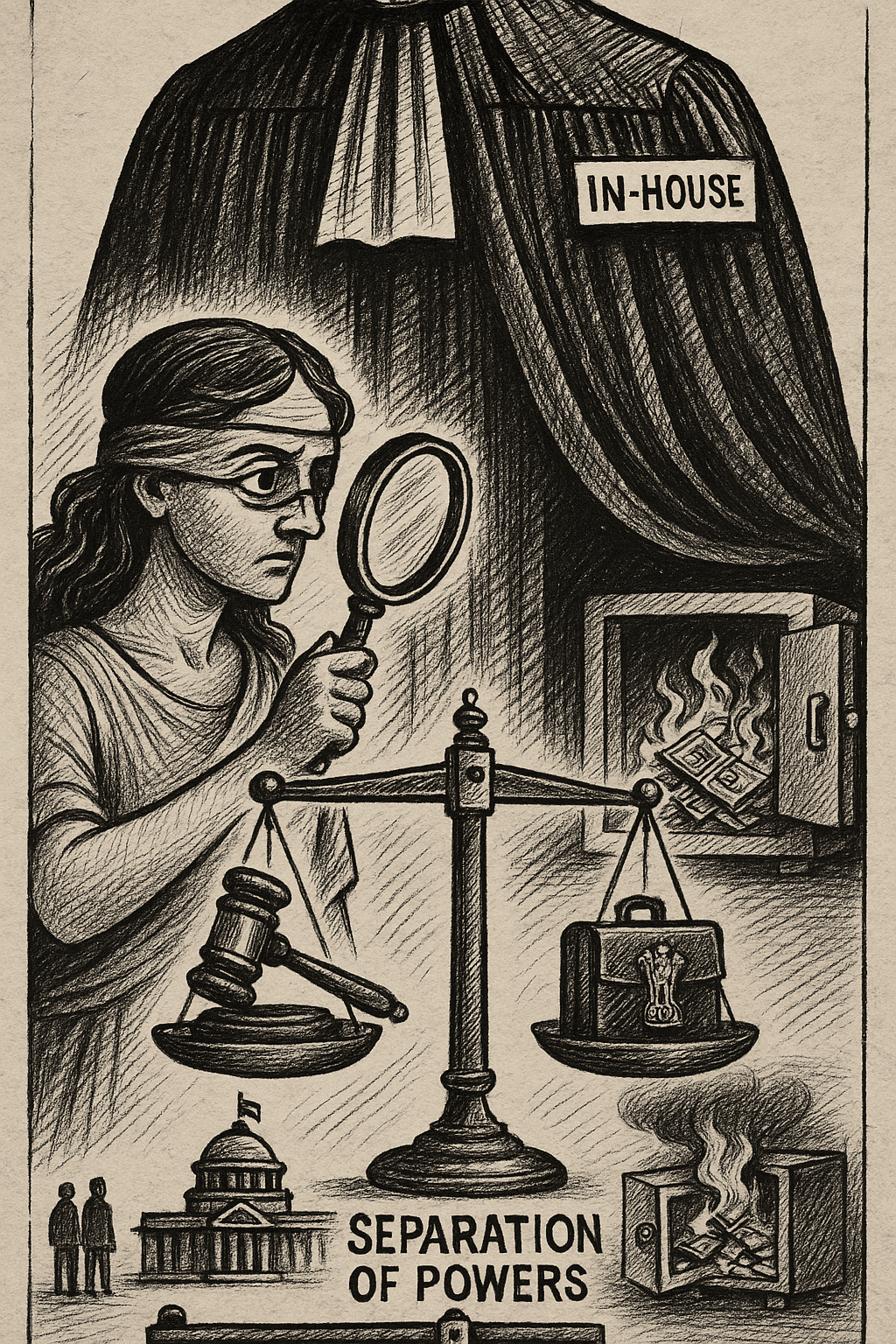
Published on : 05/10/2025
View Count : (0)
The Judiciary's Accountability Deficit: A Case for Structural Reform through an Independent Commission.
The Judiciary's Accountability Deficit: A Case for Structural Reform through an Independent Commission.
Author Details
Md Sami Rahman,
3rd year, B.A. LL.B. (Hons.),
Faculty of Law, University of Delhi
Abstract.
The independent judiciary serves as the linchpin of justice in a healthy democracy in India. Nevertheless, the power and accountability control over the rule of the powers is likely. The absence of judicious discretion has led to mechanisms aimed at accountability and neglect. This essay explains the problems with the existing mechanisms dealing with judicial. Misconduct refers to the self-governing in-house procedure and the political impossibility of the impeachment procedure. This issue of deficient mechanisms .When the judiciary is not accountable, the public loses confidence in the judiciary and rule of law should represent and uphold. After critiquing the status quo, I offer an accountable and sustainable way forward in the form of a statutorily mandated National Judicial Commission. There will be equality in judicial composition of National Judicial Commission. and non-judicial members. The Commission would be empowered to perform public investigations regarding allegations of misconduct. I would argue that a National. The Judicial Committee will not threaten the independence of the judiciary. The National Judicial Committee could serve as the best means to protect the judiciary. The framework which I present in the essay helps in making the institution accountable, keeping in mind the status of the institution. The foundation of the National Judicial Committee will have the power to evolve the judiciary in a way that helps in maintaining the autonomy of the institution, and also maintaining the public trust in the institution.
Introduction
India, which is the biggest democracy in the world, the judiciary in India is not only a part to the organ but more than that .It stands out as the torchbearer of the Constitution of the India, serving as the ultimate authority to examine the overreach of the executive authority and the potential danger of the legislative majoritarian will on the people by this it helps in protecting the structure of the democracy. This pious institution through judicial order has developed doctrine one of them is doctrine of indepence.To protect this independence the Indian constitution provides critical protection to the judges like judges enjoy security, get salaries that cannot be reduced easily and are protected by the intentional high office security.Broadly speaking, this independence provides protection against corrosive attacks to external pressures on the Court and its judges. There should be no outside pressure brought to bear affecting any judge's decision made. This is also often linked to the words "perceived impunity" The judiciary draws a veil. The veil serves to protect the internal deliberation of the court in the sense.The actions of the judiciary have become increasingly difficult to observe into needed public scrutiny. It becomes even more indefensible in the case of sitting judges in the event of serious allegations corruption, misconduct, or abuse of powerthe judiciary is exposed to a serious fault line in the constitution prior to. Democracy and independence often slam into one another,imperative of accountability. India's present system for addressing in-particular charges of
misbehavior of sitting judges falls inadequate not only to dwindling, but completely. The absence of transparent and accountable systems to ensure judges are held to expectations of virtue and professionalism renders them the most vulnerable. The intra-judicial process by which judges conduct these proceedings is opaque and non-transparent, whereas the impeachment process at Article 124(4) of the Constitution would be politically untenable.Risking not being able to hold judges accountable to anyone is refuse to guard the dignity of the judiciary and will erode its legitimacy and public trust.The public assurance to the independence of judiciary is not a public, open, and independent investigation into the judges alleged wrongdoing. The argument will be divided into four parts. Part one will set out the extensive case for the necessary and non-derogation of independence of judiciary. Part two will examine and critique the in-house process , set out some structural deficiencies and conflicting interests which make them ineffective as a system of accountability. Part three will tentatively suggest the possibility of impeachment, but demonstrate it would be fundamentally impossible to find the beginning of relief through a politically acceptable process which represents a blatant gap in our design of governance. Part four will change focus from critique and present a policy recommendation that there be a statutory National Judicial Commission established promptly. The Commission proposed does not seek independence of any institution, but rather uphold a system of transparency in the independence of judiciary, made up of distinguished external members.
The Foundation Pillar of the Justice-Understand the independence of the Justice.
The mechanism of accountability helps in the strengthening of the judiciary not undermine its independent.The principle that our courts have shall go beyond the
reach of the influence is not negotiable in the democracy.The foundation of this principle lies in rule of law and confidence of public all of it[1].
Protecting Judicial Autonomy through Constitution.
The Constitution of India produce a powerful bulwark to protect the independence of judiciary from the interference of the government interference,helps in making certain that judiciary remain forever a bulwark of the democracy[2].Articles 124 and 217 impose unprecedented security of tenure for judges of the Supreme Court and High Court by allowing them to serve until the ages of 65 and 62 respectively, and allowing their removal only by the onerous parliamentary process of impeachment and only for "misbehavior" or "in-aptitude" proved[3].The removal of judges could not be requested by the government because of these structural protections in the Constitution, and judges are also financially protected because they receive their salaries and allowances, which are extracted directly from the Consolidated Fund of India, and cannot be affected by the government[4].
The Constitution currently protects judicial independence, so that judges can engage in the act of justice without fear or favour free from the coercive influence of government and flow of public opinion. This kind of protection not only allows judges to maintain proper institutional rule of law; it gives judges the courage to rule in extraordinary ways against powerful entities (most especially the state ).The independent judiciary protect the judiciary strength transparency and accountability of the judiciary not weaken[5].
Functional Independence and Public Confidence .
Judicial independence exceeds constitutional language, making it a necessary functional condition for the judiciary to perform its duty as trustee for the Constitution ˇand neutral dispute resolver. The importance of this principle was expressed strongly in “S.P. Gupta v. Union of India” (the First Judges Case) by the Supreme Court when it said that every individual, as a citizen of the country, has an interest in the quality of independent judiciary[6]. .Such independence is not for the benefit of the judges; rather, it is the citizenry's right, founded on the need for an impartial tribunal for the resolution of any dispute without influence from external factors. The independence of the judiciary is rooted in public trust. Public trust is the greatest asset of the judiciary but is also incredibly vulnerable. While judicial independence and the idea of functional independence is not affected by legitimate criticism, it is impacted negatively by perceptions by the public that the judiciary lacks accountability in dealing with the integrity of the judiciary[7].
The challenge remains is whether we can make a system to keep individual judges accountable for ethical or professional transgressions, without unduly exposing the institution of the judiciary to the dangers of political interference or populist backlash. As we will see in our analysis of the current system, it will be shown that the system clearly fails to achieve this balance, putting in jeopardy the public's trust in the rule of law[8].
The Black Box of Accountability: Critiquing the In-House Procedure
The In-House Procedure stock-in-trade secrecy, and near total lack of transparency, operates as a judicial black box, absolutely insulating self-dealing judges from meaningful accountability[9]. The lack of transparency and structural bias means it is a perfunctory, meaningless process - more a shield for judges than a sword for justice. The blueprint of this fragile process lead to the process which will erode the trust of the people that ultimately lead to the destruction of the integrity that was made to protect[10].
Structural Opacity and the Secrecy Paradigm
The In-house process lacks the institutional transparency that undermine the public trust in the process.The secrecy in the process created a barrier that the absence of knowledge available in the public,immunity of judges from being named in the complaint and proceeds that are totally private[11].All the good reasons and assertion of maintain the judiciary reputation,the process itself many times provide shield to the unprofessional behaviour of the judge,maintain a process in which lack of transparent leads to the doubt about the process that undermine the credibility of the process.By violating the process of maintain the integrity,it fundamentally not able to deliver the justice authentically[12].
The model of the secrecy gives rise to the ‘Pandora Box’ in which the input goes in but output comes out with no fair information or weather the procedure adopted is fair or not.This is conflicting because it undermine the principle of natural justice that judiciary swear to uphold at any cost [13].Opposing reasonable outcomes undermines the complaint and right of the public to know what has happened in the process it prevents from any liability,rise to frivolous allegation,get unanswerable without any reasonable justification.Importantly the process adopted to protect the Institution constitute a threat by abandoning the value of the judge for the short term but the long term impact on the institution integrity will be questioned[14].
When a grave allegation left unnoticed for over a long period and met with a pin drop silence,the result is demolishing and long lasting.Silence does not bolster the judiciary’s honour; it inflicts a wound, creates cynicism in the public mind, and diminishes the moral authority of the courts.To rebuild trust, a transparent process must be allowed to emerge and light must be allowed to enter a system that has been shrouded in darkness. The judiciary will only reappear with those ideals, as an institution of public justice rather than secrecy[15].
The Judge-Judge Problem:
Looking Into Oneself There is an inevitable conflict of interest that irrevocably compromises the in-house process for judicial misconduct, which is carried out by a committee made up of the Chief Justice of India and some of the most senior judges. These judges must evaluate a member of their own group with whom they have institutional ties, personal ties, and professional associations[16].The arrangement fundamentally undermines a fair and impartial process by placing judges in an untenable position as decision-makers about allegations against a colleague whose
reputation and status abut their own. Hence the process is completely closed, with no external input, from which it will lose its credibility.It lacks credibility and is undermining the appearance of fairness, not to mention that there is no transparency[17].
The issue is more complex than flawed process; it is fundamentally about human and institutional bias. Judges, like all people, have fraternal loyalty–the implicit desire to defend a member of one's own group. When the allegations are serious like corruption or sexual harassment, one would hope that loyalty to self, and therefore arguably, to others, would be if not a regretted circumstance, fundamentally undermined[18].
How could a peer committee, comprised of people who regularly share work, deliberation, and social activities with the accused, properly investigate the situation with the rigor and detachment? Their shared experience with the accused, in addition, to the bonds created during the process of institutional socialization, significantly lessened the likelihood of objective and complete investigation of the events at issue[19].
In the end, while there is no independent and external panel that is charged to conduct these reviews, it became clear that this process evolved into and then was trapped into an insular process fraught with the potential for solicitude or protective clustering.When the procedure keeps out the independent persons beyond from the judiciary domain the including the eminent jurist, Advocate and civil society representative,it can be seen as the protective rather then held accountable towards the public.This approach rusts public trust that ultimately lead to the corrode of public trust in the judiciary and broader judiciary system.Moreover,it dilute the obligation of the state to provide the justice impartial,with transparency and equal treatment before the law.There is a deep difference among the work of judiciary when work as custodian of the morality of the constitution and a scene where the system failure to prevent the delivery of the morality[20].
Lack of Formal Powers and Ineffectual Outcomes
The Critical flaw in the In-House Proceeding is the absence of the formal investigation authority like Police to investigate the allegation,a shortage that always cripples its effectiveness as a credible body in the eyes of public.The absence of power to issue summons to the witness,force evidence and oath of the administration because of all these the committee runs in void.Therefore,the committee is not capable of conducting the inquiry of its own in the matter related to the serious allegation with transparency[21].The process's risk of allegation of arrogance and illogicality reinforces the image of the committee in the public's is that the function of the committee works as an insulator to the judiciary rather than an institution at risk of injustice. Lack of these principles, the committee is losing credibility to investigate the allegation, and at the onset of the committee loses its credibility in the public's eyes[22].
Additionally, the results of the committee are very poor because it has only two options available: either to remove the judge or to dismiss the complaint. This is all or one approach lacks a middle path, like a warning or reprimand of the services for a less grievous act . Absence of this may encourage to conduct of the offence, which gets normalized otherwise[23].The absence of the middle path can be seen in 2019 when the allegation of sexual harassment was leveled against the former CJI. A process which was a controversial and divisive investigation, leading to the exoneration, even then, also led to tarnishing the reputation of the institution. This event significantly reduced the public's faith in the judiciary, confirming its negative views of the public about its ineffectiveness[24].
The Nuclear Option: The Political Impossibility of Impeachment.
Constructed constitutionally as a sledgehammer that has only a limp wrist for internal mechanism in qualifying impeachment under Article 124(4) in conjunction with the Judges (Inquiry) Act, 1968, this imposes removal of a judge as a last resort. It requires only a presidential order issue after an address from both Houses of Parliament that not only requires a simple majority, but another requirement that is even more extraordinary; a majority of total membership; and a super majority of two-thirds of those present and voting[25].It was purposely restrictive in nature to protect judicial independence from passing political majorities that allows judicial removal as a last resort - it is a constitutional fail-safe against a judge who has acted with serious misconduct. In reality, this restriction has ironically rendered it ineffective. The convoluted party politics involved and deep ideological divides that exist in India's form of parliamentary democracy effectively make that super-majority, almost a mathematical impossibility[26].
The judicial process is in form, yet political in substance it is a partisan strategy that uses evidence to impeach or embed the judge in question, when the only criteria that matters is the electoral time-based or coalition's pressure. The process is more political tool than legal weapon to use, and it is so difficult to implement that it has simply not been. India’s sparse impeachment experiences provide empirical evidence of this ineffectiveness[27].In the case of Justice V.Ramaswami, the year 1993 is the only incident that comes close to the impeachment. While the investigation confirmed the charge, he was not impeached because of political .At the time of impeachment, the abstention of the ruling party gave the pathway to not succeed in the motion, which shows critical flaws[28].
In reality, the impeachment is an obsolete mechanism because it has severe punishment available in the constitution, but too political that it is not easily used. Therefore, it failed to act as a genuine danger. Due to the complexity of rules, no one can understand the Judge ,due to which Judges may misbehave without any fear. Additionally, the process is very secretive, which ultimately erodes the faith of the public in the judiciary[29].
Revolutionizing Accountability: A Blueprint for Structural Reform
The current process's devastating failure requires a clear overhaul and changes in the system, which is the need of the hour. The constructive changes will come from the overhaul of the new system, which focuses on accountability, not from minor change.
6.1 Relooking Justice: The time for India's National Judicial Commission to ensure transparency and integrity.
In India, in such a time when the faith of the public started diminishing in the democratic institution, motivated by social media, the Judiciary can regain the trust of the public by adopting the National Judicial Commission (NJC).This body shall replace the old in-house committee, which has limitations and people have criticized; instead, this will be independent and transparent and will be vested with statutory powers to investigate allegations. The allegations will be still vigorously investigated and judged fairly under the NJC; these investigations will not viewed as mere process but as a constitutional commitment to accountability that will hold the custodians of justice to the highest standard[30] .
The very nature of the NJC is that of a balanced and innovative body designed to complement judicial experience with independent oversight.The inclusion of the Chief Justice of India and two senior judges of the Supreme Court in the NJC retains important judicial leadership. However, the NJC's transformation strength is its hybrid composition[31].By including the Attorney General of India, public interest still protected, while three external members a respected jurist appointed by the President, a person of unimpeachable character from civil society (i.e., a former CAG or CVC), and an eminent legal academic provide important external perspectives and moral authority. Such a framework establishes that the decisions considered by the NJC will not just be legal, but socially legitimate and transparent[32]..If the NJC is to have authority, constitutional amendment or an act of Parliament that grants it significant legal power must establish it. With such foundational authority, the NJC would be able to call witnesses, compel production of documents and take full investigations without fear of undue influence or obstruction [33].
Enhancing Judicial Integrity: An Accountable and Trusted Progressive Framework. Currently, the National Judicial Commission (NJC) must have a modern and responsive system of judicial accountability that goes past the limited alternatives of exoneration or removal.The process when implementing the tried disciplinary action ensures that the result is directly proportional to the appropriate gravity[34].This effectively allows responses to be fair and proportionate that range from a reprimand and loss of pay for "misconduct" to a suspension while investigations are ongoing to forced retirement for any breach of trust and judicial impeachment for the most serious breaches of conduct.Accepting the misconduct of the judiciary can be corrected and strengthened, then undermining the integrity of the judiciary . This approach provides the bulwark of institutional autonomy . The core of this can be viewed in the implementation of the sanction applied with accuracy, which reflects the particular gravity of the act[35].
The steps (censure, deduction from pay, suspension, forced retirement, impeachment) has a degree of accountability that addresses a particular level of judicial conduct breach without moving to extreme punishment and without mask/providing consent to conduct that does not uniquely meet certain thresholds. This not only inhibits misconduct but enables the dignity of the court/judicial body and its members while It helps in promoting a sense of responsibility in maintaining the principle of fairness and equity[36].
Setting up the concrete rules can acted the cornerstone of the reformed system. It is crucial to give assurance to the judges to give the right to defend himself /herself, give access to all the important documents and the right to question the witness. Moreover, even though in the first stage the complaint can be maintained confidential to protect the character of the Judge, but full report of the investigation and the judgment will be uploaded to the website. This helps in maintaining the transparency, which helps maintaining the trust of the public in the institution[37].
Integrity and Accountability: Enhancing Judicial Conduct and Financial Disclosure.
The transit towards attain the original judiciary integrity starts with the step of making clear and concrete codes that are widely available to the public. The code will define the judicial behaviour, the ethical framework and aspirant norms for the judges[38].Importantly, the code must provide a road map for judges and assurance to the public. It provides the SOP, ethical benchmark that judges have to follow in difficult situations and an assurance to the public that judges act in a consistent principle. Writing these expectations, the code establishes the judiciary's commitment towards transparency and accountability, which builds the institution's trust and integrity[39].
Financial disclosures that require judges to disclose all assets, liabilities, and significant interests to an independent body (e.g., a National Judicial Council). Financial disclosures should remain confidential (to protect the privacy of a judge and statutory independence), but require verification of the judges' declarations in cases where a complaint has merit. This approach allows for accountability based on a true understanding of judge's interests and commitments, penalizes corrupt behavior, and mitigates conflicts of interests without inviting intrusive examination — the judiciary must remain above reproach, but always within public confidence [40].
Rejecting the slippery slope: Institutional independence and accountable governance can be synergistic.
The claim that encroachment on judicial independence is inevitable when under external oversight is an often repeated, and over-stated, argument. While it is necessary to be vigilant to avoid inappropriate influence, the proposed National Judicial Commission (NJC) model is specifically designed to avoid such concerns[41].
Utilizing a bedrock principle of judicial independence, with most members being from the judiciary, ultimately coming from a judicial-dominated collegium, the NJC will retain oversight of, and accountability for, our judiciary even if some would elected politicians are involved. The NJC defines and limits accountability in such a way that it truthfully transforms accountability from a threat into a protective tool - a tool that will enhance the integrity of our institution, but one that fundamentally does not limit judicial independence[42].
True judicial independence is not immunity from oversight, which does not mean that judges cannot perform their roles free from fear or favor, based on their constitutional duties. A self-governing judiciary risks perceived, and actual, autocracy, which will undermine public trust in the judiciary as a profession, and individual and honourable judges will be painted with the brush of mistrust when others have acted improperly[43].
The NJC will enhance independence by reinforcing credibility: it will demonstrate that the judiciary is accountable to the rule of law that it enforces, and demonstrate to society that it is insulated from political pressures and manipulations and credential its role as productively independent. The model of NJC will revolutionize the traditional model and the people and make them directly responsible, powerful and self sufficient[44].
Conclusion
The accountability of the judiciary is an important aspect in a democratic country. The current collegium system's secrecy and the very tough removal process(impeachment process) do not ensure accountability. When secrecy prevails it only gives rise to speculation ultimately that diminishes the confidence in the judiciary. In the current structure there is required an overall reform to ensure that the confidence of people in judiciary remains and the changes are aligned with the norms of democracy. Another concrete solution is the setting up of the National Judiciary Commission in which transparency will win over secrecy. Such an institution would establish reasonable assessment procedures for judicial behavior and enhance the credibility of the judiciary.
References
[1] Udai Singh & Apoorva Tapas, Judicial Accountability: The Eternal Dilemma, 1 Christ U. L.J. 69, 69-74 (2012).
[2] Aparna Tiwari & Ayushi Choudhary, From 1993–2019: Has Collegium Over-Lived Its Utility?, 6 NLUJ L. Rev., no. 1, Summer 2019, at 1, 5–7.
[3] Rangin Tripathy & Soumendra Dhanee, An Empirical Assessment of the Collegium’s Impact on Composition of the Indian Supreme Court, 32 Nat'l L. Sch. India Rev. 119, 119–23 (2020)
[4] Shaila Arora, Independence of Judiciary in India, 4 Int'l J.L. Mgmt. & Hum. 714, 719 (2021)
[5] Martin Shapiro, Judicial Independence: New Challenges in Established Nations, 20 Ind. J. Global Legal Stud. 253, 258–59, 273, 275 (2013).
[6] Mohammad Taha M. Yadi, S.P. Gupta and Others v. Union of India, 2 Jus Corpus J. 83, 88–90 (2022)
[7] Harikrishna Pramod & Arunima, Judicial Accountability: An Overview of the Legislative and Judicial Trends in India, 2 N.L.I.U. L. Rev. 197, 223–25 (2011)
[8] Sairam Bhat et al., Towards a New Judicial Commission: Maintaining Independence, Strengthening Integrity, Ensuring Accountability, Bar & Bench (Sept. 8, 2025), https://www.barandbench.com/columns/towards-a-new-judicial-commissionmaintainingindependence-strengthening-integrity-ensuring-accountability.
[9] Srivats Shankar, Looking into the Black Box: Holding Intelligent Agents Accountable, 10 NUJS L. Rev. 451, 470–73 (2017).
[10] Ishita Rajput, Judging The Judges: Crisis Of Accountability in India, NLIU L. Rev. Blog (July 6, 2025, 10:00 AM), https://nliulawreview.nliu.ac.in/blog/judging-the-judges-crisis-of-accountabilityinindia/,(last accessed 9th Sep 2025).
[11] Prem Chandra & Ashutosh Garg, Judicial Accountability and Transparency in India: Flaws and Road Ahead, 3 GLS Law J. 79, 82–86 (2021).
[12] Shayonee Dasgupta & Sakshi Agarwal, Judicial Accountability and Independence: Exploring the Limits of Judicial Power, 2 NUJS L. Rev. 779, 797–800 (2009).
[13] Brandon L. Garrett & Cynthia Rudin, The Right to a Glass Box: Rethinking the Use of Artificial Intelligence in Criminal Justice, 109 Cornell L. Rev. 561, 565-70 (2024).
[14] Shreyash Singhal & Kashish Garg, Assessing the Impact of the Right to Information on Promoting Transparency and Accountability, 6 Int'l J.L. Mgmt. & Humanities 936, 942-43 (2023).
[15] Vibhantika Dwivedi, Transparency and Accountability in the Indian Judicial System: A Renewed Debate on Collegium System, 10 Int’l J. Res. & Rev. 425, 432–36 (2023)
[16] "V. Venkatesan, Judge Inquiry: The Opacity of the In-House Process, Sup. Ct. Observer (Apr. 8, 2025), https://www.scobserver.in/journal/judge-inquiry-the-opacity-of-the-in-house-process/.,(last accessd 10th Sep,2025)
[17] Rangin Pallav Tripathy, The Supreme Court Collegium and Transparency: A Non-Committal Relationship, 17 Socio-Legal Rev. 1, 13-15 (2021)
[18] Anshul Dalmia & Pratyay Panigrahi, Who Judges the Judges?: Viewing Judicial Recusal and Disqualification as a Litigant, 14 NUJS L. Rev. 1, 7-14 (2021).
[19] Megha Mehta, The Inefficiency of Internal Complaint Mechanisms in Resolving Sexual Harassment Claims – A Study in the Context of Sexual Harassment Law and #MeToo in India, 14 NUJS L. Rev. 413, 430–34 (2021).
[20] Jahnavi Sindhu, A Responsive Theory of Judicial Review—A View from India, 34 Nat’l L. Sch. India Rev. 59, 77–81 (2022).
[21] Siddharth Singh Rathaur, Judicial Accountability: A Comparative Study Between India and USA, 14 Int'l J. Curr. Sci. 979- 981 (2024).
[22] Anjila Bhattacharya, Due Process vs. Victim Justice: A Critical Analysis of Institutional Response to Sexual Harassment Allegations, 3 Int'l J. Legal Stud. & Soc. Sci. 838, 840–43 (2025)
[23] Amita Dhanda, Powering Responsibility, Conscience Keeping in Public Law: The Scholarship of S.P. Sathe, 49 J. Indian L. Inst. 1, 11-15 (2007).
[24] Sanjay Jain & Saranya Mishra, Scandalizing the Judiciary: An Analysis of the Uneven Response of the Supreme Court of India to Sexual Harassment Allegations Against Judges, 18 I•CON 563, 565–67 (2020)
[25] Saurabh Bindal & Uday Shankar, "Resignation v. Removal: The Indian Impeachment Saga."NLIU Law Review 3 (2013): 119-133.
[26] Sanya Kashyap, Judicial Accountability in India, 2 Indian J. Integrated Rsch. L. 1, 6–7 (2021).
[27] Aditi S. Varghese & Albin G. Thomas,The Origin and Sources of the Judicial Standards and Accountability Bill, 2010, 2 NLIU L. Rev. 332, 332–33 (2011).
[28] Neha Jain,God, Save the Judiciary, 1 Indian J.L. Polity & Admin. 795, 797 (2020).
[29] Astha Tripathi, Comparative Analysis of Impeachment Procedure of President of India and the U.S., 45 Indian J. Const. L. 2, 2–5 (2020).
[30] Adarsh Ramakrishnan & Prakhar Bhardwaj, Need For a National Judicial Commission :the struggle for primacy and unconstitutional of the collegium system, 2 NLIU L. REV. 242, 267–70 (2011).
[31] Akshita Jain & Kavya Maheshwari, Case Commentary on the National Judicial Appointments Commission (NJAC) Judgment, 3 Int'l J.L. Mgmt. & Human. 1046, 1046–48 (2020).
[32] Mantu Swain & Laba Tudu, Collegium System v. NJAC: A Critical Study on Indian Judiciary, 10 Int'l J. Sci. Dev. & Res. 879 (2025).
[33] Harsh Gagrani, Appointment or Disappointment: Problem and Perspective to the Appointment of Judges in the Indian Judiciary, 1 N.L.I.U. L. Rev. 52, 67-70 (2010).
[34] Venkatesan, V., Does India Need a National Judicial Commission?, SC OBSERVER (Mar. 10, 2021), https://www.scobserver.in/journal/njacorjsab/#:~:text=If%20the%20government%20is%20keen,system%20don (last visited Sept. 13, 2025)
[35] Janak Sejpal, Balancing Judicial Independence and Accountability in India: Comparative Perspectives and Constitutional Reforms, 6 Indian J.L. & Legal Res. 3106, 3114–15 (2024).
[36] Shivaraj Huchhanavar, Judicial Conduct Regulation: Do In-House Mechanisms in India Uphold Judicial Independence and Effectively Enforce Judicial Accountability?, 6 Indian L. Rev. 352, 355-58, 372, 378 (2022)
[37] Ayush Kothari, Critical Analysis of the Independence of the Judiciary, 5 Int'l J. Rsch. Publ'n & Rev. 6934, 6941–42 (2024).
[38] Sura Anjana Srimayi, Judicial Ethics: The Foundation of Justice and Public Trust, Legal Mantra (Aug. 20, 2025)
[39] Krishnadas Rajagopal, The Code of Conduct Judges Need to Follow, THE HINDU (Dec. 11, 2024), https://www.thehindu.com/news/national/the-code-of-conduct-judges-need-to-follow/article68970576, (last accessed 14th Sep,2025)
[40] Zygmont A. Pines, Mirror, Mirror, On the Wall—Biased Impartiality, Appearances, and the Need for Recusal Reform, 125 Dick. L. Rev. 69, 137–45 (2020).
[41] Anavi Sidana, Balancing Judicial Accountability and Judicial Independence: An Analysis of the Collegium System of Judicial Appointments,4 Indian J. Integrated Rsch. L. 787, 787–90 (2024).
[42] Sudhir Krishnaswamy, Sindhu K Sivakumar & Shishir Bail, Legal and Judicial Reform in India: A Call for Systemic and Empirical Approaches, 2 J. Nat'l L. U. Delhi 6, 14-15, 18-19, 21 (2014).
[43] Shivaraj S. Huchhanavar, Conceptualising Judicial Independence and Accountability from a Regulatory Perspective, 9(2) Oslo L. Rev. 110, at 116–17, 120, 123–24, 145–47 (2022).
[44] Suraj Verma & Shova Devi,Balancing the Scales: Judicial Independence Versus Accountability in India’s Higher Courts and Common Law Systems, 8 Int'l J.L. Mgmt. & Humanities 3694, 3707-10 (2025).
Journal Volume
You should always try to find volume and issue number for journal articles.

Nyayavimarsha
No. 74/81, Sunderraja nagar,
Subramaniyapuram, Trichy- 620020