

"Justice cannot be for one side alone, but must be for both"
Patenting Authentic Indian Street Foods: Protecting Recipe Names and Cultural Heritage
Published on : 03/06/2026
View Count : (1)
Patenting Authentic Indian Street Foods: Protecting Recipe Names and Cultural Heritage
Authentic Indian Street foods carry deep cultural significance, yet they largely fall outside the traditional scope of intellectual property (IP) protection. This paper critically examines how Indian law can safeguard the names and recipes of beloved street foods – such as golgappa (pani puri) and vada pav – without eroding their communal heritage. We explore patent law’s limitations in protecting recipes (given strict novelty and non-obviousness criteria under Indian law) and why most traditional dishes cannot be patented.
We then analyze alternatives: trademark law to guard distinctive names or brands, geographical indications (GIs) to recognize regional specialties (e.g. Hyderabadi Haleem), and the role of cultural heritage recognition. A comparative perspective from the United States is provided to highlight different approaches, noting that American law favors trade secrets and trademarks over GIs. Through real case studies – including a trademark dispute over “Golgappa” and the celebrated GI battles for Rasgulla – the paper demonstrates how legal tools can protect culinary traditions in principle, while emphasizing a need for balance. Ultimately, preserving street food heritage requires blending formal IP rights (to prevent misappropriation) with respect for the collective ownership of culture.
The discussion underscores that any legal framework must nurture innovation and entrepreneurship around traditional foods without allowing exclusive rights to “lock up” shared heritage. The paper concludes with recommendations for strengthening protections of recipe names and know-how in India in a manner that honors and sustains the country’s rich gastronomic legacy.
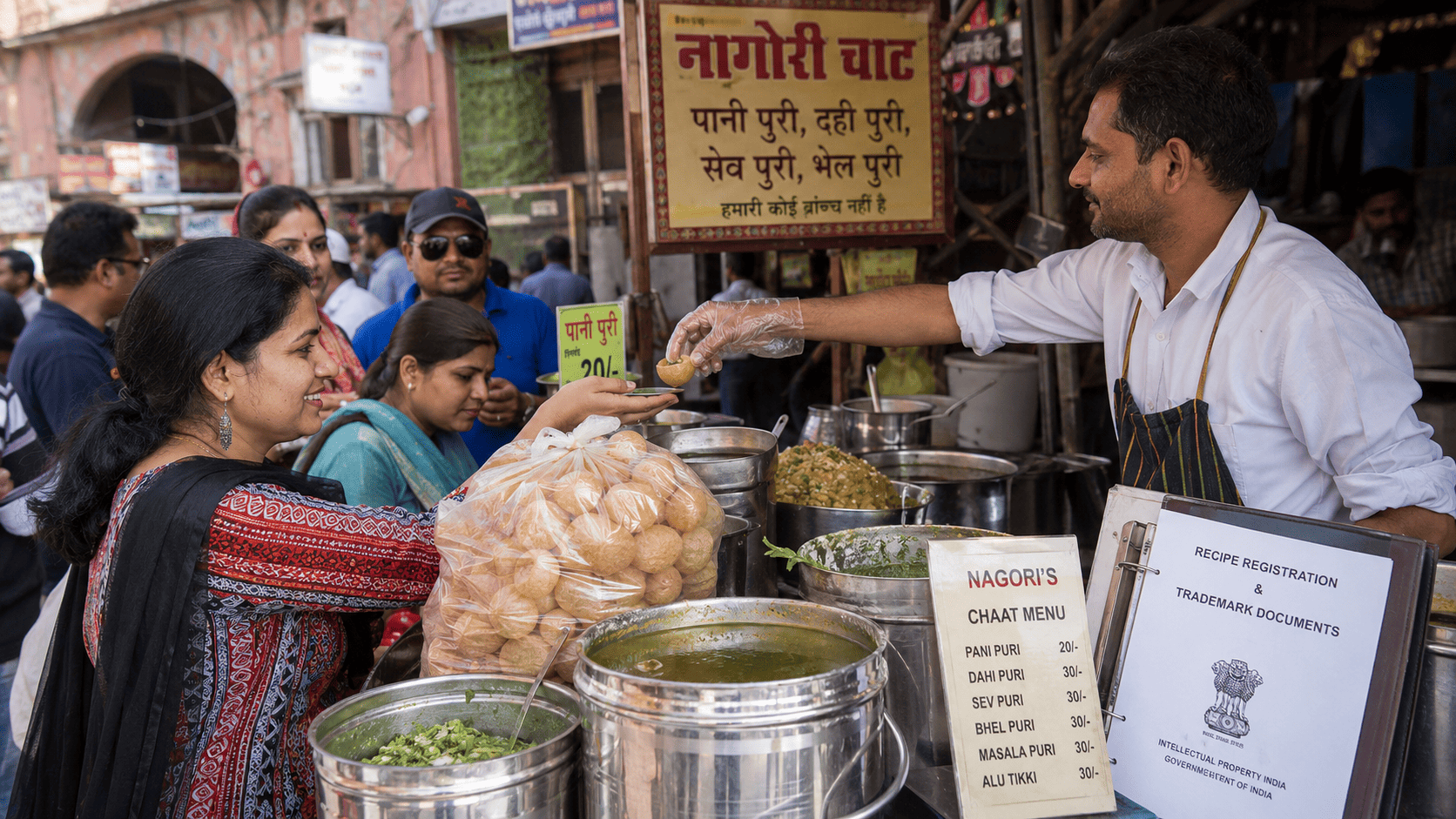
On a bustling evening in Old Delhi’s Chandni Chowk, the aroma of spiced potatoes and tamarind water drifts through the air as a vendor deftly fills crispy golgappas for a queue of eager customers. This scene – or a similar one with a vada pavseller in Mumbai dishing out spicy potato fritters sandwiched in soft bread – plays out daily across India. These street foods are more than just snacks; they are cultural icons, steeped in history and emotion. But as popular as they are, can the law protect such ubiquitous creations? This question is at the heart of a growing debate in intellectual property circles: how do we legally safeguard the names and recipes of traditional foods without stripping them of their heritage or making them the private property of one individual or company?
The impetus for this discussion arises from instances where traditional Indian foods have been subject to intellectual property claims, sometimes by entities far removed from the communities that originated them. For example, India once had to fight a U.S. patent on the use of turmeric (haldi) for wound healing – knowledge that had been part of Indian culture for centuries. That patent was eventually revoked in 1997 after India’s Council of Scientific and Industrial Research (CSIR) provided evidence of turmeric’s traditional uses. The incident rang alarm bells about the appropriation of traditional knowledge, and it spotlighted the need for mechanisms to protect cultural heritage from misappropriation under the guise of intellectual property rights. If something as commonplace (in India) as turmeric could be patented abroad, what about treasured recipes or famous dishes?
At first glance, the notion of “patenting street food” might sound perplexing. Patent law is designed to reward innovation – novel, non-obvious inventions – not grandma’s recipes passed down through generations. And indeed, most recipes for common dishes fail to meet patent law’s high bar for novelty. Yet, there have been attempts to secure exclusive rights over aspects of food. Entrepreneurs have sought patents for unique food processes or formulations, and trademark disputes have erupted over famous dish names. Even the term “patenting” in the context of foods often really means exploring any form of IP protection that might apply, including trademarks for names or geographical indications for origin-linked specialties. This paper takes a critical perspective on these trends. It asks, fundamentally, whether India’s existing IP framework – rooted in western legal concepts of private ownership – can accommodate the communal nature of culinary heritage, or whether new approaches are needed to protect cultural expressions like cuisine.
The inquiry is not merely academic. It has very real implications for business, culture, and law. Consider the economic value of Indian street foods: Hyderabadi haleem (a spiced meat porridge) has an annual market of nearly ₹1,000 crore and is now exported globally Its Geographical Indication (GI) status, obtained in 2010, helped elevate the dish’s reputation and authenticity Or take the humble golgappa: when companies tried to brand and package these pani puri snacks, they ended up in court over similar-sounding trademarks. And in late 2023, a fiery debate arose over who “invented” butter chicken – with two Delhi restaurant chains battling not over a secret recipe, but over the credit and goodwill attached to this famous dish These examples illustrate a spectrum of legal issues from trademark conflicts to questions of authorship and advertising, all centered on traditional foods.
In the sections that follow, we navigate the landscape of Indian intellectual property law as it relates to recipes and food heritage. We begin by outlining the challenges of fitting traditional culinary creations into IP law’s existing categories. Next, we delve into patent law – why most recipes aren’t patentable in India (or elsewhere), and what narrow circumstances have enabled a few food patents to be granted. We then turn to trademarks and examine whether the names of dishes or the branding of street food businesses can be protected, drawing lessons from real disputes like the golgappa and butter chicken cases. The discussion subsequently moves to Geographical Indications (GIs), a form of protection particularly relevant to foods tied to a location or culture – India has enthusiastically embraced GIs for items like Bikaneri Bhujia and Benarasi paan, and we will see how GIs operate as a shield for cultural heritage. Alongside these formal IP regimes, we will consider the role of traditional knowledge preservation and international concepts like UNESCO’s Intangible Cultural Heritage in safeguarding foodways. A comparative look at one other jurisdiction, the United States, is woven in to highlight different strategies – for instance, how American law relies on trademarks and trade secret protection for recipes, due to the absence of a GI framework.
Throughout this journey, a critical and culturally engaged lens is applied. Protecting India’s street foods is not just a matter of giving legal rights to some innovator or company; it raises normative questions: Should anyone exclusively own a dish that is part of a shared culture? Who gets to control the commercial use of names like “Hyderabadi Biryani” or “Banarasi Paan”? How do we encourage culinary innovation and entrepreneurship (so that a brilliant new recipe can be rewarded) without allowing the privatization of our collective heritage? By the end of this paper, we aim to have sketched out a nuanced answer – one that recognizes the importance of IP tools in promoting and protecting culinary traditions yet cautions against overreach that could stifle the very culture we wish to celebrate.
Indian street food is often described as the subcontinent’s gastronomic soul – accessible, inventive, and woven into daily life. From the chaat vendors of North India to the dosa stalls in the South, street foods reflect regional history and local ingenuity. These dishes are typically developed over generations by communities, not by lone “inventors.” A plate of pani puri (known variously as golgappa, puchka, or pani ke batashe depending on region) carries with it tales of migration and adaptation; its recipe isn’t written in any one cookbook but lives in the collective memory of those who make and enjoy it. This communal origin presents an immediate tension with classical IP law, which is premised on identifiable creators and first-to-file ownership.
Economically, the street food sector in India is enormous and largely informal. It provides livelihood to millions of small vendors and offers affordable nutrition to consumers. When a particular street food becomes iconic – say Kolkata’s rosogolla (rasgulla) or Mumbai’s vada pav – it can spawn entire local industries and even attract tourism. Local governments and businesses have an interest in promoting these as part of their cultural brand. For example, Indore’s poha-jalebi and sarafa bazaar snacks, or Lucknow’s tundey kebabs, are points of pride. Protecting these famous names and recipes from outsiders who might exploit them commercially (without any benefit to the local community) is a growing concern. Thus, the law is increasingly called upon to serve cultural preservation goals as well as economic interests.
Culinary heritage also has a symbolic value that defies easy quantification. When Odisha and West Bengal locked horns over the origin of the rasgulla, it was not just a matter of who could market a sweet; it became a matter of state pride. Both states eventually obtained their own GIs for distinct versions of the dessert – “Banglar Rosogolla” for West Bengal in 2017 and “Odisha Rasagola” for Odisha in 2019 – formally recognizing two traditions. Yet, the cultural debate over who invented it persists beyond the legal resolution This illustrates that IP rights like GIs can acknowledge and validate cultural claims, but they don’t definitively settle arguments about heritage or stop people from continuing to make the dish elsewhere. Indeed, GIs are territorial rights – they prevent unauthorized commercial use of the name in the market, but they cannot force people to agree on a single narrative of origin.
In framing legal strategies to protect Indian street foods, one must keep in mind these dual dimensions: the intangible cultural heritage dimension (traditions, community ownership, identity) and the tangible commercial dimension (branding, market value, livelihoods). A critical perspective recognizes that an overzealous use of IP could harm the very culture we seek to protect. If tomorrow someone obtained an exclusive patent on the process of making masala chai, that might incentivize one business, but it would outrage millions for whom chai is a daily ritual and a piece of national heritage. Conversely, letting anyone and everyone use a famous regional name with impunity can dilute its meaning – for instance, if “Hyderabadi Biryani” were used by restaurants with no connection to Hyderabad or its style of biryani, consumers would be misled and the authentic makers could suffer. Therefore, the challenge is finding a balance: using IP law to prevent exploitation and ensure credit (and economic benefits) accrue to rightful stakeholders, while not converting heritage into a commodity owned by a single entity.
With these concerns in mind, let us examine how various forms of intellectual property law apply (or fail to apply) to recipes and food names, starting with the most ostensibly relevant yet problematic tool – patent law.
Can an age-old recipe be patented? Under Indian law, the answer is generally no. The Indian Patents Act, 1970 (as amended) sets strict criteria for patentability – an invention must be novel, involve an inventive step (non-obvious), and be capable of industrial application. Most recipes for traditional dishes will flunk this test. They are usually neither novel (having been known in some form for generations) nor non-obvious (combining common ingredients in expected ways). Moreover, Indian patent law contains explicit exclusions aimed at preventing the patenting of traditional knowledge and simple admixtures of ingredients.
Section 3 of the Patents Act lists what are not inventions (and thus not patentable). Two clauses are particularly relevant to food recipes:
Additionally, patent law worldwide requires a written disclosure of the invention. A patent, if granted, is published – meaning the recipe or process would be publicly disclosed in exchange for the limited monopoly. For those rare truly novel recipes, this poses a dilemma: seek a patent and reveal your secret sauce, or keep it secret but unprotected. Many famous formulas, from Coca-Cola’s beverage recipe to the blend of herbs in a certain fried chicken, have been kept as trade secrets precisely to avoid disclosure In India, the concept of trade secrets is recognized through contract and common law (not via statute), but more on that later.
It’s worth noting that patenting food was outright impossible in India before 2005. The Patents Act, 1970 originally did not allow product patents for food or pharmaceuticals – only process patents – as a policy to ensure accessibility. This changed with the 2005 amendments (to comply with WTO TRIPS requirements), which extended product patents to food, drugs, and chemicals Thus, legally one can attempt to patent a food product or recipe in India today, but the aforementioned substantive hurdles remain high.
There are a few notable examples that show it’s not entirely impossible to patent a food-related invention if it meets the criteria. One is the case of Shubhangi Patil, a housewife who, in 2020, obtained an Indian patent for her recipe of ragi (millet) soup with walnuts How did she succeed where others fail? The key was positioning the recipe as a technical solution to a problem – in this case, a nutrient-rich vegetarian soup to address Vitamin B12 deficiency (for her husband who couldn’t eat meat The patent application likely emphasized the specific ratios and preparation method that yielded enhanced nutritional benefits, arguing a synergistic effect (the combination of ragi and walnuts giving more health benefit than expected from just adding their properties). By framing it as a functional beverage with unexpected advantages, and not merely a tasty soup, she apparently convinced the Patent Office that it wasn’t a trivial mix. It’s an outlier, to be sure. The success of the “ragi-walnut soup” patent highlights that novelty in food patents usually comes from science – e.g., a new process (freeze-drying a snack to preserve it differently), a new functional ingredient combination, or a technical improvement, rather than just a new flavor combination.
Other examples of patents granted in India for food-related inventions include processes like a method for making a certain type of long-lasting energy bar or a new fermentation technique for a beverage These tend to be closer to food technology than to grandma’s cookbook. Indeed, AsiaIP notes that a few recipe patents have been granted when they met the criteria, such as a process for freezing dough that was novel. In essence, a patentable “recipe” is often not a recipe in the traditional sense, but a scientific innovation in food processing or composition.
Looking at the United States for comparison, the landscape is similar in principle with some nuances. U.S. patent law also demands novelty and non-obviousness. A standard American legal adage is that “mere combinations of ingredients, each functioning as expected, are obvious” – echoing the bar against mere admixture that India codifies in Section 3(e). Thus, you won’t get a U.S. patent for combining butter, flour, and sugar into a cookie, even if you add your personal twist of a pinch of cardamom. However, if you invent a novel food processing technique or an unexpectedly effective preservative blend, that could be patentable. For example, patents have been issued in the U.S. for things like improved methods of making gluten-free bread with a certain texture, or for unique manufacturing processes of food products (like a patent on crust-free peanut butter and jelly sandwiches, which is a real albeit peculiar example often cited in IP classes).
That said, the U.S. has seen its share of controversial “recipe patents” – and like in India, traditional knowledge has been a battleground. The turmeric case was actually fought in the U.S., where the patent was originally granted; U.S. law didn’t have an explicit “traditional knowledge” exception, but CSIR successfully argued lack of novelty based on printed publications about turmeric’s uses. Another infamous instance was a patent on a strain of basmati rice (granted in the U.S. to a company called RiceTec in the late 1990s), which India and Pakistan viewed as an appropriation of a traditional crop. International outcry and evidence of basmati’s existing qualities forced a narrowing of that patent’s claims. These incidents have pushed the U.S. to be more cautious and to improve prior art searches (including looking at foreign publications or traditional knowledge databases) before granting patents on food or medicinal recipes.
Yet, the fundamental approach in the U.S. remains: if you truly innovate, you can get a patent, even for food. Innovate means something beyond a cook’s routine skill – perhaps a lab-based development or an industrial tweak. Most chefs in New York or San Francisco are not rushing to the patent office every time they create a new fusion dish; they rely on being first-to-market and building a reputation, rather than legal exclusion. Patents are costly and time-limited (20 years from application, after which anyone can use the invention). As a result, in the culinary world, patents are relatively rare and often seen in industries like food technology or packaged foods rather than in traditional cuisine.
Given the limited role patents play in protecting traditional recipes, India has focused more on defensive measures – preventing others from patenting what is already known. The turmeric episode spurred the creation of the Traditional Knowledge Digital Library (TKDL), where thousands of formulations from Ayurveda, Unani, and other traditional systems are recorded in accessible formats. This has helped foil multiple patent applications globally, as examiners can find documented prior art for things Indians have known anecdotally for ages. Although TKDL is mostly about medicinal knowledge (herbs, remedies, yoga poses even), one can imagine a similar approach for culinary knowledge: documenting regional recipes, not to restrict their use but to ensure they remain in the public domain.
India’s patent law also allows for oppositions and revocations if a patent slips through on a traditional item. The message from cases like turmeric is clear: if someone tries to claim exclusive rights over a bit of our food heritage, Indian institutions and even international cooperation can be mobilized to challenge it. As R.A. Mashelkar (former CSIR chief) noted after winning the turmeric patent fight, well-supported legal challenges can ensure “traditional knowledge cannot be taken away” by re-packaging it as a private invention.
In summary, patent law in India is a poor fit for protecting everyday recipes or dish names – and that is by design. It’s a feature, not a bug, that you cannot patent grandma’s chai masala mix or the technique for dum pukht biryani as practiced in Lucknow for 200 years. Such things lack the inventive step and fall under traditional knowledge. While patents have their place in the food industry for genuine innovations, they offer little solace to someone looking to simply protect a beloved street food from copycats. We must therefore look beyond patents, to other forms of IP.
Before moving on, it’s worth reflecting: is it even desirable to patent something like a street food recipe? If it were possible, we might face absurd outcomes – imagine one company owning the patent to idli or samosa and demanding royalties from every vendor. Fortunately, the law’s standards and the public domain status of traditional recipes prevent that nightmare. Instead, those concerned with protecting street foods usually turn to names, brands, and indications of source as the next line of defense. This is where trademark law and geographical indications come into play.
Walk through any Indian city’s food markets and you’ll see plenty of signs and logos: a bright red "Bikaner Bhujiawala" shop in Kolkata or a "Venkatadri Tiffins" in Hyderabad. Vendors often develop distinctive names or branding to differentiate their version of a common dish. Trademark law can protect those specific brand identifiers – but it cannot give ownership of the generic name of the food itself. In other words, while the name “McDonald’s” is a protected trademark for a fast-food chain, no one can monopolize the word “burger” or “alu tikki”. This principle is crucial in food-related trademark disputes.
Under the Indian Trademarks Act, 1999, a trademark is meant to indicate the source of goods or services and distinguish them from others. It can be a word, logo, slogan, etc. However, marks that are purely descriptive or generic for the goods cannot be registered (or, if somehow registered, are not enforceable). “Butter Chicken” is a generic term for a dish – it describes the product itself, so it cannot function as a trademark for one restaurant’s goods. This was pointed out in the butter chicken dispute: just as no single entity can claim exclusive rights to words like “pizza” or “biryani” to describe those foods, “butter chicken” as the name of the curry is free for all to use.
In the Delhi High Court case between Moti Mahal and Daryaganj restaurants, the feud ostensibly was about bragging rights to being “inventors” of butter chicken. Legally, if the fight were framed as a trademark issue over the term “Butter Chicken”, it likely wouldn’t go far – the term is generic. Instead, that case may hinge on false advertising or misrepresentation: one party claiming in ads to have invented the dish, which the other alleges is a false claim meant to mislead consumers. We see here how trademark law’s limits push parties into other doctrines (like passing off or unfair competition) when it comes to these generic food names. The court will not award ownership of “butter chicken” to anyone – but it might tell a restaurant to stop falsely claiming to be the inventor if that claim is deemed misleading and material to consumers’ choices.
Another instructive case arose in Gujarat in 2021 involving the beloved puffed snack known as golgappa or pani puri. Two companies, Chhajed Foods and Grainspan, clashed over similar sounding brands: “Gol Mol” versus “Gol Mal” for packaged golgappa kits. Here again, neither could monopolize “golgappa” – it’s the generic name of the snack. But “Gol Mol” was a specific brand name coined by Chhajed Foods, and they alleged Grainspan’s “Gol Mal” was a deliberate imitation to confuse consumers.. Chhajed had even applied for a trademark (Gol Mol) and claimed copyright over its packaging artwork. This is a classic trademark dispute: one party says the other is using a deceptively similar mark on identical goods, amounting to infringement and passing off. The court’s initial stance was to allow the suit to proceed, rejecting an objection that trademark and copyright claims couldn’t be combined. The matter illustrates how businesses try to carve out brand identity even for common foods – by using a catchy brand name or unique packaging – and then rely on trademark law to protect that marketing investment. It’s a far cry from “patenting golgappa”, but it achieves a similar end through another route: if Chhajed ultimately proves its case, Grainspan could be barred from using “Gol Mal” or any confusingly similar get-up for golgappa products. Chhajed wouldn’t own golgappas per se, but it would secure its niche brand.
From these examples, one principle is evident: trademark law protects the dress of the salad, not the salad itself. You can own a brand that you build around a food item, but you cannot seize the common name of that food. This holds true in the US as well. In America, numerous restaurants have tried to trademark dish names, only to be refused if the name is generic or descriptive. For instance, an attempt to trademark “Chicago deep dish pizza” would fail; it describes a style, not a source. However, if you come up with a fanciful name like “Deepo’s Dream Pie” for your special pizza, that could be trademarked.
One strategy for those who want IP protection is to create a unique branding even when selling a traditional item. Many Indian sweet shops and namkeen (snack) makers have done this successfully. Haldiram’s, for example, is a famous trademark in the realm of Indian snacks. They sell bhujia and rasgulla and namak para – items any home cook might make – but their brand name and packaging set them apart, and those are protected. In fact, Indian courts have seen infringement cases where one local halwai (sweet maker) uses another’s name to ride on their goodwill. The names “Bikaji” and “Bikanervala” are well-known marks for Rajasthani snacks and have been defended in court.
An interesting crossover of trademark and heritage occurred with the dish Dal Bukhara. ITC’s famous restaurant Bukhara in Delhi is known for its black lentil dal, and “Dal Bukhara” became so iconic that others started using the name. ITC fought to protect “Bukhara” as a mark for its restaurants (and perhaps the dish by extension). They ran into issues when an ex-employee opened “Bukhara Grill” in New York. In ITC Ltd. v. Punchgini, Inc., a U.S. court held that since the Bukhara restaurant trademark wasn’t actively used in the US by ITC, they couldn’t claim it, despite its renown abroad.This case highlighted how even a famous dish name associated with a brand can have limited legal protection across borders.
For street food vendors or small businesses, trademark protection is a double-edged sword. On one hand, registering a trademark for your unique eatery name or product name (provided it’s not generic) can prevent local copycats from diluting your reputation. On the other hand, the expense of registration and enforcement can be prohibitive for small players – and if the name is too generic, you won’t even get a registration. A vendor selling “Benaras Tamatar Chaat” really can’t trademark that phrase – it just names the dish and its place. But if they sell it under a quirky name like “ChaatChow™” (hypothetically), that brand might be protectable.
From a cultural perspective, trademarks have to be wielded carefully. We don’t want a situation where one person corners the market on a cultural name. Imagine if someone trademarked “Banarasi Paan” and started sending cease-and-desist letters to all paan shops in Varanasi – it would be absurd and unjust, and the law’s genericness doctrine prevents that. However, someone could trademark “Banarasi Paan Bhandar” as the name of their specific shop (if it attains distinctiveness), which only stops others from using that full phrase or a close imitation in a confusing way. The geographical indication regime, discussed in the next section, is actually a better fit to protect names like “Banarasi Paan” in a way that benefits all authentic producers, rather than giving it to a single trader. It’s telling that many food names we think of regionally – Champagne, Darjeeling, Parma Ham – are protected as GIs or appellations in their home jurisdictions, not as private trademarks.
One more angle: Certification trademarks. In countries like the US, a group can register a certification mark (or collective mark) for regional or traditional products. For example, “Parmigiano Reggiano” cheese is protected in the US via a certification mark that only authorized producers can use, mirroring its protected status in the EU. India’s law also allows certification marks, though GIs have become the more popular tool for region-linked products. A certification mark could, in theory, be something like a logo that certifies “Authentic Mumbai Vada Pav” if an association decided to create standards and allow verified vendors to use it. That’s essentially GI logic, but under trademark law’s umbrella.
To sum up, trademark law in India (and similarly in the US) can shield the goodwill attached to a specific business or brand, but not the inherent identity of a food that’s widely shared. Trademarks address the issue of unfair competition – stopping someone from passing off their goods as yours – which is important in the commercial realm. They don’t, however, directly stop someone from making the same food. If I have a secret recipe and brand it, someone else can still cook a similar item; they just can’t call it by my brand. This is why trademark is powerful for names and logos, but if the goal is to protect the recipe or product characteristics themselves (taste, ingredients), trademarks won’t suffice. That’s where we look to geographical indications and other sui generis protections tailored for traditional products.
Geographical Indications (GIs) are often described as IP rights that belong to a community rather than an individual. They are particularly suited for products that owe their reputation or qualities to their place of origin – including many foods. Think of Darjeeling tea, Champagne wine, or Roquefort cheese. In the context of Indian street foods and traditional foods, GIs offer a compelling mechanism to protect recipe names as a form of collective cultural property tied to a location. India has embraced GIs with gusto since enacting the Geographical Indications of Goods (Registration and Protection) Act, 1999 (in force since 2003).
A registered GI means that only those producers from the defined region, adhering to the specified standards or method, can use the name for commerce. It prevents outsiders from falsely using the name. Notably, it doesn’t prevent others from making a similar product; it only stops them from calling it by that protected name. For example, anyone outside Champagne, France can make sparkling wine via the same method, but they cannot label it “Champagne” in trade. This nuance is important: GIs protect names and linked reputation, not the underlying idea or recipe per se. Thus, it aligns well with preserving heritage and preventing misrepresentation without stifling general culinary practice.
In India, over 500 goods now enjoy GI status, ranging from fabrics to fruits to sweets. The first product to get an Indian GI was Darjeeling tea in 2004. Since then, a plethora of food items have been added: Malabar pepper, Banarasi Langda mangoes, Ratlami sev (a spicy sev from Ratlam), Bikaneri Bhujia (a crisp gram flour snack from Bikaner), Agra Petha (a candy from Agra), and so on. Each GI registration comes with a detailed description of what makes the product unique and the geographical boundaries where it is produced. This inherently ties the product’s qualities or reputation to its region.
The GI most pertinent to our discussion might be Hyderabadi Haleem. Registered in 2010, it was India’s first meat-based dish to get GI protection. The award of GI status recognized that haleem made in Hyderabad during Ramadan had attained a special character and reputation. Fifteen years on, it’s credited with boosting the dish’s iconic status and economic value. The GI ensures that “Hyderabad Haleem” as a label is reserved for the authentic product made by certified Haleem makers in Hyderabad. This prevents, say, a random restaurant in another city (or another country) from marketing any generic meat porridge as “Hyderabadi Haleem.” It thereby protects consumers from deception and producers from unfair competition.
The Rasgulla duel between Odisha and West Bengal is another fascinating GI saga. Both states wanted to claim this syrupy cottage cheese sweet. West Bengal secured a GI for “Banglar Rasogolla” in late 2017. Odisha, not to be outdone, documented its own distinct tradition and got “Odisha Rasagola” a GI in 2019. The GI registry recognized that these were two different regional varieties of a similar dessert, each deserving protection. This case showed the GI system’s flexibility in dealing with overlapping claims of heritage: it can, if evidence supports, acknowledge more than one origin story by differentiating the product names (here by prefixing with the state name). The larger cultural tussle – who made it first – continues in the court of public opinion, but legally each state’s producers can proudly market their own GI-tagged rasgulla without fear of the other appropriating the name. It’s a draw where both sides win, in a sense. Meanwhile, anyone outside those regions, in theory, shouldn’t call their sweets “Odisha Rasagola” or “Banglar Rosogolla.” They might call it simply rasgulla, which remains a generic term, but savvy consumers might then ask: is it the authentic one?
To clarify, a Geographical Indication is different from a trademark in that it doesn’t belong to a single owner; it’s typically managed by a collective or an authority on behalf of all genuine producers. It also cannot be licensed for use on products from outside the region – that would defeat the purpose. Trademarks, by contrast, can be assigned or licensed, and belong to companies or individuals. Patents again are individual rights. A GI is enshrined in Indian law as a distinct form of IP right, and internationally it’s recognized under the TRIPS Agreement as well.
From a cultural heritage perspective, GIs are often the preferred tool because they embed the concept of terroir or cultural origin into the protection. They effectively say: this product’s value comes from our community and land, and we collectively own that value. It resonates with notions of protecting the commons. UNESCO’s Intangible Cultural Heritage lists operate on a similar ethos of collective recognition, though they have no commercial enforcement power. (For instance, India has had things like its traditional Vedic chanting or Kumbh Mela listed by UNESCO, and some countries have gotten cuisines or dishes listed – like the Mediterranean diet, or Turkey with its Turkish coffee culture. Such listings are honorific and help preservation, but unlike GIs, they don’t stop someone from misusing the name commercially.)
One might wonder: could something like “Indian Yoga” or “Ayurvedic Cuisine” be a GI? Not really, because GIs need a specific locality. You could, however, imagine a GI for, say, “Kolhapuri Misal” (a spicy curry dish from Kolhapur) if the local makers come together and define what makes Kolhapuri misal unique. Indeed, some Indian GIs already registered are essentially prepared dishes or foods with regional names, such as “Bikaneri Bhujia” (snack from Bikaner), “Ratlam Sev”, “Dharmavaram Biryani” (hypothetical example for illustration), etc. The GI registry lists a wide range of items, including some less obvious ones like “Bangkok street food” is not an Indian GI but conceptually, GI could cover that if a country’s law allowed foreign ones (generally it’s domestic).
While GIs are powerful, they are not a panacea. For one, getting a GI registered involves bureaucratic process and proving that the product has a certain reputation or quality linked to geography. It usually requires a producers’ association or the state government to take initiative. Small street vendors might not have the knowledge or resources to pursue a GI on their own. In India, often state governments or NGOs help push GI applications for local specialities.
Enforcement is another issue: once a GI is granted, stopping misuse requires vigilance. If a sweet shop in Delhi started calling its product “Authentic Odisha Rasgulla,” it would infringe the GI. The holders of the GI (likely a committee in Odisha) would need to take action. Cross-border, if an overseas entity uses the name, it depends on whether that country recognizes Indian GIs. (TRIPS requires minimum GI protection for wines and spirits; other products depend on bilateral or national laws. The EU, for example, honors many foreign GIs; the US relies on trademarks, so an Indian GI might be protected there only if also registered as a certification mark).
Additionally, not every traditional food name can neatly fit a GI. Some dishes are so widespread with multiple regions claiming them that pinning it to one geography is hard (e.g., biryani is made across India with local variants – there are attempts to GI particular styles like “Hyderabad Biryani” possibly, but biryani generically is too broad). GIs work best for distinct products closely identified with a place: e.g., “Malabar Parotta” could be a GI if one shows the Malabar version has unique traits. But something pan-Indian like “samosa” could never be a GI.
However, GIs have an important cultural benefit: they encourage preserving traditional methods. To maintain a GI, producers often codify what makes their product special – ingredients, method, even things like climate or feed if it’s an animal product. This helps ensure that in chasing commercial growth, the authentic recipe isn’t lost. For example, the GI for Hyderabad Haleem might specify using particular spices or a certain slow-cooking technique, thereby safeguarding the authenticity that made it famous. A GI can even spur quality improvements, as producers take pride in meeting the GI standards (knowing that they carry a premium). We saw a hint of this in the 15-year celebration of the Haleem GI: an expert urged that the GI should incorporate GI-certified spices and wheat to maintain quality, indicating an ecosystem of GIs supporting each other for a superior product.
Finally, GIs tie into tourism and branding at the regional level. A city or region can market itself as the home of a GI-tagged delicacy, drawing visitors. Think of how Champagne region in France benefits from wine tourism or how tourists flock to Kolhapur if “Kolhapuri chappals” or “Kolhapuri cuisine” is highlighted as authentic. In India, something similar could happen – a food GI can become a must-try item in its locale, boosting local businesses.
In conclusion, geographical indications provide a robust and culturally respectful way to protect the names of traditional foods. They acknowledge that the “ownership” of these names belongs to the community that has nurtured the recipe over time. Unlike patents (individual monopoly) or trademarks (individual/firm ownership), GIs are a public recognition of private, collective skill. They are by no means the solution for every scenario – and they come into play mostly for region-specific famous products – but where applicable, they strike a healthy balance between protection and shared heritage.
Having covered patents, trademarks, and GIs, we have one more corner of IP to examine briefly: trade secrets and unfair competition, as they apply to recipes. We touched on trade secrets earlier: if you have a truly secret recipe or formula (say a special spice blend or the technique for your secret chutney), you can keep it undisclosed and that secrecy itself is your protection. No one can steal it unless they break confidence or reverse-engineer it – and the former can be litigated. Many businesses worldwide rely on trade secret law (or simple discretion) rather than patenting recipes. This is especially true for formulas that can’t be easily figured out by tasting the product. Indian law would protect such secrets under common law if confidentiality agreements are in place or if someone misappropriates through breach of trust. But again, for street foods, the concept of a guarded secret recipe is less common (though not unheard of – a family might closely guard the mix of spices that makes their kebab stall famous).
It is evident that conventional IP law provides an imperfect toolbox for protecting culinary heritage. Patents are largely a mismatch, trademarks guard brands but not the food itself, and GIs cover region-linked specialties but not everything. So, what else is there? Here we step a bit outside the usual IP regime into broader concepts of cultural heritage protection and traditional knowledge (TK). These concepts influence policy and lawmaking, even if they don’t provide straightforward rights like a patent or trademark.
On the international stage, UNESCO’s Convention for the Safeguarding of Intangible Cultural Heritage (2003) encourages nations to identify and support traditions, rituals, and knowledge that communities recognize as part of their heritage. Cuisine is explicitly included – for example, the “Mediterranean diet” (a set of practices and knowledge surrounding food in Mediterranean countries) and “traditional Mexican cuisine” have been inscribed on the UNESCO ICH list. While UNESCO listing is more about recognition and conservation rather than commercial rights, it raises the profile of the tradition and can mobilize resources for its preservation. If India were to nominate, say, “Traditional Indian street food culture” or specific culinary practices (imagine “Benaras street food festival tradition” or “Ayurvedic food knowledge”) as intangible heritage, it could bolster the argument for protecting these from unfair exploitation. It’s a soft protection – you cannot sue someone in court for violating a UNESCO heritage, but it creates moral pressure and international awareness.
Interestingly, some countries have started linking ICH status with legal indications. For example, after UNESCO recognized the Naples art of pizza-making (pizzaiuolo) as ICH, Italy moved to further support its pizza makers. In India, one could foresee that if a certain food practice is deemed heritage, it might push authorities to help producers get a GI or provide subsidies to practitioners to keep it alive. Imagine if the practice of making langar food (community kitchen food) or something like the regional street food fairs got heritage status – it could translate into more pride and possibly more people stepping up to guard it from dilution.
India has been at the forefront of advocating for international legal instruments to protect traditional knowledge and genetic resources (largely in context of medicinal plants, agriculture, etc.). While these efforts at WIPO haven’t yet produced a binding treaty, the philosophy is that communities have rights over their traditional knowledge and cultural expressions, and these should not be freely appropriable under standard IP rules by outsiders. Food recipes and techniques certainly fall under traditional knowledge/cultural expressions in many cases. For instance, the method of fermenting idlibatter or the practice of preparing prasad (temple food offerings) could be seen as traditional knowledge of a community.
India does not have a specific law granting ownership of traditional culinary knowledge to communities (the way, say, the Plant Variety Protection law covers farmer-developed seeds). However, there are allied laws like the Biological Diversity Act, 2002 which requires benefit-sharing if a company uses biological resources or associated traditional knowledge for commercial gain (e.g., if a company exploits a tribal food recipe using forest herbs, theoretically they should share benefits with that community). These things haven’t been tested much in the food context, but the framework exists.
Another thought: Cultural indication marks. Some scholars have proposed forms of IP that could protect cultural expressions more directly. For example, a “Traditional Specialty Guarantee” (TSG) as practiced in the EU is a scheme that protects a recipe or traditional product not linked to a single location. A famous example is “Traditional Speciality Guaranteed Pizza Napoletana” – which is not a GI (since pizza is made everywhere), but an EU certification that certain restaurants adhere to the traditional Neapolitan method. Similarly, Belgian “Traditional Speculoos” biscuit is protected for its recipe. If India had something akin to TSG, one could protect, say, the concept of “Langar dal” or “Ayurvedic kadhai drink” on a national level by defining it traditionally. Right now, India doesn’t have TSG, but its Food Safety and Standards Authority (FSSAI) sometimes recognizes traditional foods in standards (mostly for quality control, not IP). It’s perhaps an area for future policy: a non-location-based tag for historically significant recipes.
It is worthwhile to reflect on scenarios where lack of protection leaves a sour taste. Indian food has often been adapted and marketed abroad with new names or without credit. Take “turmeric latte” – essentially haldi doodh (turmeric milk) rebranded by western cafés as a wellness trend, with no mention of its Indian roots. Nobody can or perhaps should legally stop someone from selling turmeric milk, but the issue is one of respect and attribution. When western companies attempted to trademark yoga sequences or terms like “bhakti” for tea, there was understandable backlash. One infamous incident: a US company trademarked the word “Neem” for a line of products, which angered many in India given neem’s revered status; that trademark was eventually canceled as it was generic/descriptive in context. Another: “Texas basmati” (Texmati) tried to cash in on basmati’s fame – it’s legal to breed a rice and call it Texmati, but they cannot call it basmati if consumers would be misled.
The global nature of cuisine means that protecting cultural heritage isn’t just a domestic legal task. It involves diplomacy and mutual recognition. India has pushed for better GI recognition in trade agreements. For example, in the EU-India trade talks, India would like the EU to recognize its suite of GIs like Banarasi Sarees, Alphonso mango, etc., and possibly famous foods, just as the EU asks India to respect Champagne or Feta. With an expanding diaspora and global love for Indian cuisine, India might consider more proactively registering something like “Darjeeling Tea” as a certification mark in the US (which they did) or even exploring UNESCO heritage status for its culinary traditions as some countries have done.
The flip side is also true: within India, there are foods from minority or indigenous cultures that risk being lost or commercialized without any benefit to those communities. Think of certain Northeastern fermented foods or tribal recipes that become trendy. Without documentation and assertion of ownership, those communities might see outsiders profit from their food ideas. While IP law doesn’t yet directly address that scenario well, awareness is growing. Ethical chefs now often try to acknowledge the source of inspiration (for instance, crediting a tribal recipe in a menu). Some NGOs work with communities to brand and sell their products (like millet-based snacks by women’s cooperatives) ensuring the community benefits. These are more on the development and ethical trade side than IP, but they align with the ethos of equitable benefit-sharing.
From an academic legal viewpoint, the interplay of IP and cultural heritage poses tough questions. IP law is grounded in a sort of utilitarian incentive theory (patents reward innovation, etc.), whereas cultural heritage is about stewardship and identity. One fundamental conflict is individual vs collective rights. Patents and trademarks typically vest in one entity; heritage belongs to all in the group. GIs are a bridging concept but they still operate in the trade context (you have to be a producer to use it).
Scholars like Madhavi Sunder (on cultural IP) or those in the field of “traditional cultural expressions” argue that Western IP frameworks can undervalue or even harm traditional cultures if applied without sensitivity. For example, if tomorrow a corporation trademarks a folk song or design, that’s taking from the commons. In food, if a corporation trademarked a festival dish’s name and aggressively enforced it, that would be similarly problematic.
One might advocate for a sui generis law for traditional recipes. But designing that is challenging. Would it mean any recipe older than X years cannot be patented by someone? Or that communities can register their recipes and then get some form of right? Some Latin American countries (like Peru) have registries of indigenous knowledge, including recipes, mainly to evidence prior art and prevent patents. India’s TKDL is similar in spirit. Extending it to cuisine may be a logical next step: document, say, “the traditional recipe of Awadhi biryani” or “Naga bamboo shoot pickle method” in a database, so if someone files an IP claim somewhere, it can be refuted with this prior art.
Another angle is moral rights or attribution. Just as artists have moral rights in copyright to be credited, perhaps chefs or communities could have a right to be acknowledged as originators of a famous recipe. This is more of a moral claim than a legal one currently, except insofar as false advertising law might punish false origin claims (like the butter chicken inventorship spat). It’s a thought: could there be a legal requirement that if you market a product as “traditional”, you disclose whose tradition it is? That might be too idealistic for now.
In any event, the critical perspective demands that we do not simply assume more IP is always the answer. Sometimes, foods flourish precisely because they are not owned – everyone can make them, riff on them, and that creative freedom is part of cultural evolution. If our goal is to protect heritage, we must ensure the laws we employ do not inadvertently freeze or privatize that heritage. It is a fine line.
The case of butter chicken is illustrative: had one party somehow gotten a trademark for “Original Butter Chicken” and tried to stop others, that would hamper the spread of the dish. Instead, what’s happening is more a narrative battle. Perhaps the solution there is not legal at all but historical documentation – maybe a food historian can ascertain who first published the recipe, etc. Or maybe the answer is both restaurants can claim a version of the story and coexist, as long as neither deceives consumers with false claims.
We’ve interwoven some comparison with the US above, but let’s consolidate the key differences and similarities between Indian and U.S. approaches, as understanding these highlights India’s unique path and potential improvements.
In other jurisdictions, worth noting: France, Italy, and other European countries heavily protect food names via their own GI systems and local laws. They also have cultural laws – e.g., Italy once considered a law to protect traditional recipes from modification in restaurants (which was controversial). Thailand has something called “Thai Select” which certifies restaurants abroad that serve real Thai cuisine – a soft power move. India could think of promoting “Authentic Indian Cuisine” certifications globally to ensure quality and recognition (again, more of a marketing quality seal than IP per se).
Let’s briefly apply the above concepts to a couple more street food examples, to solidify how these protections play out:
From these, we see a pattern: Where there is a will and an organized body, there is often a way to protect or at least brand a traditional food. Where organization is lacking, the items remain in the public domain and one can only rely on social norms or minor legal theories to curb outright abuse.
Indian street foods are a source of immense pride and joy – they belong to the people, yet the people also want them defended from exploitation. The legal system can support this cause, but it must tread carefully, respecting the open and collective nature of culinary heritage.
Our exploration shows that no single branch of IP law provides a silver bullet:
Ultimately, protecting the names and heritage of authentic Indian street foods is about empowerment, not exclusion. We want to empower the traditional makers – the chaat-wallahs, the halwais, the namkeen sellers – so that their products are respected and they reap the benefits of their popularity. We want to prevent large corporations or opportunists from capitalizing unfairly off cultural cachet (be it by slapping a sacred name on a product that has nothing to do with the place, or by claiming credit for something that isn’t theirs). At the same time, we must ensure that legal protection of recipes doesn’t fossilize them. Part of what makes street food culture vibrant is how it evolves: today’s schezwan dosa and chocolate pani puri are examples of innovation meeting tradition on the street. Law should not impede such creativity by imposing too many fetters on “derivative works” of food – a delicate balance, since one person’s innovation can be seen as another’s dilution.
In conclusion, a mix of IP rights – trademarks for branding, GIs for regional specialties – combined with robust documentation and cultural advocacy, appears to be the way forward. India’s legal framework is gradually adapting to value its rich culinary traditions within the IP domain, and comparative lessons from the U.S. and elsewhere underline the importance of tailored solutions. By applying these tools judiciously, India can ensure that when the world enjoys its pani puri or biryani, it does so in a way that honors the communities behind those delights. In the words of a popular idiom, we must allow everyone to have their biryani and eat it too – that is, enjoy the fruits of our culinary heritage, while safeguarding the roots that give those fruits their unique flavor.
[1] [2] [23] Us Revokes Haldi Patent
https://www.business-standard.com/article/specials/us-revokes-haldi-patent-197082501068_1.html
[3] [4] [5] [41] [42] Hyderabad Haleem Celebrates 15 Years of GI Tag
[6] [7] [27] [28] [29] [30] Gujarat: Dispute over golgappa brand reaches court | Ahmedabad News - Times of India
[8] [9] [24] [25] [26] Squawking over butter chicken: The mystery of the real master chef – SpicyIP
https://spicyip.com/2024/01/squawking-over-butter-chicken-the-mystery-of-the-real-master-chef.html
[10] [11] [12] [39] The Battle Of Rasagola Vs Rosogolla - Intepat IP
https://www.intepat.com/blog/the-battle-of-rasagola-vs-rosogolla
[13] [14] [15] [16] [18] [19] [20] [21] [31] [32] [33] [34] [35] [36] [37] [40] Indian cuisine and intellectual property law
[17] Protecting Recipes with Intellectual Property Law
https://www.klemchuk.com/ideate/protecting-recipes-with-intellectual-property-law
[22] Is patenting a soup recipe possible? - Asia IP
https://www.asiaiplaw.com/sector/patents/is-patenting-a-soup-recipe-possible
[38] From Fasting to Feasting: The Tale of Hyderabadi Haleem - IP Wave
Journal Volume
You should always try to find volume and issue number for journal articles.

Nyayavimarsha
No. 74/81, Sunderraja nagar,
Subramaniyapuram, Trichy- 620020