

"Justice cannot be for one side alone, but must be for both"
Naxalism’s Undoing: A Movement Against Its Own Cause?
Published on : 05/10/2025
View Count : (20)
Naxalism’s Undoing: A Movement Against Its Own Cause?
How Did A Movement Born For Social Justice Become Entangled In Violence, Hinder Development, And Harm Those It Vowed To Help—While Also Enabling Foreign Interference?
Author Details
Ms. Vaishnavi Jella,
law graduate (B.A. LL.B.),
P.G. College of Law
Introduction
India has a remarkable knack for embracing foreign concepts and reincarnating them by infusing it with a local flavour, culture or sensibilities, be it McAloo Tikki Burger, paneer tandoori pizza or the ideology of Naxalism. Naxalism, or it’s Chinese variant Maoism, or it’s Russian cousin socialism (Lenin), are re-engineered forms of communism. At their core, these ideologies seek to dismantle capitalism, which exploits the proletariats, with an egalitarian system of collective ownership. The method of achieving it varies. While socialism advocates for a gradual, democratic transition, Maoism insists on violent revolution through a military strategy known as "protracted people's war”. Power flows from the barrel of the gun is the motto of Maoism. Naxalism is more or less an Indian manifestation of Maoism. The term Naxalism originates from a peasant revolution in 1967 against oppressive land lords and ineffectual land reforms in Naxalbari village in Siliguri district of West Bengal.
The overturn window is like a PH scale for ideologies. It gauges the societal acceptance of ideas. Just as the PH scale ranges from strong to weak acids, alkaline and weak to strong bases, the overturn window tracks ideas from unthinkable, radical, acceptable, sensible, popular, policy ideas from leftward or rightward to centre. An ideology isn’t inherently bad. But if a popular idea turns radical, it becomes problematic. Naxalism is one such case. What began as people’s struggle against structural exploitation, eventually transformed into a militarised insurgency, like a fire, which can warm and nourish when controlled, but can just as easily consume a forest if left unchecked.
Origin of Naxalism
The communist Party of India was formed in 1925. It was inspired by the ideologies of Lenin, and Mao Zedong. It became associated with several major workers’ and peasants’ struggles, such as the Telangana rebellion (1946–51), Tebhaga movement (1946–47), and aligned with All India Trade Union Congress (AITUC). It largely operated within the framework of parliamentary democracy, gradually shifting from its revolutionary roots to electoral politics. It even formed the first communist government in Kerala in 1957. However, in 1960s, the Sino-soviet tensions caused ideological divisions in the party. One faction remained loyal to the Soviet Union’s democratic, reformist path, while the others formed CPI (Marxist) embracing a more radical, China-inspired revolutionary line. The 1962 India-China standoff and 1965 India-Pakistan war further fragmented the left.
The 1967, in Naxalbari village, the tribal-peasant uprising against social injustices and exploitation started the Naxal movement. It was led by the CPI (M) leaders Charu Majumdar, Kanu Sanyal and Jangal Santhal. Charu Majumdar later formed the CPI (Marxist-Leninist) in 1969, advocating an armed revolution based on Mao’s doctrine. When this uprising turned into a militant movement, the government responded with Operation Steeplechase in 1971 by deploying the army and the Central Reserve Police Force (CRPF) to crush the rebellion. Though this incident fizzled out, it set the stage for further Naxalite movements in India, which over the decades had snowballed into a lethal internal security threat.
Evolution: From Uprising to Unraveling
After this setback, conflicts emerged in the party over the future strategy of the left-wing movements in India leading to the fracture of CPI (ML). These splinter groups resurfaced as different parties in various states such as People’s War Group (PWG) in Andhra Pradesh, Maoist Community Centre of India (MCCI) in Bihar. In 2004, the merger of 2 main Left-wing groups, MCCI and PWG, into CPI (Maoist) strengthened the organisational base of Naxalism and also led to the creation of its armed wing, PLGA (People’s Liberation Guerrilla Army). By 2008, CPI (Maoist) emerged as the umbrella organisation for Left Wing Extremist (LWE) groups. It evolved into a militarized movement that adopted guerrilla tactics and modern weaponry. It spread across states that were plagued with the issues like land alienation, tribal exploitation, social inequalities, caste-based discrimination like Andhra Pradesh, Jharkhand, Chhattisgarh, Maharashtra, Odisha, Kerala, Madhya Pradesh, Uttar Pradesh.
The main aim of the LWE outfit is to dismantle the existing democratic state structure and replace it with communist regime. Violence not only seen as a legitimate tool for this transformation but actively promoted. Charu Majumdar is the trailblazer for the naxalist movement. Maoism is based on Mao Zedong’s doctrine of agrarian revolution and guerrilla warfare which advocates for capturing state power through a combination of armed insurgency, propaganda, disinformation against state, mass mobilisation of especially the downtrodden rural peasants and strategic alliances. Charu’s “Historic Eight Documents”, the ideological backbone for the Naxalism movement, is deeply influenced by Mao’s doctrine.
Root Causes of Naxalism
The menace of Naxalism prevails in the states of Chhattisgarh, Jharkhand, Odisha, Maharashtra, Kerala, West Bengal, Madhya Pradesh, and parts of Andhra Pradesh and Telangana.[1] Coincidentally[2], as per the Socio-Economic caste census (SECC), 1932, these states have the highest share of deprived, landless rural households with Chattisgarh topping the list at 70%. There’s hardly any change in the 2011 SECC census report. As per the Indian State of Forest Report, 2009, these same states experienced the most significant loss of forest cover. Large areas of forest were cleared for mining, infrastructure and other projects. These projects were often given clearance without conducting proper socio-economic and environment impact assessments, leading to widespread displacement.
As per the Report of the Committee on State Agrarian Relations and the Unfinished Tasks in Land Reforms, (GOI-2009)[3], the Dalits and Adivasis account for over 10% of operational holdings in states like Andhra Pradesh, UP, Bihar, but they cultivate a disproportionately smaller area, with similar imbalances for Adivasis in MP and Orissa, highlighting a structural exclusion from land ownership. The incidence of poverty, debt trap, land alienation and food insecurity in these regions are much higher than the national average. High unemployment rates and low wages, lower than minimum wage, further exacerbate the situation. These Naxal-hit areas lack basic amenities and supporting infrastructure. Though the government came up with laws such as PESA, 1996[4] and FRA, 2006[5], their implementation was poor. Social atrocities like untouchability and caste discrimination further excluded them. Misgovernance, incidents of corruption and embezzlement among the officials created a trust deficit in the justice and governance systems.
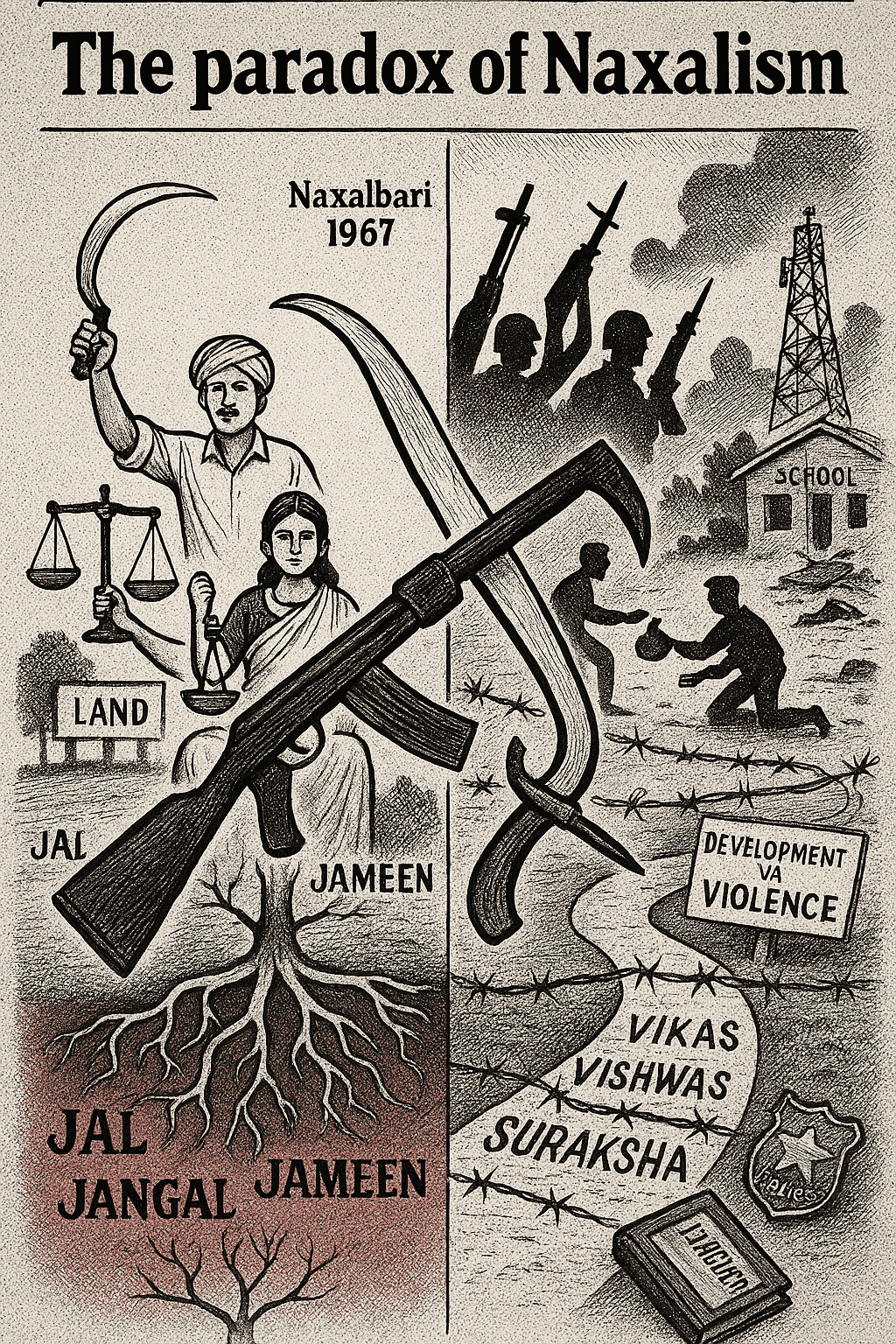
Amidst this chaos, the Naxalism Movement stepped in like a Messiah for the masses. It raised slogans like “land for the tiller” and championed the cause of tribals, who attached their identity to “Jal, Jangal, Jameen” (water, forest, land). Capitalizing on public resentment, Naxalites fanned anti-government sentiment. In Andhra Pradesh, they held Praja Courts, a kangaroo court, which entertained complaints against moneylenders, even government officials. Its orders were generally obeyed out of fear of retribution by Naxal cadres. They forcibly collected funds from land-owners, businessmen, contractors and such. Although they recruited women cadres to challenge the patriarchy, female representation in top leadership positions has remained minimal.
The bureaucrats often view postings to these areas as “Punishment postings” and seek transfers to other areas. Even the people do not obey laws in these areas due to lack of proper administration. It’s a vicious cycle of chicken and egg. This administrative vacuum and people’s anti-government sentiments form right conditions for the Maoists to spread their ideology. Even the people get attracted to the Maoist ideology as it gives them a semblance of hope. A large portion of recruits to Naxal Cadres are from deprived or marginal backgrounds.
Modus Operandi of Naxalites
Naxalism has evolved into an internal security threat masquerading as a revolutionary movement. Its modus operandi resembles terrorism, as it often resorts to violence to achieve its goals. As per the Maoist doctrine, bearing of arms is “non-negotiable”, thus it glorifies violence. PLGA, the armed wing of CPI (Maoist), was raised for this express purpose. Naxalists routinely ambush and assassinate the government officials, police and security forces. They sabotage and destroy public infrastructure to isolate indoctrinated communities from mainstream society and developmental initiatives. Through tactics of subversion, extortion, kidnapping, murder, it creates a fear psychosis and maintains the status quo of underdevelopment in those regions.
Tribal communities are especially vulnerable to recruitment. Their traditional subsistence skills such as hunting and gathering translate seamlessly into guerrilla warfare capabilities with an additional training in making improvised explosive devices (IEDs). Their mastery of terrain, fieldcraft, and natural marksmanship makes them ideal insurgents. LWE’s most potent tool is the anti-state narrative. It projects itself as saviours and misguides the innocents. The urban naxals, who are usually based in urban areas, are key drivers of this narrative war. They provide intellectual and logistical support, organising mis-information campaigns and spreading propaganda especially on college campuses and social media.
External Linkages
The Naxalities expressed solidarity with other insurgent and extremist groups both within and outside India to form a web of linkages. It has linkages with the non-state actors such as the Al Qaeda, Nepali Maoists, Noth East militants, Liberation Tigers of Tamil Eelam (LTTE). Although the nature of these linkages is unclear as they lack any direct evidence, they may also have linkages with state actors like the ISI, for whom Naxalism works well with their intention to “make India bleed through a thousand cuts”, or maybe to destabilize the country through proxy wars such as Iran lending support to Hamas against Israel or the US to Ukraine in it’s war against Russia. The arrests of top leaders revealed that these Maoists possess advance weapons[6] like AK47, UMGs, Carbiners etc., which are also used by other militant groups across the globe.
They may also have an unholy nexus with transnational organized crime syndicates involved in illegal activities like in drug trafficking, smuggling of contraband goods to finance their extremist activities and facilitate procurement of arms and ammunition.[7] The CPI (Maoist) established links with militant groups of the Northeast India such as the People's Liberation Army (PLA) of Manipur, United Liberation Front of Asom (ULFA), and National Socialist Council of Nagaland (NSCN-IM) and anti-India terror groups based in Pakistan. It has ties with umbrella organisations like Coordination Committee of Maoist Parties and Organisations of South Asia (CCOMPOSA) formed in July 2001 and Friends of Indian Revolution (FOIR). The platforms serve as a medium for exchanging cross-border dialogues.
Compact Revolutionary Zone or a Red Corridor are the regions with presence of Naxalities. It early 2000s stretched from Pashupati in Nepal to Tirupati in South India, spanning in 126 districts from across 10 states in 2013[8] to only 38 districts in 2024 (with effect from April-2024) across 09 states to 6 districts in 4 states of Chhattisgarh, Jharkhand, Odisha and Telangana.[9] The proximity of red corridor to the Golden Triangle, infamous for opium trade, situated in the region where the borders of Laos, Thailand, and Myanmar meet is a grave concern. Especially with decline in Naxalite insurgency, there’s rise in of drug cultivation in the states of Bihar, Odisha, Jharkhand.[10]
People’s Struggle Between Government and Naxalites
On the midnight of 14th August 1947, PM Jawaharlal Nehru, in his famous "Tryst with Destiny" speech said that, “At the stroke of the midnight hour, when the world sleeps, India will awake to life and freedom….when we step out from the old to the new, when an age ends, and when the soul of a nation, long suppressed, finds utterance.”. But the irony is that even after decades of achieving Independence, some of our countrymen are not entirely free. They are still shackled by the chains of poverty and uncertainty. Even in the 21st century they are still living in the darkness, quite literally, as electricity has not reached them yet.
Though Naxalism was born as a movement for social justice, it has ended up harming the very people it vowed to help. Every person who carried a promise of hope had his own vested interests, be it the politician who saw them as mere vote banks or the militants who used them as an anti-government tool. These innocent people were crushed between the Government and the parallel government run by these Maoists. The state's failure to recognize and protect the land rights of forest dwellers was a critical mistake. People felt betrayed by the state and this drove them straight into the arms of Naxalities.
Initially, militants the government treated this menace as a law and order problem and not as a social issue. So accordingly it devised an offensive strategy to bring the situation under control. But it’s not an external threat like terrorism, where force can be met with force. Innocents were caught in the crossfire between the state and the Naxalites. A bias emerged against anyone who was remotely associated with the Maoists, including against those working for the welfare of the downtrodden like NGOs or activists. The government enforced draconian laws, such as the Unlawful Activities (Prevention) Act, 1987, Chhattisgarh Public Safety Act, 2006 criminalized basic acts of human kindness. For example, Section 8(2) of the Chhattisgarh Public Safety Act, 2006 punishes a person who aids any unlawful organization or harbours any member of such organization. It’s viewing things in black and white when the reality lies in a grey zone, since proving someone as a Naxlite is difficult. People were repeatedly harassed, arrested and jailed on mere suspicion of giving shelter to Naxalite. Such arbitrary powers were given to the authorities. And sometimes the authorities were in cahoots with the Naxals especially with the lower-level officers.
On the other side, if the Naxalites suspected villagers of supporting or being informers of police, they would abduct and kill the villagers ruthlessly. They actively prevent development from reaching these villages and destroy the essential infrastructure like roads and schools to isolate the population from mainstream society. Instead of fostering progress, Naxalites actively obstructed it. Choosing between Naxalites and the state was like a Hobson’s choice for the people who live in a climate of fear and unprecedented terror. In India, between 2004 and March 31, 2025, Left Wing Extremism violence claimed 8,895 lives.[11] Behind these stats are stories of families torn apart, villages left grieving, and futures cut short. Each life, a thread in the fabric of communities that now carry the weight of absence. The Central India, the epicentre of Naxalism, also faces the “resource curse” i.e., resource-rich regions remaining paradoxically underdeveloped, adding another layer to these complex problems.
Way Forward: Justice, Not Just Force
The government’s response to Naxal movement began with Operation Steeplechase to control the peasant uprising in West Bengal. Although it quelled the initial unrest, it dispersed the movement to other states. The Naxals entrenched themselves in the remote and inaccessible pockets of the dense Dandakaranya forest, which spans across Chhattisgarh, Odisha, Telangana, Andhra Pradesh, Maharashtra and Madhya Pradesh. Though the government launched some operations like Operation Octopus, Operation Green Hunt, Operation Chakrabandha and successfully raised specialized forces like Greyhounds in Andhra Pradesh, COBRA battalion in Chhattisgarh, C-60 in Maharashtra, it was like a game of whack-a-mole. Whenever there was a cracked down in one state, Naxalites simply slipped across borders into another.
Naxalism is a unique internal security issue. Unlike terrorism, which stems from external threats, this is a problem from within. One can defend against external bodily threats with weapons, but when the threat is internal, like an auto-immune disease attacking its own vital organs, weapons are futile. If left untreated, internal decay could turn fatal. Naxalism, in that sense, is an internal affliction. Hence, a strategy of applying force to reduce force is ineffective. For instance, the coercive approach in dealing with the civilians in state backed initiatives Salwa Judum and Operation Green Hunt, which reported instances of excesses by security forces and human rights violations is a prime example.
The schemes such as Backward Regions Grant Fund and Integrated Action Plan were a step in the right direction, but they failed in implementation. Lack of co-ordination among states, an unstable political climate, absence of political will among the elected representatives, shortage or misappropriation of funds allocated to the development of these regions, failing to recognize the root cause of the problem all worked in the favour of the Naxalities. Even the state police are groomed maintain law and order and community policing so tackling with a militarily organised and trained Naxals through offensive combat operations is an uphill task.
There is a significant decline in LWE violence now due to effective government initiatives and changing ground realities. The National Policy and Action Plan (2015) is a multi-pronged strategy was built on 3 main pillars i.e., curbing extremists’ violence with ruthless approach (security level), improving coordination between centre and states and among states (governance level) and eliminating support for Naxalism through public participation in development (Civil society level).
At security level, initiatives[12] like Security Related Expenditure (SRE) scheme, deployment of elite forces trained under in jungle warfare, establishment of Multi Agency Centres (MAC) to improve coordination and intelligence sharing were taken. The government Operations like Black Forest and Kagar have neutralized hundreds of insurgents and dismantled key leadership structures. At governance level, initiatives like Special Infrastructure Scheme, District level monitoring committees, Aspirational District Programme, PM Gram Sadak Yojana, construction of essential infrastructure like mobile towers, banks, ATMs, post offices can finally connect these areas with the mainstream and put them on the track to development.
Housing schemes like PM Awas Yojana can help rehabilitate the displaced lives. At civic society level, ROSHNI Scheme provides vocational training and employment to the youth. Initiatives like Ekalavya Model Residential Schools (EMRS), Tribal youth exchange programmes, and most importantly, rehabilitation of Surrendered Naxalities are bearing fruits. Winning the hearts and minds of tribal communities is essential. Recognizing the contributions of iconic tribal leaders such as Birsa Munda and honouring and celebrating their unique culture as a part of India’s heritage will foster a sense of inclusion. Celebrating diversity is a strong unifying force for India.
Conclusion
On May 14, 2025, after a major anti-Naxal operation in the Karreguttalu Hills, near the Chhattisgarh–Telangana border, the government has announced a resolution to make India Naxal-free by 2026[13]. This marks a hopeful turning point for affected regions, moveof priority for the government, to uplift the marginalized people first, protect nature through sustainable practices, and then build an economic prosperity that benefits all. When humanity and ecology are prioritized, true progress organically follows and peace prevails. As India steps into Amrit Kaal, this vision must guide our journey towards a just, inclusive, and resilient future.
References
[1] Press Information Bureau, Naxalmukt Bharat Abhiyan: From Red Zones to Growth Corridors: India’s Decisive Battle Against Left Wing Extremism, Ministry of Home Affairs (India), Apr. 10, 2025, https://www.pib.gov.in/PressReleasePage.aspx?PRID=2120771
[2] Vijay Kumar Ahluwalia, Problem of Naxalism in India: Ground Realities and Strategic Challenges towards Conflict Resolution ch. 4 , Pg: 52, (Ph.D. thesis, Amity Univ. 2016), https://shodhganga.inflibnet.ac.in/handle/10603/188992
[3] Report of the Committee on State Agrarian Relations and the Unfinished Task in Land Reforms, Ministry of Rural Development, Government of India, 2009, Table 4.5, https://dolr.gov.in/a-statement-of-the-categories-of-the-documents-that-are-held-by-it-or-under-its-control/
[4] Panchayat (Extension to the Scheduled Areas) Act, 1996
[5] The Scheduled Tribes and Other Traditional Forest Dwellers (Recognition of Forest Rights) Act, 2006
[6] Anoop A. J., Maoist Funding: Dimensions, Sources and Implications (Jan. 14, 2011), https://www.vifindia.org/article/2011/january/14/Maoist-Funding-Dimensions-Sources-and-Implications#:~:text=According%20to%20the%20Home%20Minister,with%20Nepal%2C%20Bangladesh%20and%20Myanmar
[7] Talk by Lt Gen V K Ahluwalia (Retd) on ‘Future of the Naxalite Movement’ (Inst. for Def. Stud. & Analyses, Sept. 29, 2023), https://www.idsa.in/idsa-event/talk-by-lt-gen-v-k-ahluwalia-retd-on-future-of-the-naxalite-movement
[8] Press Information Bureau, Ministry of Home Affairs Year End Review – 2023 (Gov't of India, Dec. 31, 2023), https://www.pib.gov.in/PressReleasePage.aspx?PRID=2042128
[9] Press Information Bureau, Ministry of Home Affairs Year End Review – 2024 (Gov't of India, Dec. 31, 2024), https://www.pib.gov.in/PressReleasePage.aspx?PRID=2120771
[10] Jaideep Deogharia, Hemanta Pradhan, Manoj Chaurasia, How East India’s Red Corridor Became a Green Belt for Narcotics, Times of India (May 16, 2024, 08:30 AM), https://timesofindia.indiatimes.com/toi-plus/crime/how-east-indias-red-corridor-became-a-green-belt-for-narcotics/articleshow/123521519.cms
[11] KM Seethi, What Lies Ahead as Centre Mounts Offensive Against Maoists, Indian Express (May 17, 2024), https://indianexpress.com/article/upsc-current-affairs/upsc-essentials/what-lies-ahead-as-centre-mounts-offensive-against-maoists-10046069/
[12] Ministry of Home Affairs, Left Wing Extremism Division, Gov't of India, https://www.mha.gov.in/en/divisionofmha/left-wing-extremism-division (last visited May 17, 2024).
[13] Press Information Bureau, Government Notifies The Rules Under The Criminal Law (Amendment) Act, 2023 (Gov't of India, Feb. 12, 2024), https://www.pib.gov.in/PressReleasePage.aspx?PRID=2101142
Journal Volume
You should always try to find volume and issue number for journal articles.

Nyayavimarsha
No. 74/81, Sunderraja nagar,
Subramaniyapuram, Trichy- 620020