

"Justice cannot be for one side alone, but must be for both"
LAAL SALAM - From Red Flags to Bleeding Nation
Published on : 05/10/2025
View Count : (25)
LAAL SALAM - From Red Flags to Bleeding Nation
Author Details
Ms. Aastha Pednekar,
4th year B.A. LL.B.
Lords Universal College of Law, Goregaon (Mumbai University)
Growing up in Chattisgarh, I always thought of it as a peaceful place, the land of tribals, the beauty of the environment, the hardworking spirits of all the labourers and farmers, making it a peaceful place to live in. Over time, this peace was disturbed by external forces, as kids we only heard the concept of naxalism as a bedtime story never realising that we are becoming the host states to them it continued till now
The red flag rose, and the seeds of Naxalism were sown & this communist ideology began to grow in the 1960s, starting as a conflict between tribal peasants and landowners. This was attributed to a failure of the Indian government to implement constitutional reforms to provide for tribal autonomy with respect to natural resources on their lands. According to Maoist sympathizers, the Indian constitution "ratified colonial policy and made the state custodian of tribal homelands" and turned tribal populations into squatters on their own land.[1] Naxalites believe that there is a class conflict between agricultural workers and landowners and that the Constitution of India lacks protections for tribal workers. This ideology has been popular among tribal people.
The tribals who took Maoism as their constitution and the ideologies were followed as a Holy Book by them. Inspired by Maoism, Charu Majumdar wrote the Historic Eight Documents, which became the basis of Naxalism and as the naxalism was on growing in the places where the state was absent to fulfill all its duties the naxlaism stepped up to support the groups the people or the areas with no electricity, running water, or poor healthcare provided by the state probably accepted social services from Naxalite groups, and gave their support to the Naxal cause in return[2].
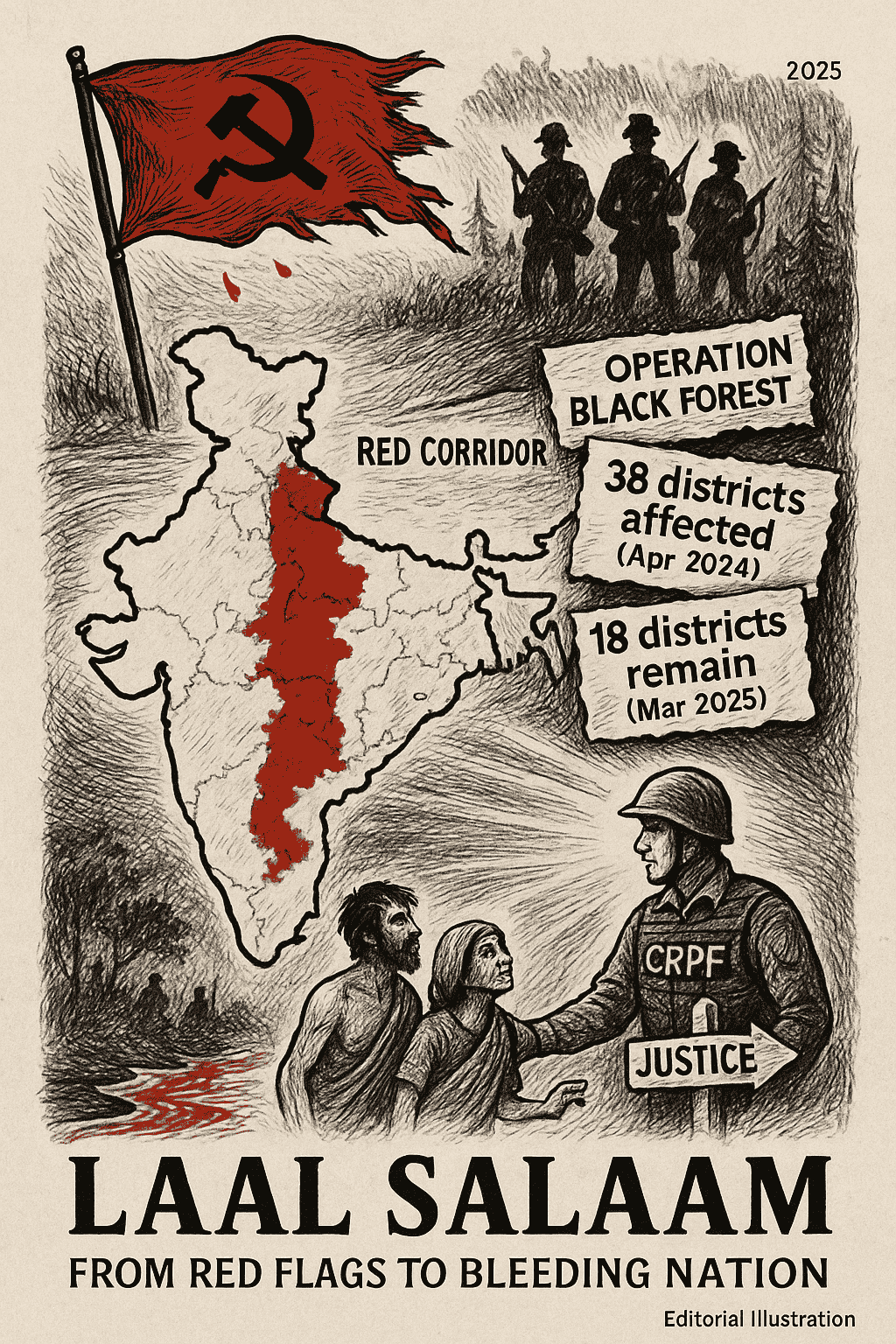
The Red Corridor took its place into existence when the insurgency reached its peak in the late 2000s, with almost 180 affected districts, and has been on the decline since then due to the counter-insurgency actions and development plans formulated by the Government.[3] As of April 2024, 38 districts across nine states are affected by Naxalist extremism.[4]In March 2025, the home minister informed the parliament that Naxalism was mostly limited to 18 districts, of which six of them were classified as 'most affected'.[5] The corridor is largely spread across areas of Central and East India.
This corridor was not only the pathway for the blood-stained justices but also a horror crime for women, as Naxalite feminists have said that leaders of Naxalite groups have committed violence against women and sexual violence. Naxalite groups are funded by extorting profits from companies, especially mining companies, in areas they control. The illegal drug trade is another funding source. This whole rich funding arm rebellion took what they needed and cut the hands off of the ones who were feeding them.
This horrendous crime persisted for many years, but recently the Minister of Home Affairs Amit Shah announced on 14 May that the offensive had concluded in a major success for the Indian forces, killing 31 Maoists, including top commanders. Operation Black Forest (also called Operation Kagar) is a military operation conducted by Indian security forces against Naxalite insurgents in areas located between the states of Chhattisgarh and Telangana.[8] The operation began on 21 April 2025. The Chief of the CRPF Gyanendra Pratap Singh confirmed that security forces completed the operation in the Karreguttalu Hills between the borders of the states of Chhattisgarh and Telangana, facing severe weather conditions and retrieving 28 bodies of the 31 killed Naxalites.[6]
Some sections of society, especially the younger generation, have romantic illusions about the Maoists, arising out of an incomplete understanding of their ideology. The central theme of Maoist ideology is violence. The Maoist insurgency doctrine glorifies violence as the primary means to overwhelm the existing socioeconomic and political structures. The People's Liberation Guerrilla Army (PLGA), the armed wing of CPI (Maoist), has been created with this purpose in mind. In the first stage of the insurgency, the PLGA resorts to guerrilla warfare, which primarily aims at creating a vacuum at the grass-roots level of the existing governance structures. This is achieved by killing lower-level government officials, police-personnel of the local police stations, the workers of mainstream political parties and the people's representatives of the Panchayati Raj system. After creating a political and governance vacuum, they coerce the local population to join the movement. A strident propaganda is also carried out against the purported and real inadequacies of the existing state structure.[7]
The inconsistencies, the history, the Red Corridor, or whether it was the crime done by them, for them, or whether it was an entire funded planning—this Laal Salaam, the very notion of CPI-M, the very belief of the oppressed and of wrong justice, became an irony and turned the tables, as they themselves took pride in staining the red flag with the blood of innocent people and hyper-romanticizing the communist, Maoist ideology. Through this, armed rebellions roared across the host states, claiming them as their own. But like every story has its end, this too will end. The officials of our nation are out on the hunt, the red flag hides under the bushes, and the blood of innocent people waits to be washed off that flag. The Laal Salaam will return to its origin with pride, leaving behind the armed toxicity, as this one nation for all will build a corridor towards justice whenever the nation screams for help.
References
[1] Wikipedia [ Naxalism ]
[2] Shah, Alpa (1 August 2013). "The intimacy of insurgency: beyond coercion, greed or grievance in Maoist India". Economy and Society. 42(3): 480–506
[3] Naxal Problem needs a holistic approach. Press Information Bureau
[4] "Naxal affected Districts". Government of India. Retrieved 1 October 2024.
[5] Most affected' Naxal districts down to just six from 12: Amit Shah
[6] “31 Maoists killed in 21-day anti-Naxal operations at Karregutta hills; Amit Shah hails 'historic breakthrough'". Live Mint. Retrieved 14 May 2025.
[7] Ministry of Home Affairs [Press conference-Division]
Journal Volume
You should always try to find volume and issue number for journal articles.

Nyayavimarsha
No. 74/81, Sunderraja nagar,
Subramaniyapuram, Trichy- 620020