

"Justice cannot be for one side alone, but must be for both"
From Rules to Results: Judicial Oversight of Plastic Waste Regulation in India
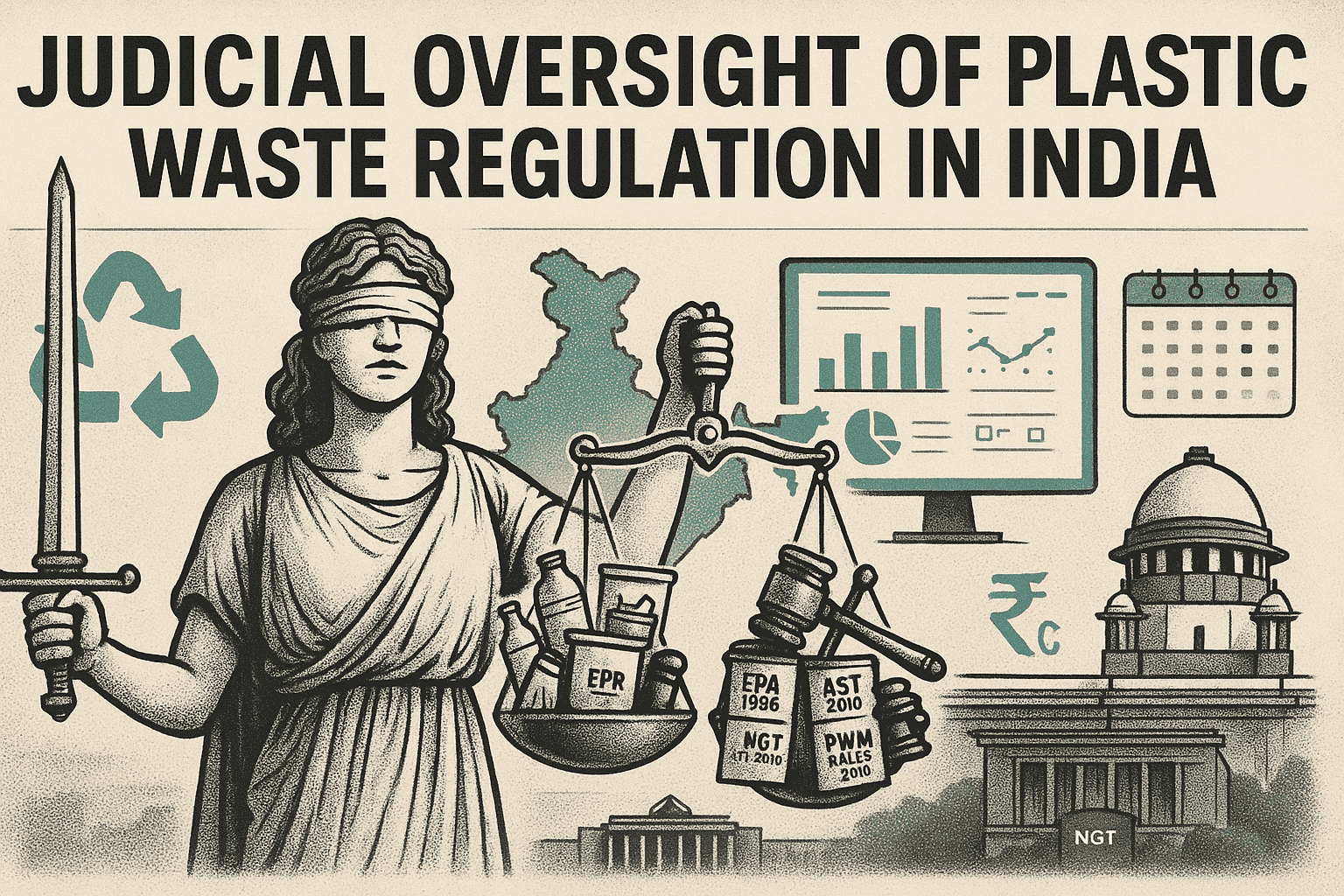
Published on : 23/10/2025
View Count : (10)
From Rules to Results: Judicial Oversight of Plastic Waste Regulation in India
Author Details
Mr. Aman Mani Tripathi
Doctoral Student, South Asian University
Abstract
This paper examines how India's courts have transformed plastic-waste rules from paper norms into actionable obligations, with the National Green Tribunal (NGT) anchoring jurisdiction under Sections 14-15 of the NGT Act, 2010, and the Supreme Court supplying constitutional weight. Section 14 confers jurisdiction over "substantial question[s] relating to environment" arising from listed enactments. In contrast, Section 15 empowers the NGT to order relief, environmental compensation, and restitution—tools repeatedly used to force timely compliance by local bodies and regulated entities. Building on the statutory duties assigned to local authorities, SPCBs/PCCs, PIBOs, and waste generators in the Plastic Waste Management Rules, 2016, especially the operational responsibilities and EPR-facing enforcement roles, the NGT has treated non-performance as a remediable legal breach rather than a mere policy lapse. Two accelerants explain the courts' positionality. First, continuing (monitorial) jurisdiction coupled with environmental-compensation frameworks has produced concrete deterrence altering cost–benefit calculations for chronic violators. Second, higher-court doctrine has validated robust plastic restrictions, reducing litigation risk for administrators. In Tamil Nadu and Puducherry Paper Cup Manufacturers Association v. State of Tamil Nadu (2023), the Supreme Court upheld a state ban on "one-time use and throwaway plastics," stressing public-interest justifications and noting the Union's nationwide single-use-plastic prohibitions notified in 2022. Those Union-level measures, banning identified SUP items and tightening carry-bag thickness thresholds, supply a national compliance baseline that the NGT can demand to be implemented on the ground. Against this backdrop, this paper argues that judicial oversight has measurably accelerated administrative compliance.
Keywords Plastic Waste, NGT, PWM, EPR
Introduction
India's plastic-waste regime has expanded dramatically over the past decade, moving from framework legislation to smaller, target-based obligations on governments and market actors. The Environment (Protection) Act 1986 (EPA) supplies the backbone and an executive power to give directions that enables nationwide prohibitions and compliance orders; the National Green Tribunal Act 2010 (NGT Act) creates a specialist forum to enforce these norms; and the Plastic Waste Management Rules 2016 (PWM) (as amended) now detail duties on municipalities and producers, including Extended Producer Responsibility (EPR) for plastic packaging.[1] Against this statutory backdrop, courts, especially the National Green Tribunal (NGT) and the Supreme Court, have increasingly exercised what Indian public law terms continuing or supervisory jurisdiction to translate broad statutory duties into time-bound, monitorable commands. This article argues that such judicial oversight has functioned as a compliance accelerator for plastic regulation, even though the Supreme Court has clarified limits on tribunals' ability to outsource decision-making to expert committees.[2]
The regulatory arc since 2016 is clear. First, the PWM Rules 2016 allocated responsibilities across local bodies, waste generators, producers, and brand owners.[3] Second, the PWM (Amendment) Rules 2021 phased in a prohibition of specified single-use plastic (SUP) items with effect from 1 July 2022, and raised minimum thickness/GSM norms for carry bags.[4] Third, the PWM (Amendment) Rules 2022 (notified 16 February 2022) gave legal force to detailed EPR Guidelines in Schedule II, building a portal-based system for registration, target-tracking, and annual returns.[5] Finally, the PWM (Amendment) Rules 2024 tightened reporting and clarified institutional responsibilities, complementing CPCB's operational guidance.[6] Together, these measures furnish courts with trackable benchmarks (registrations, filings, targets) that can be demanded in affidavits and verified against official dashboards.[7]
Preliminary evidence suggests that post-2022 judicial and executive signalling has coincided with intensified field enforcement. In a 21 August 2025 statement to the Rajya Sabha, the Government reported 8,61,740 inspections, 1,985 tonnes of seized banned SUP, and ₹19.82 crore in fines across July 2022–July 2025. These figures are collated through the SUP compliance-monitoring portal and State Board reports.[8] An earlier Lok Sabha reply had already recorded 60,367 inspections and ₹19.77 crore in fines alongside the roll-out of CPCB's online monitoring module, grievance app, and a national dashboard.[9] While causation cannot be claimed from correlation alone, these nationally consolidated series make plastic a rare environmental domain in which India now publishes compliance metrics that courts can, and do, demand and scrutinise.[10]
At the doctrinal level, judicial oversight is shaped by two Supreme Court vectors. On one hand, in Tamil Nadu & Puducherry Paper Cup Manufacturers Association v State of Tamil Nadu (2023), the Court endorsed a calibrated, public-interest-driven approach to material restrictions. It noted the national SUP prohibition, lowering the litigation risk for states and regulators enforcing bans.[11] On the other hand, in Kantha Vibhag Yuva Koli Samaj Parivartan Trust v State of Gujarat (2022), the Court set limits on the tribunal process, holding that while expert committees may assist, they cannot delegate adjudication. This is a due-process guardrail for NGT-style supervisory proceedings.[12] These decisions frame the following analysis: how Indian courts transform plastic-waste rules into monitorable obligations while respecting separation-of-powers constraints.
Finally, an international and scholarly lens reinforces the stakes. UNEP's Environmental Rule of Law assessment (2019) diagnoses a persistent enforcement gap worldwide despite proliferating environmental statutes; the OECD's guidance on EPR (2016; 2023–24 updates) distils institutional design lessons for producer-responsibility schemes; and Indian treatises and edited volumes emphasise how Article 21 jurisprudence and tribunalisation have enabled results-oriented environmental governance.[13] These strands justify taking judicial oversight itself as an object of study, both to document what works in the Indian plastics context and to delineate principled limits.
Legal and institutional architecture
As mentioned in the introduction, India's plastics regime rests on a three-pillar legal scaffold: (i) framework powers and offences under the Environment (Protection) Act 1986 (EPA); (ii) a specialised adjudicatory forum and remedial toolkit under the National Green Tribunal Act 2010 (NGT Act); and (iii) product- and actor-specific duties under the Plastic Waste Management Rules 2016 as amended in 2018, 2021, 2022 and 2024. Together, these instruments let administrators prescribe standards and issue binding directions, give tribunals jurisdiction plus compensatory powers to enforce them, assign obligations, and measurable returns to local bodies and market actors.[14]
EPA 1986: framework powers and offences
Section 5 empowers the Central Government to issue binding written directions to "any person, officer or authority," while section 15 provides penal consequences for contravention of rules and directions made under the Act.[15] These two provisions underwrite nationwide prohibitions (e.g., specified single-use plastics) and compliance mandates to State Boards and local authorities, and they anchor the deterrence side of enforcement where tribunals or Boards escalate breaches.[16] The Environment (Protection) Rules 1986 supplement this by prescribing the manner of issuing section 5 directions relevant when agencies defend due process in enforcement campaigns.[17]
NGT Act 2010: forum, jurisdiction, and principles
Section 14 gives the NGT original jurisdiction over "substantial questions relating to the environment" arising under scheduled enactments (including the EPA). In contrast, section 15 authorises it to order relief, compensation, and restitution. These tools are used to transform plastic rules into time-bound compliance mandates.[18] Section 20 further requires the Tribunal to apply the principles of sustainable development, precautionary, and polluter-pays.[19]
PWM Rules: duties and accountability across the chain
The 2016 Rules allocate responsibilities across the lifecycle:
Local authorities must establish segregation, collection, storage and channelisation systems, and ensure processing and scientific disposal (Rule 6).
Waste generators (including institutions and commercial establishments) must minimise, segregate and hand over waste, and avoid littering (Rule 8).
Producers/Importers/Brand Owners (PIBOs) carry Extended Producer Responsibility (EPR) obligations for plastic packaging; they must establish a system for collecting and managing the plastic they introduce and comply with registration/reporting (Rule 9, as later elaborated).[20]
These role assignments make the regime auditable. They translate into checklists that tribunals can demand in affidavits and status reports.[21]
In 2021, the Union notified a phased prohibition of identified single-use plastic (SUP) items with effect from 1 July 2022, and increased carry-bag thickness to 75 microns from 30 September 2021, and to 120 microns from 31 December 2022.[22] The notification's legal basis is the EPA's rule-making power, read with section 5 directions. Administratively, it supplies a national baseline that State authorities and courts can enforce uniformly.[23]
The PWM (Amendment) Rules 2022 inserted a detailed Schedule II that operationalises EPR for plastic packaging. Producers, importers, and brand owners (PIBOs) and Plastic Waste Processors (PWPs) must register on the Centralized EPR Portal, file annual returns, and meet collection, recycling, reuse, and recycled-content targets with auditable certificates.[24] On one hand, the CPCB Guidance Manual explains the workflow that includes entity categories and target computation, generation of EPR certificates, and quarterly or annual filings. On the other hand, Boards regularly annex these screens and IDs in compliance proceedings, thus allowing judicial oversight to rest on machine-readable filings rather than narrative affidavits.[25]
The 2024 amendment tightens definitions and reporting lines. The PWM (Amendment) Rules 2024 refined definitions (e.g., compostable plastics), strengthened reporting by ULBs/PRIs and market actors, and reinforced prohibitions and liaison duties, including engagement with organisations working with waste-pickers.[26] These amendments are already showing up in State Board circulars and status reports.[27]
To make violations costly and comparable across States, the CPCB Guidelines for Assessment of Environmental Compensation for Violation of PWM Rules, dated 4 April 2024, set out formulas and tables for EC against distinct breach types (unregistered activity, target shortfalls, banned-item violations), with roles allocated between SPCBs and local bodies.[28] The SOP on Assessment and Characterisation of Plastic Waste, dated 24 June 2024, complements this by standardising sampling, reporting, and verification. These are the inputs that tribunals and High Courts increasingly ask to see.[29]
Read together, the EPA's direction-issuing and offence machinery, the NGT Act's adjudicatory and compensatory toolkit, and the PWM Rules' actor-specific duties, as sharpened by the 2021 SUP prohibition, 2022 EPR portalisation, and 2024 reporting tweaks, create a governance stack optimised for judicial supervision. These include commands with clear duty-holders, verifiable filings, and a priced consequence for non-compliance.[30]
Judicial oversight as a compliance accelerator
Indian environmental adjudication has developed a distinctive supervisory technique, often called continuing mandamus, through which constitutional and statutory courts retain hold of a matter, issue iterative directions, and demand periodic compliance reporting from executive authorities. In Vineet Narain v Union of India the Supreme Court explicitly described and normalised this modality, keeping investigation oversight "pending" and requiring the CBI and other agencies to report progress, characterising the proceeding as a "continuing mandamus".[31] This supervisory template later migrated to environmental governance, notably T N Godavarman forest matters, where the Court repeatedly monitored implementation and crafted consequential directions.[32] In doctrinal terms, continuing mandamus is justified as an adjunct to Articles 32/226 and, in the environmental field, is reinforced by statutory policy principles, such as precaution, polluter pays, and sustainable development, that decision-makers must apply.[33]
Against this background, specialised jurisdiction under the National Green Tribunal Act 2010 equips the NGT to convert open-textured duties into monitorable obligations. Section 14 confers original jurisdiction over substantial environmental questions arising under scheduled enactments (including the EPA), while s 15 authorises "relief, compensation and restitution", and s 20 mandates applying sustainable development, precautionary, and polluter-pays principles.[34] These textual anchors are what permit the Tribunal to: (a) crystallise time-bound compliance plans from general rules (e.g., PWM/SWM), (b) price non-compliance through environmental compensation (EC), and (c) insist on status reports backed by measurable indicators.[35]
Yet the Supreme Court has also policed the limits of supervisory technique to ensure the Tribunal does not surrender its adjudicatory function. In Kantha Vibhag Yuva Koli Samaj Parivartan Trust v State of Gujarat (2022), a solid-waste case, the NGT Principal Bench had disposed of a four-year-old Original Application by directing parties to approach a multi-tier committee created in OA 606/2018 for nationwide SWM monitoring. The Supreme Court set aside that order, restored the matter, and stressed that the NGT must adjudicate the pending controversy instead of relegating it to committee processes.[36] The Court extracted the NGT's order closing the case "with liberty" to go to the committees, then held that "valuable time" had been lost because the Tribunal failed to decide the issues before it; the appeal was allowed and the OA restored to the NGT's file to be heard from the stage before disposal.[37] The ratio preserves a crucial line: committees may assist fact-finding and monitoring, but adjudication cannot be delegated.[38] It is the constitutional guardrail for judicial oversight of plastic regulation, that supervision may be intensive, but it must remain judicial.[39]
A second, complementary strand in the doctrine is deference to calibrated regulatory choices, especially under the Environment (Protection) Act 1986 (EPA), so long as process and proportionality are respected. In Tamil Nadu & Puducherry Paper Cup Manufacturers Association v State of Tamil Nadu (2023), the Supreme Court upheld the State's Section 5 EPA-based restrictions issued under a valid delegation under Section 23 EPA on single-use and related products, while engaging with natural-justice claims under the Environment (Protection) Rules 1986, Rule 4. The Court reproduced Section 5 and noted the 1988 central delegation to States. It endorsed the State's competence to issue an across-the-board restriction in the public interest.[40] On hearing, the Court accepted that pre-decisional hearings are ordinarily required by Rule 4, yet held that, in the case's peculiar facts and in light of subsequent national developments (including the 1 July 2022 central single-use plastics ban), post-decisional opportunities and the six-month deferment of the ban's commencement sufficed. Thus, invalidation was unwarranted.[41] The Court also signalled proportionality review by acknowledging that non-woven bags had, by later amendments to the PWM Rules, been regulated (GSM threshold) rather than per se prohibited, and therefore remitted that sub-issue to the pollution board for fresh consideration.[42] In plastics litigation, this template means courts will usually validate rule-based prohibitions (and their enforcement) while fine-tuning margins where less-restrictive alternatives exist.[43]
Put together, these strands (i) continuing/supervisory jurisdiction; (ii) adjudication-not-delegation; and (iii) calibrated deference, explain the effectiveness of judicial oversight as a compliance accelerator in plastic regulation. Supervisory orders translate PWM/EPR baselines into time-bound, monitorable duties (e.g., portal registration, annual returns, target fulfilment), with affidavits keyed to dashboard data rather than narrative assertions.[44] Courts can require specific EPR Portal extracts, insist on verified returns, and cross-check State action against centrally reported indicators.[45] NGT's Section 15 powers and the CPCB's EC guidelines supply an ex-ante schedule for consequences, while Kantha Vibhagcautions that levy decisions must remain tribunal decisions, not committee determinations—preserving notice, hearing, and reasoned orders.[46] Besides, TN Paper-Cups lowers litigation risk for administrators enforcing Section 5-based prohibitions and reinforces that central SUP measures provide a national baseline against which state action can be evaluated.[47]
Finally, the constitutional normative substrate that informs this supervisory approach bears recalling. The right to life under Article 21 has long been read to include the right to clean air and water,[48] and the Court has mainstreamed precautionary and polluter-pays principles.[49] While these are familiar, their practical force in plastics cases is to legitimate ex ante restrictions (e.g., SUP prohibition; recycled-content obligations) and ex post internalisation of harm (environmental compensation), within the NGT Act's remedial frame.[50] Scholarly treatments have, accordingly, emphasised that India's environmental adjudication blends constitutional rights, statutory principles, and managerial judging. Such a blend is crucial to complex, polycentric compliance problems like plastic leakage.[51]
Enforcement toolkits the courts catalyse
Indian courts have not created a new plastic-waste code; instead, they have activated an interlocking toolkit the legislature and regulators already supplied: (a) environmental compensation under the polluter-pays principle; (b) portalised EPR compliance with machine-readable filings; (c) standardised inspections and reporting; and (d) due-process scaffolding that keeps coercive powers within constitutional bounds. This section maps those tools and shows why they lend themselves to judicial supervision.
Three legal anchors convert polluter-pays from rhetoric to consequence. First, s 15 of the National Green Tribunal Act 2010 empowers the NGT to order "relief, compensation and restitution" for environmental harm, a text the Supreme Court has repeatedly treated as capacious enough to price non-compliance.[52] Second, s 20 NGT Act requires application of sustainable development, precautionary, and polluter-pays principles.[53] Third, under the PWM (Amendment) Rules 2022, Schedule II lays down EPR Guidelines, directs the CPCB to lay down and update EC guidelines for violations, and keeps EC proceeds in escrow for plastic-waste management.[54] In 2024, the CPCB issued a consolidated Guidelines for Assessment of Environmental Compensation for Violation of PWM Rules, 2016. The document sets out breach categories, for example, target shortfalls under EPR, operation without registration, manufacture or stocking of banned items, and formulae that tie EC to quantities and compliance gaps so that levies are predictable, comparable, and deterrent.[55] Later clarificatory circulars and revision notes in August–September 2024 refined slabs and values for particular categories, keeping parity with the amended PWM architecture.[56] Therefore, courts and High Courts can ask simple, monitorable questions: "What was the entity's EPR target? What was its shortfall? What EC did the Board compute under the CPCB table? Show the calculation." That is precisely the input-output that a supervisory forum can verify on affidavit.
Two features of the EC regime matter for adjudication. One, institutional locus: EC against multi-State PIBOs is imposed by CPCB; EC against single-State PIBOs and plastic-waste processors (recyclers/co-processors/end-of-life) is imposed by SPCBs/PCCs, ensuring there is a clear respondent for each levy.[57] Two, utilisation: Schedule II specifies that EC proceeds are ring-fenced in an escrow and may be released only for plastic-waste collection/recycling/end-of-life treatment corresponding to the non-compliant fraction, another item courts can audit.[58] These design choices convert an abstract principle into auditable line items.
The Centralised EPR Portal for Plastic Packaging compels registration of PIBOs and Plastic Waste Processors, creates entity-level targets by packaging category, and generates system reports on filings, certificates, and EPR performance. CPCB's public guidance explains that transactions between registered entities are captured, certificates are issued per tonne processed, and the system produces monitoring reports; modules cover annual returns, credit exchange, third-party audit, and even automatic EC triggers against non-conforming certificates.[59] CPCB has also issued directions to SPCBs/PCCs emphasising verification of EPR certificates and corresponding EC, where certificates are not in conformity with requirements.[60] In litigation, these machine-readable traces (registration IDs, targets, returns, certificate numbers) allow courts to move beyond narrative affidavits. Benches can order the production of portal extracts, compare targets to credits, and confirm whether EC has been raised and deposited.
To reduce measurement disputes, CPCB has issued a Standard Operating Procedure for Assessment and Characterisation of Plastic Waste. The SOP sets a common method for estimating district-level generation, incorporating legacy waste and requiring officials to compile uniform proformas. Several fields are designed to be auto-fetched from the EPR portal and Single-Use Plastic (SUP) compliance dashboards (e.g., number of registered entities, audits, EC levied), which further integrate inspection outputs with portal data.[61] These templates are regularly annexed to State/Board status reports before the NGT/High Courts, so orders can track the same indicators term-to-term.
Even before the portalised EPR regime matured, tribunals used environmental compensation and seizure to alter behaviour, for example, Delhi's implementation of NGT orders prescribing ₹5,000 EC per default for possession/use of banned thin plastic bags, with multi-agency enforcement teams and stock seizure.[62] Today, the Centre reports nationally consolidated enforcement series after the SUP prohibitions. By 2 December 2024, there were 60,367 inspections, 1,963.6 tonnes of seized plastic, and a collection of ₹19.77 crore in fines.[63] These series are valuable to courts because they are centralised, periodic, and disaggregable, allowing a bench to ask a State why its inspections or seizures deviate markedly from peers, or to direct targeted hotspots enforcement.
The Environment (Protection) Rules 1986, r 4 mandates that proposed directions under s 5 EPA be served, objections invited (usually 15 days), and a reasoned decision taken within 45 days.[64] In Tamil Nadu & Puducherry Paper Cup Manufacturers Association, the Supreme Court engaged closely with r 4 and s 5 (including the State's delegated power), ultimately upholding the State's material restrictions while treating notice/hearing defects contextually, given deferred commencement and subsequent national measures. The Court remitted a narrow sub-issue (non-woven bags) for fresh consideration, an example of calibrated deference.[65] Conversely, in Kantha Vibhag, the Court protected adjudication from being outsourced. The NGT could not dispose of a long-running OA by sending parties to expert committees; it had to decide.[66] Tribunals may rely on committee fact-finding or portal data for EC disputes, but the levy requires a judicial determination with reasons.
Conclusion
This article has argued that India's plastic-waste regime delivers results when judicial oversight translates open-textured statutory duties into time-bound, monitorable obligations, while preserving constitutional guardrails. The Courts and the NGT shall tighten supervision without overstepping adjudication. They can do so by: First, continuing mandamus focused on measurable milestones that map to statutory hooks, whereby they require parties to file standardised EPR-portal extracts (registration IDs, annual returns, targets, certificates retired) rather than narrative affidavits and direct Boards to annex EC worksheets showing the precise formula from CPCB's 2024 Guidelines.[67] This refines supervision into an input–output check and reduces contestable fact claims. Second, preserving the Kantha Vibhag line: committees may gather facts and follow up, but adjudication cannot be delegated.[68] Third, embedding Rule 4 (EPA Rules 1986) due process in all coercive steps, service of proposed directions, a genuine objections window (≥15 days), and a speaking order within 45 days, reserving the urgency proviso for clearly recorded cases.[69] Finally, practicing calibrated deference as per TN Paper-Cups, which asks to uphold rule-anchored restrictions that advance public interest, while remitting narrow edges where later PWM amendments or evidence show less-restrictive means.[70]
It is notable that the judicial oversight does not create plastics policy. It makes existing law governable by demanding evidence that duties are being performed, and by pricing non-performance. Done within the bounds of Kantha Vibhag and Rule 4, such oversight respects separation of powers while closing the implementation gap identified in environmental rule of law assessments.
References
[1] Environment (Protection) Act 1986, ss 3, 5, 15; See generally, The Environment (Protection) Act, 1986, National Green Tribunal Act 2010, ss 14-15, National Green Tribunal Act, 2010, Plastic Waste Management Rules 2016, GSR 320(E), 18 March 2016 (as amended).
[2] Kantha Vibhag Yuva Koli Samaj Parivartan Trust v State of Gujarat (CA 1046/2019, 21 January 2022) (SC) (Chandrachud and Trivedi JJ) (holding NGT cannot abdicate adjudication to committees).
[3] PWM Rules 2016, rr 4–11 (obligations of local bodies, generators, producers/brand owners).
[4] PWM (Amendment) Rules 2021, GSR 571(E), 12 August 2021 (phasing out identified SUPs by 1 July 2022; thicker carry bags)
[5] PWM (Amendment) Rules 2022, 17 February 2022, inserting Schedule II (EPR Guidelines); see also CPCB EPR Portal Guidance Manual (version 2023).
[6] PWM (Amendment) Rules 2024, GSR 201(E), 14 March 2024 (reporting/role clarifications).
[7] Centralized EPR Portal for Plastic Packaging (CPCB) and Guidance Document (registration, target-tracking, annual returns).
[8] PIB, ‘Parliamentary Question: Status of Ban on Single-Use Plastic’ (21 August 2025).
[9] Lok Sabha Starred Q.94 (2 December 2024), MoEFCC reply (recording 60,367 inspections, ₹19.77 cr fines; dashboard/app/monitoring module).
[10] For CPCB’s EC Guidelines linking penalties to PWM violations, see CPCB, Guidelines for Assessment of Environment Compensation for Violation of PWM Rules (4 April 2024).
[11] Tamil Nadu & Puducherry Paper Cup Manufacturers Association v State of Tamil Nadu (CA 8536/2022, 20 October 2023) (SC) (Bhat J), upholding the State’s material-restriction policy and noting the central SUP ban.
[12] Kantha Vibhag (n 2)
[13] UNEP, Environmental Rule of Law: First Global Report (2019) (diagnosing the global enforcement gap); OECD, Extended Producer Responsibility: Updated Guidance for Efficient Waste Management (2016); and OECD, Extended Producer Responsibility: Basic Facts and Key Insights (2024). See also, Shyam Divan and Armin Rosencranz, Environmental Law and Policy in India (3rd edn, OUP 2022) (overview of statutory architecture and Article 21 environmental jurisprudence); Shibani Ghosh (ed), Indian Environmental Law: Key Concepts and Principles (Orient BlackSwan 2019) (procedural rights; tribunalisation); Gitanjali Nain Gill, Environmental Justice in India: The National Green Tribunal (Routledge 2017).
[14] Environment (Protection) Act 1986 (EPA), ss 3, 5, 15; Green Tribunal Act 2010 (NGT Act), ss 14–15, 20; Plastic Waste Management Rules 2016, GSR 320(E), 18 March 2016 (as amended).
[15] EPA 1986, s 5 (‘Power to give directions’) and s 15 (penalties).
[16] Shyam Divan and Armin Rosencranz, Environmental Law and Policy in India (3rd edn, OUP 2022) 116–22 (EPA ss 3–6, 15; direction-issuing powers and enforcement).
[17] Environment (Protection) Rules 1986, r 4 (form and manner of directions).
[18] NGT Act 2010, s 14 (jurisdiction) and s 15 (relief/compensation/restitution).
[19] NGT Act 2010, s 20 (application of sustainable development, precaution, polluter-pays). See also, Shibani Ghosh (ed), Indian Environmental Law: Key Concepts and Principles (Orient BlackSwan 2019) chs 1–3.
[20] PWM Rules 2016, rr 6, 8–9 (local bodies; waste generators; PIBOs/EPR).
[21] Gitanjali Nain Gill, Environmental Justice in India: The National Green Tribunal (Routledge 2017) 83–107 (compliance-monitoring modalities and affidavits).
[22] PWM (Amendment) Rules 2021, GSR 571(E), 12 August 2021; prohibition of identified SUP items w.e.f. 1 July 2022; carry-bag thickness to 75μ (30 Sept 2021) and 120μ (31 Dec 2022).
[23] Tamil Nadu & Puducherry Paper Cup Manufacturers Assn v State of Tamil Nadu (SC, 20 Oct 2023)
[24] PWM (Amendment) Rules 2022, 17 February 2022 (inserting Schedule II—EPR Guidelines). Centralised EPR Portal for Plastic Packaging (CPCB) (entity registration; filings; target tracking).
[25] CPCB, ‘Guidance Manual for Centralized EPR Portal for Plastic Packaging’ (v.2023/24).
[26] PWM (Amendment) Rules 2024, GSR 201(E), 14 March 2024 (definitions; ULB/PRI reporting; liaison duties).
[27] See, eg, TNPCB posting reproducing the 2024 amendments.
[28] For consolidated publication text, see Gazette reproduction (GSR 201(E), 14 March 2024). CPCB, Guidelines for Assessment of Environmental Compensation for Violation of PWM Rules, 2016 (4 April 2024).
[29] CPCB, SOP: Assessment & Characterisation of Plastic Waste (24 June 2024).
[30] Divan and Rosencranz (n 5) 635–58 (judicial remedies; compensation; supervisory orders); P Leelakrishnan, Environmental Law in India (7th edn, LexisNexis 2025) 712–29 (tribunalisation; EPA/NGT interface); OECD, Extended Producer Responsibility: Updated Guidance for Efficient Waste Management (2016) ch 4; OECD, Extended Producer Responsibility: Basic Facts and Key Insights (2024) 9–17 (on portalised compliance architectures).
[31] Vineet Narain v Union of India (1998) 1 SCC 226, esp the Court’s description of a “continuing mandamus” and periodic monitoring orders (e.g., orders of 5 Dec 1994; 30 Jan 1996).
[32] T.N. Godavarman Thirumulpad v Union of India (order, 12 Dec 1996), WP (C) 202/1995; subsequent monitoring orders; for an official compilation see Supreme Court orders referencing continuing oversight.
[33] National Green Tribunal Act 2010, s 20 (sustainable development, precautionary, polluter-pays to be applied by NGT); see also s 14, s 15. For doctrinal overviews: Shyam Divan and Armin Rosencranz, Environmental Law and Policy in India (3rd edn, OUP 2022) chs 1–2; Shibani Ghosh (ed), Indian Environmental Law: Key Concepts and Principles (Orient BlackSwan 2019).
[34] NGT Act 2010, s 14 (jurisdiction), s 15 (relief/compensation), s 20 (principles).
[35] Gitanjali Nain Gill, Environmental Justice in India: The National Green Tribunal (Routledge 2017) 83–107 (NGT’s supervisory modalities and affidavit-based monitoring).
[36] Kantha Vibhag Yuva Koli Samaj Parivartan Trust v State of Gujarat Civil Appeal No 1046 of 2019 (SC, 21 January 2022) (D Y Chandrachud and Bela M Trivedi JJ). The NGT had closed OA 81/2014 by referring parties to committees set up in OA 606/2018.
[37] ibid paras 6, 18 (reproducing the NGT’s “committee” disposal; allowing appeal; restoring OA to NGT for adjudication and noting delay occasioned by non-adjudication).
[38] ibid (ratio that the Tribunal must adjudicate—committees may aid monitoring/fact-finding but cannot replace decision-making).
[39] See also D P Chouri, ‘National Green Tribunal and Environmental Justice in India’ (2024) (noting Supreme Court’s stance that NGT is an expert adjudicatory body and discussing the scope/limits of its powers).
[40] Tamil Nadu & Puducherry Paper Cup Manufacturers Association v State of Tamil Nadu Civil Appeal No 8536 of 2022 (SC, 20 October 2023) (S Ravindra Bhat J), paras 32–34 (reproducing s 5 EPA, confirming competence; noting 1988 delegation under s 23 EPA) and Rule 4 of the 1986 Rules.
[41] ibid paras 40–41 (pre-decisional hearing and deference in light of public interest and the 1 July 2022 central SUP ban).
[42] ibid paras 53 (regulation of non-woven bags by GSM threshold under PWM amendments) and disposal (remit to TNPCB on non-wovens).
[43] See also OECD, Extended Producer Responsibility: Updated Guidance (2016) ch 4 (regulatory design and proportionality in producer-responsibility schemes); OECD, EPR: Basic Facts and Key Insights (2024) 9–17.
[44] Plastic Waste Management Rules 2016 (as amended 2022/2024) and the EPR Portal architecture translate duties into filings/targets/returns used in status-monitoring before courts/NGT. (Cited in detail in Section 2.)
[45] See official PWM amendments and MoEFCC/CPCB portal guidance (used by courts for affidavit-backed verification).
[46] NGT Act, s 15; CPCB, ‘Guidelines for Assessment of Environmental Compensation for Violation of PWM Rules’ (4 April 2024); read with Kantha Vibhag on adjudication.
[47] TN Paper-Cups (n 10) paras 32–34, 40–41; noting the 1 July 2022 national SUP prohibition within the Court’s proportionality/natural-justice analysis.
[48] Subhash Kumar v State of Bihar 1991 Supp (2) SCC 594 (Article 21—right to pollution-free water/air)
[49] Vellore Citizens’ Welfare Forum v Union of India (1996) 5 SCC 647 (precautionary and polluter-pays).
[50] NGT Act, s 20 (application of principles) read with PWM/EPR architecture and EC guidelines (analysed in Sections 4–5).
[51] Divan and Rosencranz (n 3) chs 14–16; Shibani Ghosh (n 3); G N Gill (n 5) (managerial judging and tribunalisation in environmental compliance).
[52] National Green Tribunal Act 2010, s 15 (relief/compensation/restitution).
[53] NGT Act 2010, s 20 (application of sustainable development, precautionary, polluter-pays).
[54] Plastic Waste Management Rules 2016, as amended on 16 February 2022 (inserting Schedule II—EPR Guidelines, incl provisions on EC and escrow).
[55] CPCB, Guidelines for Assessment of Environmental Compensation for Violation of PWM Rules, 2016 (4 April 2024).
[56] See, eg, CPCB “Technical Guidelines/SOPs” index noting Revised Guidelines (Aug–Sep 2024); practitioner summaries of revised values/slabs.
[57] CPCB/Guidelines (n 4); division of competence between CPCB (multi-State PIBOs) and SPCBs/PCCs (single-State PIBOs and PWPs) as described in administrative explanations.
[58] PWM Schedule II (EPR Guidelines), cl 9.6
[59] Centralised EPR Portal for Plastic Packaging – official brochure and guidance (features: registration, target generation, certificate issuance, system-generated monitoring, modules for returns/audits/EC).
[60] CPCB Direction to all SPCBs/PCCs (14 Jan 2025) (verification of EPR certificates; levy of EC where certificates are non-conforming).
[61] CPCB, Standard Operating Procedure for Assessment & Characterisation of Plastic Waste (24 June 2024) (district inventories; auto-fetch from EPR/SUP dashboards); see also public copies summarising auto-fetch fields for audits and EC.
[62] Govt of NCT of Delhi, Department of Environment, ‘Waste Management’ page (implementing NGT directions; ₹5,000 EC per default for banned thin bags; seizure/teams).
[63] Lok Sabha Starred Q. 94, 2 December 2024 (MoEFCC): 60,367 inspections, 1,963.6 t seized, ₹19.77 cr fines; PIB/Parliamentary updates in Aug 2025 on continued drives and national taskforce.
[64] Environment (Protection) Rules 1986, r 4 (‘Directions’): notice of proposed direction, 15-day objections window, decision with reasons within 45 days; urgency proviso.
[65] Tamil Nadu & Puducherry Paper Cup Manufacturers Association esp paras 40–41 (r 4 hearing treated contextually), paras 43-49, 52 (merits and non-wovens remit).
[66] Kantha Vibhag paras 6, 18 (NGT cannot dispose of OA by relegating parties to committees; matter restored for adjudication).
[67] Central Pollution Control Board (CPCB), Guidelines for Assessment of Environmental Compensation for Violation of PWM Rules, 2016 (4 April 2024); see also Plastic Waste Management Rules 2016 (as amended 2022), Sch II (EPR Guidelines).
[68] Kantha Vibhag paras 6, 18, 21.
[69] Environment (Protection) Rules 1986, r 4(2)-(5); Environment (Protection) Act 1986, s 5.
[70] Tamil Nadu & Puducherry Paper Cup Manufacturers Association v State of Tamil Nadu Civil Appeal No 8536 of 2022 (SC, 20 October 2023) paras 32–35, 40–41, 51–53; Plastic Waste Management (Amendment) Rules 2021, GSR 571(E).
Journal Volume
You should always try to find volume and issue number for journal articles.

Nyayavimarsha
No. 74/81, Sunderraja nagar,
Subramaniyapuram, Trichy- 620020