

"Justice cannot be for one side alone, but must be for both"
Counting Caste, Weighing Equality: The Promise and Perils of a Nationwide Caste Census
Published on : 02/06/2026
View Count : (0)
Counting Caste, Weighing Equality: The Promise and Perils of a Nationwide Caste Census
The Indian national caste census controversy is a good example of how the pernicious nexus of power, rights, and world fault lines plays out. Enumeration is never innocuous: it puts into focus what groups the state sees, allocates resources to, and legitimizes in the public sphere to. It is suggested that evidence-based policy-making, democratic representation of the excluded, and state institution accountability demand caste data. They argue that it has the potential to reify caste categories, increase identity-based competitions, and hide class influence. This essay positions its argument in India's colonial and comparative transnational spaces. It analyzes colonial and postcolonial enumeration strategies, the epistemic demands of data, and reification dangers. With due regard to Bihar's 2023 census, Karnataka's clandestine caste census, and world equivalents in the United States of America and South Africa, it shows how identity enumeration is always politically contested. In favor of Partha Chatterjee's hypothesis, it argues that caste enumeration can lead to greater equality only when there are redistributive reforms and structural change, and not recognition.
Keywords: Caste Census, Equality, Identity Politics, Class, Recognition, Social Justice, Federalism
Bihar came out with a survey on castes in 2023 that revived one of India's most divisive discussions in recent politics: should India hold a countrywide caste census? Its defenders see it as a belated acknowledgment of deep-seated disparities, whereas its critics dread that it would further consolidate identity-based divisions. It is not a matter of numbers; it is a question of what democracy assigns between recognition, redistribution, and representation.
The stakes are high. India conducted its last caste survey in 1931, and affirmative action programs have been subsequently forced to act upon outdated data. However, critics also caution that enumeration will consolidate competitive populism and overlook the centrality of class. Similar controversies have erupted across the world, from racial enumeration in the United States to post-apartheid South Africa, to demonstrate that identity censuses never end up being apolitical but are always political.
This essay follows the course of caste enumeration in history, examines its political and epistemic stakes, and considers the dangers of reification. It takes lessons from Bihar and Karnataka, makes international comparisons, and adds a federalism perspective to demonstrate how centre–state tensions in the constitution condition the politics of enumeration. Finally, it contends that a caste census can promote equality only if supported by redistributive reforms bridging caste and class, transforming recognition into material justice.
Caste in the colonial period was turned into a state category of classification, where society became recognized in ways of rule. The British colonial government since the mid-nineteenth century formalized caste as a system of classificatory grids with the premise that social order could only be envisaged, and thus ruled over, in formalized categories. H.H. Risley's census of 1901 was the culmination of the process: it counted caste, but ranked communities hierarchically on the basis of varna, thereby naturalising Brahmanical ideology in the state machinery.[1] The census thereby legalized social prejudice into fact, making hierarchy legible to the state and more resilient in daily life.
Anand Teltumbde has contended that such bureaucratic identities were not objective depictions of society but politically constructed ones stipulated by colonial necessities.[2] Enumeration was more concerned with articulating Indian society in terms in which it might be fitted within the colonial model than with grasping Indian society in its own terms. The process solidified fluid identities. For instance, when Scheduled Castes were defined by law in 1936 through means like prohibition on entry into temples or pollution by touch, locally contested and context-bound practices were turned into hard state categories.[3] Caste was not just explained in the census but actually constructed as a state reality.
The impacts of colonial enumeration did not vanish at Independence. The makers of the Constitution, while attempting to end hierarchy, also had to operate with these existing categories. They selectively identified Scheduled Castes and Scheduled Tribes and thereby entrenched affirmative action, but gave up enumeration of caste per se. This strategic silencing was a double bind: the new republic required caste information to facilitate redistribution, yet it did not wish to perpetuate colonial logic of categorization for fear that this would reconstitute divisions. The post-1951 silence therefore was a wish—though a mistaken one—that caste would disappear with democracy and development.
That promise was a myth. As Gail Omvedt suggests, all along, even with constitutional guarantees, atrocities and exclusion continued on a caste basis, and political mobilisation on a caste basis deepened.[4] The irony was especially real with the Mandal Commission of the late 1970s. Assigned to make recommendations for the uplift of Other Backward Classes (OBCs), it was forced to use the 1931 census since there was no data thereafter. Lack of regular statistics compelled the Commission to depend on methodological expedients, supplementing imperfect reports with socio-economic surveys of public opinion. But when its recommendations were put into operation in 1990, Mandal revolutionized Indian politics, empowering new social fronts and reorganizing party alignments.
This course highlights two significant observations. Firstly, efforts to exclude caste from the census did not exclude caste from society or politics but instead worked towards giving increasing power to powerful castes by hiding their advantage from critiques. Secondly, calls for a census of caste in the twenty-first century are not a revolutionary innovation but the continuation of a long struggle over recognition and redistribution. The bringing in of caste in the 2011 census was therefore more a culmination rather than a break, showing how the decades of mobilisation subaltern and elite unease were translated into a politics of numbers that remained at the centre of the politics of equality.[5]
A caste census is not a numbers game, but an epistemological intrusion into Indian social knowledge and governance. To enumerate caste is to define what does and doesn't constitute social reality, what groups are readable to the state, and which hierarchies are recognized as deserving of policy attention.
Enumeration first lays the basis for evidence-based policymaking. In the absence of proper data, positive action can be ad hoc and subject to elite capture. Gail Omvedt has contended that the job of demolishing caste needs, paradoxically enough, has to begin with detailing out caste and mapping it out, because only if its blueprint is understood can it be dismantled.[6] Data no longer becomes a goal but turns into an instrument of targeted interventions. The lack of such information since 1931 has compelled policymakers to plan in terms of guesswork or old statistics, and policy formulated thus may look liberal in theory but tend to bypass the target groups. Such lack of empirical facts has usually favored ruling castes, as they can divert resources without the spotlight of proportional representation.
Second, enumeration is a democratic act of recognition. Zoya Hasan observes that India's primary tool of inclusion has been affirmative action, but it all too frequently overlooks layered disadvantage due to the lack of caste data.[7] Take the chronic under-representation of Muslims in public service in the midst of pervasive poverty: it indicates the ways in which groups cutting across caste and religion can be made invisible where categories fail to be defined enough.[8] Satish Deshpande also reminds us of the way the lack of caste data speaks of "willful neglect" by upper-caste elites to maintain the semblance of a meritocratic castelessness while reaping benefits disproportionately.[9] To count caste, that is, is not so much to produce figures as to derange established privilege and regard subordinated groups as political actors in the imagination. The recognition is also symbolic rather than material: it constitutes claims to dignity and makes redistributional claims possible.
Third, a caste census improves accountability. Anand Teltumbde observes that although the Constitution did enshrine social justice as a founding principle, its practice has remained unbalanced and skewed at best.[10] The lack of strong data has permitted the state greater avoidance, hiding success and failure both. Caste count in minute detail, linked to educational, employment, and political results, can allow historically disadvantaged sections to assess whether equality assurances are being met. Counting becomes thus a tool of democracy, making the state face up to inequalities that would remain concealed otherwise.
All these arguments describe how a caste census is anything but a bureaucracy exercise. It is an intervention that can realign the state and society by offering an empirical foundation for redistribution, dissolving myths of meritocracy, and holding institutions accountable to the principles of the Constitution.
But enumeration is unsafe. The process of categorization has the potential to reify the categories that it seeks to disrupt, petrifying fluid social practices into fixed formal categories.
Anand Teltumbde contends boldly that groups like the Nadars and Ezhavas, staying outside the Scheduled Castes list, progressed more than some groups that got included, partly by avoiding official stigmatisation as ritual inferior.[11] This relates to a paradox: state classification can empower groups with affirmative action but also freeze stigma through legal formalisation as "backward." Having been inscribed, such identities gain a permanence which lasts longer than the conditions under which they initially came into being, and provides incentives to groups to reproduce a stigmatised identity in order to maintain benefits.
The threat of competitive populism is not unreal either. Gail Omvedt documents how commentators mocked caste enumeration as "competitive casteism," where groups met to ask for more quotas than others.[12] This tendency indicates that enumeration might become an electoral tool and increase populist strategies instead of ending hierarchy. Bal Thackeray famously threatened to count by caste and divide society, but his demand to count by religion was a sign of elite unease at the empowerment of caste more than any philosophical commitment to integrity.[13] The incident does however show how politicized data tends to fossilize identity-based rivalries rather than spread them.
A third phobia is class-blindness. Zoya Hasan emphasizes that affirmative action does not, in fact, reach the poorest in caste groups because it fails to mix economic considerations.[14] Landless Dalits or poor OBCs have very different conditions of life compared to those in their situation of upward mobility. Unless a caste census incorporates economic variables, it may just reinforce intra-group disparities and allow relatively better-off sub-castes to reap the dividends of redistribution. Recognition without redistribution, i.e., can consolidate hierarchy between communities and even within.
Lastly, the theoretical framework offered by Partha Chatterjee is a critical theoretical focus. He makes the distinction between civil society, the arena of elites with active citizenship, and political society, where marginalised sections deal with the state on an informal footing.[15] A caste census, actively strived for as population management, could possibly further consolidate marginalised sections in political society, as populations to be governed, rather than as citizens whose rights can be asserted. Such categorisation runs the risk of institutionalising difference as opposed to structural inequality, demeaning the emancipatory potential of a caste census into an exercise in bureaucratic categorisation.
Caste enumeration issues are not hypothetical; they have materialized in real terms in India and other identity-based stratifying societies. Subnational experiments, though, show the potential as well as the danger of census-counting caste.
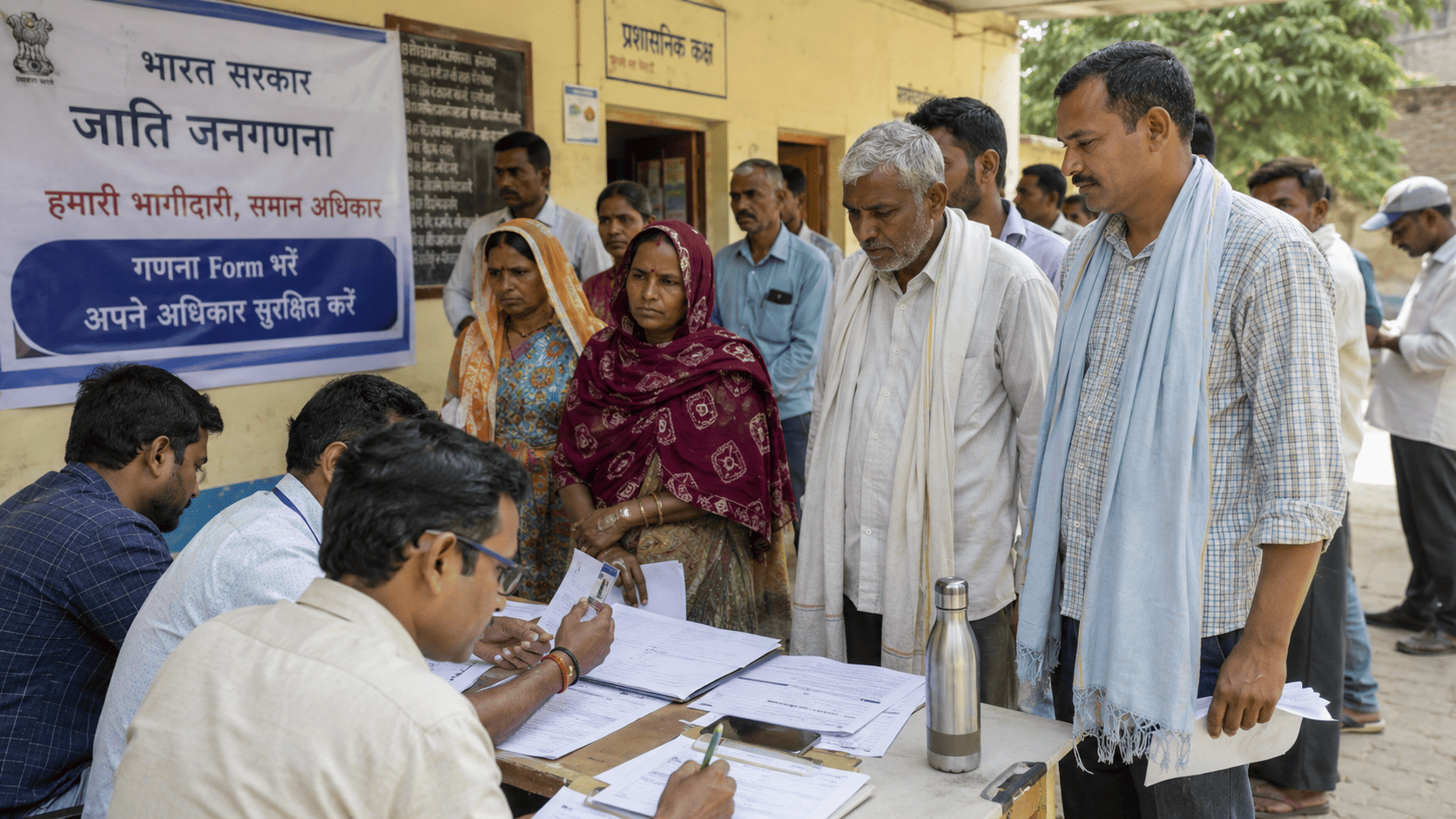
Bihar's 2023 caste survey presents perhaps the most lurid recent case. The survey found that combined, Extremely Backward Classes (EBCs) and Other Backward Classes (OBCs) represented over 60 percent of the state's population and that upper castes represented barely 15 percent.[16] Aside from these leading statistics, the survey did something innovative and encouraging in connecting caste data with socio-economic parameters like land ownership, literacy, housing quality, and earnings. It made it clear that caste poverty is never too distinct from class inequality. As an example, most landless families were from the Dalits and EBCs, which proved that material poverty is still attached to caste status. By making such correlations so overt, the Bihar survey yielded a model for a caste census that does not so much reify identities but situates them within patterns of economic disadvantage. But political repercussions also caused risks to be featured: with information in the hands of the parties, before long demands for additional reservations and quotas followed. The survey thus largely became a double-edged sword that served both as an instrument of liberation and a political tool, showing how enumeration can free and also polarise simultaneously.
The 2015 Karnataka caste census is another learning case. On a large scale, it is said to have revealed that ruling classes like Lingayats and Vokkaligas were fewer in number than was thought before, with Dalits and OBCs making up a larger percentage of the population.[17] Their revelation contravened fundamental political hierarchies. In contrast to Bihar, though, the report was never made public, broadly rumored to have been suppressed due to its disruptive potential, which challenged vested group interests. The Karnataka experience is enlightening: enumeration alone will not appease transparency or reform. In the absence of political will, enumeration can be delayed, hidden, or selectively implemented, and the promise of knowledge is another point of conflict.
The Indian case resonates with debates worldwide on enumeration of identity. In the United States, the decennial census has a long tradition of enumerating racial and ethnic identifications, the empirical foundation of civil rights enforcement, desegregation of schools, and affirmative action.[18] They would conceal racial disparities in income, education, and health without them, activists argue. But others respond that racial categories solidify differences, so that they become tangible in bureaucratic modes that replicate the very same ones which they attempt to abolish. The argument spells out India's contradictions: enumeration as empowerment or entrenchment.
The post-apartheid South Africa presents the same contradiction. Once a state obsessed with race was deconstructed, the new democratic state retained racial categorizations within the census.[19] The reasoning was that inequality could not be quantified without counting racial categories, which continued to dictate wealth and access to opportunities. As with India, long-standing inequality rendered enumeration unavoidable even as it raised discomfiting questions regarding the reproduction of those categories to which the new polity hoped to rise above.
These examples together designate two things. Enumeration of identity is never a disinterested act of knowledge accumulation. Rather, it is always motivated by political contestation, by the agendas of ruling groups, and by demands for recognition and redistribution by ruled groups. Second, it is only in its afterlife that enumeration is possible: how data is used, challenged, or suppressed makes its presence actually serve equality or aggravate division. Bihar's survey indicates the way intersections of class and caste can be plotted for redistributive justice, Karnataka illustrates the risks of political repression, and global analogues remind us that identity censuses throughout the world bear the double-edged sword of recognition and reification.
Caste census is more a matter of federal control and state autonomy within the Indian constitutional setup rather than one of statistics. Though the Union government has always shunned the possibility of a pan-Indian caste census, the states have gone ahead with these exercises, which are a reflection of enumeration being decentralized.
Bihar's 2023 caste survey is the latest instance of state intervention, which had previously been justified in terms of social justice and fair policymaking. The state government had claimed that without disaggregated data by caste, the policies could not be informed by the facts of deprivation. Karnataka's 2015 caste census was based on the same principle, even though its results were never formally released because of political reasons. These instances at the state level convey how units of the Centre have moved in to take up space.[20]
This conjunction raises crucial questions of democratic accountability. On the one hand, government-conducted polls can increase responsiveness by acting on policy in light of distinctive local circumstances. Conversely, the absence of national coordination threatens to supply disjointed and unbalanced information, making policymaking at the national level more difficult.[21] To that extent, the Centre's resistance to acceptance of caste enumeration is not merely administrative but political as well: information on caste may destabilize existing constituencies and undermine the mantra of a casteless national identity.[22]
Comparative federal settings bring out this tension. In the United States, where the national census yields national racial data, there is state-level data that inform local policy, generating layered systems of enumeration.[23] In India, state-run caste surveys and indifference at the center reveal a subtle cleavage: who gets to define and count social groups? This jurisdictional conflict points out that caste census politics is not merely a matter of recognition and redistribution but also negotiations of power in India's federal democracy.
The attempt to counter caste and class as competitive systems of explanation oversimplifies and is generally inappropriate in the Indian context. In fact, caste has conventionally structured class positions, allocating resources, education, and access to mobility. Economic hierarchies have seldom been divorced from caste status by patterns of exclusion that have been deeply historical. Thus, for instance, Dalits have stayed tied to agricultural labor with no land, while the upper castes are overrepresented in land ownership and also in white-collar jobs. Indian class, i.e., is not a floating economic category but one whose distribution has been structurally mediated by caste.
Zoya Hasan makes this point by showing how the most excluded groups—Scheduled Castes (SCs), Scheduled Tribes (STs), and Muslims—are touched both by discrimination on grounds of caste and economic exclusion.[24] Poverty among them is not only caused by the lack of income but also by institutionalized exclusion from institutions and opportunities. Therefore, policies that function by segregating caste and class as separate categories cannot fully represent the actual experience of deprivation that is intersectional and layered.
A nationwide caste census ought not to be an objective but rather a means of mapping cross-cutting disadvantages. Caste data interwoven with income, asset, literacy, and housing conditions indicators could provide a better approximation of disadvantage. It would also escape elite capture where the more advantageous sub-castes capture the benefits of affirmative action, placing the most disadvantaged beyond. Bihar's 2023 survey reinforced the potential of this combined approach by linking caste identity to economic measures and thus showing how poverty and caste intersect in ways that uncooked demographic data cannot.[25]
This integrative approach also alters the practice of citizenship as such. Partha Chatterjee's differentiation between political and civil society highlights the fact that subaltern groups are far too often placed not as equal citizens but rather as populations regulated through schemes of welfare and quotas.[26] Economic statistics in conjunction with caste tabulation can break this asymmetry, however, since it supplies an evidentiary basis for claims of structure. Citizens would no longer be pushed to go down the route of individual negotiated concessions but can assert entitlements on the basis of patterned exclusions. In a way, a caste census can shift the focus away from symbolic inclusion politics and towards a politics of accountability, in which evidence provides bite to the argument for substantive equality.
A caste census thus must be imagined as a means of mapping the intersection points of class and caste rather than as two intersecting axes of marginalisation. By consciously recording the patterns in which disadvantage along the lines of caste shows up in economic marginalisation, the exercise can provide a more accurate and better account of marginalisation. This would not only sharpen the accuracy of affirmative action but also ensure that the lowest rung of the people in communities is not rendered invisible. Enumeration, thus, becomes a means of quantifying the plural nature of exclusion, and giving meaning to the manner in which social and economic hierarchies have a tendency to precede one another in contemporary India.
The demand for a nationwide caste census is the India democracy paradox in a nutshell: how to challenge rooted hierarchies without re-legitimating them at the same time. The lack of caste data did not weaken the power of caste in public life; instead, it kept rooted privileges out of sight. Counting, however, is never safe. It risks solidifying social stigma into unchanging categories, fostering competitive populism, and intensifying group cleavages.
The Karnataka and Bihar experiences reveal both the potential and the risk of censuses on caste. On the positive side, they can offer an irreversible evidence base for policies of redistribution. On the negative side, they can be pushed to the closet by political authorities or selectively used, commodifying information into a polemical article. There are related issues in the international arena, where identity censuses have the double-edged sword of recognition and reification. The real challenge lies not so much in whether or not the caste is counted as in how something is done about the ensuing knowledge.
Reducing India's complex inequalities to caste and class simplifies too much. Caste has historically shaped economic hierarchies, and separating the two conceals overhangs. An economic-free caste census risks reflecting group-to-group inequalities, and a class-focused approach discounts the persistence of exclusion on caste lines. What is needed is an integrated approach measuring these intersections and informing more equitable redistribution.
Equally important is that caste enumeration is a concern of the federal government as well. Bihar and Karnataka-led initiatives show how state governments have moved into an area the Centre has kept open for others to occupy, raising questions about India's power balance in the democracy. This is a battle nested within a broader conflict over who gets to define and enumerate social categories and whether policy emerges out of piecemeal state-driven initiatives or out of a concerted national attempt.
To that end, a caste census needs to be seen not as an end in itself but as a diagnostic device. The utility of this exercise is to connect the recognition with redistribution, make accountability more robust, and enable historically excluded groups to make structural demands as citizens. If approached with sensitivity and followed by substantive reforms, caste census can be a tool of democratic empowerment that moves the country closer to the constitutional promise of justice and equality. Fairly enumerated and fairly responded to, it could become an instrument to make equality a reality from a mere dream.
[1] H.H. Risley, The People of India (1915).
[2] Anand Teltumbde, SC/STs and the State in the Indian Constitution, Lecture at Dr. B.R. Ambedkar Research and Extension Center, University of Mysore (Feb. 6, 2012).
[3] Id.
[4] Gail Omvedt, Caste in the Census, 40(4) Soc. Change 405, 406 (2010).
[5] Id. at 406–07.
[6] Omvedt, supra note 4, at 405.
[7] Zoya Hasan, Politics of Inclusion: Castes, Minorities, and Affirmative Action 159–60 (Oxford Univ. Press 2011).
[8] Id. at 163–64.
[9] Satish Deshpande, The Census and the Construction of Caste, Econ. Times (June 3, 2010).
[10] Teltumbde, supra note 2.
[11] Id.
[12] Omvedt, supra note 4, at 407.
[13] Id. at 407–08.
[14] Hasan, supra note 7, at 161–62.
[15] Swagato Sarkar, Civil Society and Exclusion: Partha Chatterjee on “The Politics of the Governed”, 2(2) Indian J. Hum. Dev. 447, 450–52 (2008).
[16] Government of Bihar, Bihar Caste Survey Report (2023).
[17] Anil Padmanabhan, Karnataka Caste Census and Its Suppressed Findings, Livemint (Aug. 6, 2018).
[18] Kenneth Prewitt, What Is Your Race? The Census and Our Flawed Efforts to Classify Americans (Princeton Univ. Press 2013).
[19] Statistics South Africa, Census 2011: Census in Brief (2012).
[20] Government of Bihar, supra note 16; Padmanabhan, supra note 17.
[21] Omvedt, supra note 4, at 407–08.
[22] Sarkar, supra note 15, at 450–52.
[23] Comparative example based on U.S. census practices (see Prewitt, supra note 18).
[24] Hasan, supra note 7, at 161–62.
[25] Government of Bihar, supra note 16.
[26] Sarkar, supra note 15, at 450–52.
Journal Volume
You should always try to find volume and issue number for journal articles.

Nyayavimarsha
No. 74/81, Sunderraja nagar,
Subramaniyapuram, Trichy- 620020