

"Justice cannot be for one side alone, but must be for both"
Behind The Robe: Can Judges Be Questioned?
Published on : 05/10/2025
View Count : (6)
Behind The Robe: Can Judges Be Questioned?
Behind The Robe: Can Judges Be Questioned?
Author Details
Mr. Amogh Uniyal,
1st year B.A. LL.B. (Hons.),
West Bengal National University of Juridical Sciences
Introduction
On 11th August, 2025, the Honourable Supreme Court of India passed a suo moto order that directed the Delhi Government, the Municipal Corporation of Delhi and the authorities of National Capital Region (NCR) to pick up stray dogs and relocate them to animal shelters within a span of eight weeks. This decision, taken by the bench comprising Justices J.B. Pardiwala and R. Mahadevan, aimed to protect the people of the NCR from the ‘dangers’ posed by stray dogs. The decision, however, sparked an outrage. Critics argued that the Court not only failed to hear all the parties, but also showed a lack of sympathy and understanding of the issue. It was also argued by Advocate Nanita Sharma that the order was in conflict with two previous judgements of the Court.[1]
The case of “In Re: City hounded by Strays, Kids pay Price” v. [Mr. Gaurav Aggarwal, Sr. advocate is amicus curiae] (2025)[2] has once again highlighted the unchecked and unquestionable authority of the judiciary that has been in exercise since the establishment of our governmental institutions and the implementation of the Indian Constitution.
It is no doubt that the powers granted to the judicial bodies have long gone unsupervised, with the concept of “checks and balances” being practically unapplicable to their decision taking powers. In 2015, the Supreme Court struck down the 99thAmendment Act of 2014[3], which had proposed the creation of a National Judicial Appointments Committee (NJAC) to replace the Collegium system that appoints judges for the Supreme Court and the High Courts. This was done to ensure that the executive has a say in the appointment of the law-interpreters of our nation. When the Collegium system was brought back, the then Finance Minister, Late Arun Jaitley remarked “Today, the absolute contrary to what Dr Ambedkar had envisaged is happening. Today we have reached a position where CJI...will appoint and everyone else is irrelevant. No position of law can ever justify it," he said initiating a debate in the Upper House on 'commitment to India's Constitution.[4]
The Division of Powers
Lord Acton, also known as 1st Baron Acton[5], coined the popular phrase “power corrupts”. His quote "Power tends to corrupt, and absolute power corrupts absolutely"[6], asserts the fact that power, when not bound by rules and regulations established by the society, will encourage the power-holder to misuse his power and mould the governing principles according to his will. Unregulated power corrupts the very soul of the individual and compels them to breach all boundaries of both morality and law to establish their hegemony over the system.[7]
Under Article 50 of the Constitution, which is part of the Directive Principles of State Policy (DPSP), the powers of the executive have been clearly separated from those of the judiciary in the matters of public service, in order to ensure that the principle of division of powers is maintained so that there is no interference in the duties of one organ by the another. In addition, Articles 122 and 212 have established that courts cannot interfere in the proceedings of the Parliament.[8]
Article 361[9] protects the President and the governors of the states from criminal or civil proceedings against them in any court of law for the duration of their term, considering the course of their official duties. Though such provisions clearly imply the intent of the members of the Constituent Assembly to divide the powers of the government amongst the three bodies- the legislature, the executive and the judiciary, the conduct of the courts, especially in the past few decades, has blurred the lines that mark the differentiation of powers.
The Rise of Judicial Activism
One aspect of judiciary that can be deemed responsible for the dilution of the established boundaries is Judicial Activism.The concept of Judicial Activism was established in the United Kingdom by Justice Edward Coke, with the term first coined in the United States by Arthur Schlesinger Jr. in 1947. It refers to the active involvement of courts in the interpretation and implementation of laws and guidelines to safeguard the rights of the citizens, ensure their overall welfare and establish justice.[10]
One of the earliest judgements in this regard was given in the case of A.K. Gopalan v. State of Madras (1950)[11], in which the Supreme Court played a critical role in interpreting the provisions of Part III (Fundamental Rights) of the Constitution, along with those of the Preventive Detection Act, IV of 1950, in order to determine the scope of rights of the citizens and that of the power of the state. Since then, the courts have played a crucial role in interpreting, re-interpreting, restructuring, and even creating new legal provisions in order to conform to the required legal standards of different periods of time.
This led to the adjudication of several crucial legal cases such as I.C. Golaknath v. State of Punjab (1967) and the Kesavananda Bharati v. State of Kerala (1973), which introduced the concept of the Basic Structure of the Constitution.[12]
By late 1970s and 80s, judiciary began to play an even more active role in the adjudicating and resolving a wide variety of public-related problems such as corruption, governmental inefficiency, human rights, economic and social conditions of poor and marginalised groups, etc. This was achieved through the introduction of Public Interest Litigation (PIL) in the late 70s. A PIL refers to a legal action which is initiated in a court of law for the enforcement of the obligations of the government in order to ensure the that the rights and their remedies are provided to the general public whenever the need requires. The plea for the enforcement of these rights and responsibilities can be filed by any individual who seeks to represent the party’s interests in order to ensure justice.[13]
The earliest case in which the concept came into existence was Hussainara Khatoon & Ors. v. Home Secretary, State of Bihar (1979)[14], in which the rights of prisoners and the importance of speedy trial were brought to the forum. It involved the detention of a large number of prisoners, out of whom many had exceeded their prison sentences. There were also undertrial prisoners who had not been tried for years. All this information got printed as newspaper reports, courtesy the journalists who documented the conditions of these prisoners. Based on these reports, a PIL was filed by Advocate Pushpa Kapila Hingorani in the name of one of the prisoners Hussainara Khatoon.
The Supreme Court, courtesy its power to interpret the Constitution for ensuring justice, broadened the meaning of Article 21 to incorporate the rights of prisoners who were being held in detention despite the termination of their term. Justice P.N. Bhagvati held that it was a matter of shame that the judiciary failed to deny the prisoners the right of an efficient and timely legal trial, and found the newspaper reports as valid evidence of the same, thereby granting the prisoners, whose names were mentioned in the PIL, a bail. In addition, free legal aid was mandated by the Court to ensure that poor under-trial prisoners could effectively receive bail for bailable offences, and the disposal of cases within six months of their filing was ordered. Since then, thousands of prisoners could receive bail.
Another landmark case, Maneka Gandhi v. Union of India (1978)[15], not only expanded the scope of Article 21 (by incorporating the right to move anywhere with dignity), but also emphasised the interrelationship of Articles 14, 19 and 21 to ensure that any provision of personal liberty conforms to the provisions of these articles. The Supreme Court also brought the concept of natural justice, implying that parties have the right to present their arguments and be heard before the court of law, ensuring a fair trial.
Overreach By Judiciary
While such acts of the judiciary are often looked upon as fruitful and in certain situations, even revolutionary, it cannot be denied that these same acts often breach the boundaries that have been set in order to effectively separate the powers of the government, and evolve into what is called ‘Judicial Overreach’ in a considerable number of instances.
Judicial Overreach refers to an act of a law court that goes beyond its jurisdiction and encompasses areas that fall under the ambit of executive or legislature.[16] There is no questioning the fact that one organ of the government has the power to ensure that the other two do not transgress the rights of the citizens and breach the limitations put on their power, lest all the powers are concentrated into the hands of a single body. But there is a thin line between ensuring the balance of power and interfering in the powers and obligations of one branch of the government by the other. In instances involving Judicial Overreach, the judiciary tends to violate the principle of separation of powers by engaging in functions that fall under the jurisdiction of the executive, which may include, but not limited to, enforcement of statutes, creating or modifying policies through judgements, and changing the meaning of entire legislations, or certain parts of the legislations, in accordance with how it interprets the concerned laws.[17]
For example, in the landmark case of S.R. Bommai v. Union of India (1994)[18], it was established by the esteemed Supreme Court that the provision of President’s Rule as provided under Article 356 of the Indian Constitution is subject to Judicial Review. The judgment also mandated that a floor test must be conducted to prove a government's majority before President's Rule is imposed in order to prevent arbitrary dismissal of state governments. It further held that a state assembly cannot be dissolved until the proclamation of the same is approved by the Parliament. The principle of Secularism as a fundamental aspect of the Indian Constitution was also reinforced, emphasizing the state's neutrality towards all religions.
The case signifies the attempt of judiciary to involve itself in matters that fall under the domain of executive, whether it is the power to mandate floor test or redefining and reinforcing the constitutional provisions.
It is to be noted that Judicial Overreach does not only include breaching the boundaries that define the powers of each branch of the government, but also those actions that impose excessive regulations on the lives of the people and the functioning of the society as a whole. There have been instances where the Indian Judiciary attempted to overregulate the actions of the citizens, even if it meant breaching their rights to a certain extent.
In the case of Shyam Narayan Chouksey v. Union of India (2016)[19], the Supreme Court made it mandatory to play the National Anthem before the featuring of the film in all cinema halls, according to which, everybody present in the halls were required to stand. The display of the National Flag and the closure of all the entry and exit points was declared mandatory throughout the duration of the anthem. It was argued that by establishing such a precedent, the court went against its very decision in the case of Bijoe Emmanuel v. State of Kerala (1986)[20], where it was held that there is no obligation on any citizen to sing the National Anthem. The court, it was argued, also overlooked the physical and intellectual incapabilities of certain individuals as well as the right to practise religious traditions or hold beliefs (as provided under Article 25 of the Indian Constitution)[21], which might prevent them from standing up when the National Anthem played.
In the case of State of Tamil Nadu v. K. Balu (2016)[22], the Supreme Court, based on a PIL regarding road safety, banned the sale of liquor at shops, hotels, restaurants and bars that are located within 500m of any state or national highway. The judgement was criticised on the ground that it compelled the executive to act on the Directive Principles of State Policy (DPSP) that are unenforceable in nature and allow the state to act on them at its own discretion.
When judiciary plays a pro-active role in the adjudication of cases as well as enforcing certain steps and methods which, by virtue of the set-up of our horizontal governmental system, fall under the ambit of executive, the notion of Judicial Activism turns into that of Judicial Overreach. The judiciary, in its effort to solve legal matters that are in relation to the rights and duties of the citizens, attempts to enforce laws and bring quintessential changes to them, in accordance with its judicial discretion, thus assuming the role of the executive.
Judicial Overreach leads to the erosion of the trust of the general public in the mechanisms of judiciary. Citizens start questioning the role of judiciary- whether it is meant to interpret laws and enforce them according to the constitutional provisions, or to play a proactive role and exercise powers that are akin to that of judiciary. The notion also creates tensions between the judiciary and the executive, for the former tends to create an imbalance by interfering with the functioning of the latter for the sake of enforcement of law and justice. In an attempt to interpret and enforce legal principles at the expense of the citizens’ rights and the established division of powers, the judiciary inevitably comes into conflict with both the citizenry and the executive branch, soiling chances of cooperation and coordination with the other two branches of the government.
In-House Inquiry- The Controversy
Besides this significant aspect, the provision of In-House Judicial Inquiry has also come under scrutiny. The in-house procedure[23] is a method for conducting a fact-finding inquiry into allegations of misconduct against a judge. This process, which is different from a formal judicial inquiry, is carried out by a committee consisting of two Chief Justices and one High Court judge. Unlike the formal inquiries conducted under the Judges (Inquiry) Act, 1968[24], the in-house procedure does not permit witness examination, cross-examination, or legal representation. While the judge under investigation is allowed to appear and present their side, the committee is free to create its own process as long as it aligns with the principles of natural justice. Despite eight such committees being established by the Chief Justice of India, their reports have not been made public. This lack of transparency means there is little information about their internal workings and how they reach their conclusions.
The in-house procedure, created after the case of C. Ravichandran Iyer v. Justice A.M. Bhattacharjee (1995)[25] by the Supreme Court, was designed to handle a specific type of judicial misconduct. The Court saw it as a way to address "bad conduct" that didn't meet the high standard of "proved misbehaviour" required for a formal inquiry.
The procedure, however, is not without its own flaws. It has been found that judges who have ever been found guilty of misbehaviour or misconduct by the inquiry committee never had to face any criminal punishment. Since the data found as a result of conducting these inquiries are kept confidential, one cannot expect to find valid reasons for the decisions taken by these committees, not to mention the fact that even the appointment of judges to the High Courts and the Supreme Court by the Collegium, a body comprising of Chief Justice of India and four seniormost judges of the Supreme Court (two when the judges to the High Courts are to be appointed), is not revealed to the public or any other party. As a result, the judges do not hold accountability to any party and do not give reasons for their decisions on matters of appointment and removal.[26]
For instance, a fire that broke out at the residence of Justice Yashwant Varma of Delhi High Court revealed a huge sum of cash, estimated to be Rupees 15 crore, that got burnt inside the residence’s storeroom. In order to conduct preliminary inquiries to find out the truth of the matter, the then CJI Sanjeev Khanna asked for responses from Justice Varma. The latter responded by claiming that there was no hidden cash at his residence and no evidence of burnt cash was ever presented to him or his family during the fire-control operation. While a three- member committee for the inquiry was set up to look into the matter, Justice Varma was transferred to the Allahabad High Court by the Collegium. The judge was also relieved from his judicial duties for the time being. As the information has been kept confidential by the inquiry committee and the collegium, there is no clarification regarding the transfer of Justice Varma and the subsequent dealing with the current matter.[27]
The case put into question the accountability of judges and raised the discussion regarding their conduct. The Speaker of Lok Sabha, Om Birla, announced a three-member panel to investigate corruption charges against Justice Varma by initiating the process of his removal from the Allahabad High Court. According to Article 124 (4)[28] of the Constitution, the panel is to submit its report to the Speaker, who in turn will place it before the Lok Sabha. If the judge in question is found guilty, a motion will be conducted and put to vote for the judge’s removal. The motion must receive two-thirds of those present and voting, after which the motion is transferred to the Rajya Sabha, from where, if it is passed, it is sent to the President for assent.
The case of Justice Varma, however, is not the only evidence of the corruption and misconduct that have enveloped the judicial actions and processes. In a recent development, the Enforcement Directorate (ED) attached 24 properties connected with the former railway claims tribunal judge R.K. Mittal. Accused of conducting a Rs 50 crore fraud in death compensation claims, the accused allegedly conspired with a group of five lawyers to exploit the system for their own gain. Between May 2015 and August 2017, a staggering 91% of all applicants were represented by these lawyers, raising serious doubts about the legitimacy of their claims.[29] The fraudulent actions not only deprived the stakeholders of justice but also exposed the corruption that is rooted in the judicial system.
Despite the occurrence of such incidents, the practices of the judges are never put into question. Article 121[30] of the Constitution prohibits the discussion of the conduct of the judges of the Supreme Court and the High Courts in the Parliament during the performance of their duties. It means that throughout their conduct, the authority of the judges can go unquestioned and they may take decisions that not only go against the current legal standards regarding the separation of powers or the protection of the citizens’ rights, but are taken in an arbitrary and unreasonable manner. Such actions of the judiciary put its credibility into question, and discourage the citizens to put their faith on an institution that is often looked upon as the harbinger of justice.
Solutions
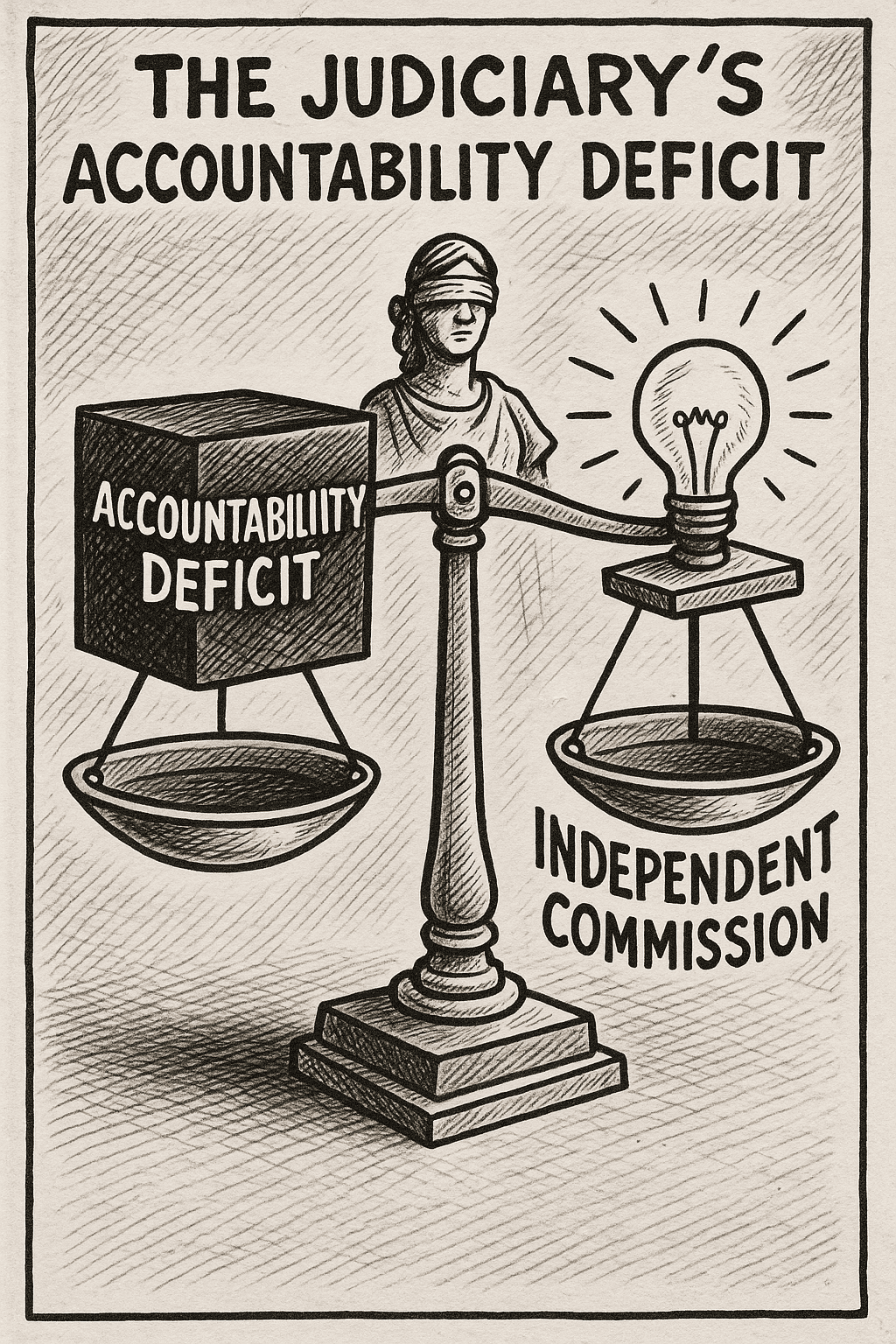
It is evident that reforms in the judicial system are quintessential in order to restore the credibility and accountability of the judicial bodies. The powers given to the judges cannot go unquestioned and unregulated. It must be put into check by the executive and the legislature in order to prevent the imbalance of powers and their arbitrary use. These reforms vary in nature and may include, but not limited to, the following:
First, a national committee must be set up which will have the power to probe the acts of corruption, misbehaviour and insufficient capacity in relation to the judges of the Supreme Court and the High Courts, and take necessary actions for the prevention and deterrence of such acts by the judges in the future. It shall exercise the authority to dispense penalty charges or orders of dismissal from the exercise of judicial powers in order to create a sense of deterrence amongst the judges. It will include the members of both the executive and the judiciary in an equal ratio to ensure that both the organs have an equal say in the process of removal, mitigating the chances of unilateral and arbitrary decision-making.
Second, it must be ensured that the appointment of the judges by the Collegium is conducted with minimal to no bias. To this extent, the executive must be allowed to verify the background and qualifications of the appointed judges to ensure that the appointment is being conducted in a fair and unbiased manner. Such information regarding the appointed judges, as well as that regarding the process of their appointment, should also be disclosed to the public at large so that the Collegium is held accountable for its decisions.
The judgements given by the established judicial bodies, for the sake of ensuring proper justice and enforcement of rights and responsibilities, must be scrutinised by a body, comprising of the members of both the judiciary and the executive. The body shall have members from both the organs in an equitable ratio, and ensure that the judgements neither breach the established boundaries that divide the powers of the government, nor do they fail to act in accordance with the rights and responsibilities of the citizens. Such a body may be established through a constitutional amendment to give its authority a constitutional nature, and therefore, making it difficult to challenge it except in cases of constitutional breach.
Conclusion
The Constitution has clearly laid down the guidelines on the separation of powers and the independence of the judiciary from the influence of the executive in order to ensure that the judicial system is able to function without any form of bias or external control. But just as the judiciary plays a pro-active role in ensuring that limitations on the powers of each branch of the government are not breached, so should the executive use the principle of checks and balances to ensure that while independent from any authority, the judiciary exercises its powers in a reasonable manner and within the set provisions of the Constitution and the current statutes. The judges, just like the legislators of the nation, are accountable for their actions, not just for the sake of maintaining a democratic structure, but also for creating a sense of faith and honesty in the masses, who look upon the institution as the harbinger of law and justice.
References
[1] Supreme Court Observer (Vekatsena, 2025)
[2] The Times of India (Choudhary, 2025)
[3] SCC Online (sucheta, 2015)
[4] DNA India (Team, 2015)
[5] Britanicca (James, n.d.)
[6] Acton Institute (Lord Acton Quote Archive, n.d.)
[7] Encyclopedia.com (Laurence., n.d.)
[8] SCC Online 2025 EBC Publishing Pvt. Ltd., Lucknow.
[9] Manupatra (Manupatra, n.d.)
[10] Lawful Legal (Nair, 2024)
[11] Law Bhoomi (Law Bhoomi, 2020)
[12] Manupatra (Manupatra, n.d.)
[13] The Lawyers and Jurists (Lawyers and Jurists, 2025)
[14] LawFoyer (Law Foyer, 2024)
[15] LawLex.org (Panda, 2020)
[16] Sabinet African Journals (Heerden, 2018)
[17] Polityprober.in (Anon., n.d.)
[18] Manupatra (Manupatra, n.d.)
[19] Supreme Court Cases (Anon., 2018)
[20] Manupatra (Manupatra, n.d.)
[21] SCC Online 2025 EBC Publishing Pvt. Ltd., Lucknow
[22] Academia Edu (Tandon, n.d.)
[23] Supreme Court Observer (Spandana, 2025)
[24] India Code (India Code, n.d.)
[25] SCC Online EBC Publishing Pvt. Ltd., Lucknow.
[26] The Hindu (R., 2025)
[27] Telegraph India (Yadav, 2025)
[28] SCC Online 2025 EBC Publishing Pvt. Ltd., Lucknow.
[29] Hindu Post (Vishnu, 2025)
[30] SCC Online EBC Publishing Pvt. Ltd., Lucknow.
Journal Volume
You should always try to find volume and issue number for journal articles.

Nyayavimarsha
No. 74/81, Sunderraja nagar,
Subramaniyapuram, Trichy- 620020