

"Justice cannot be for one side alone, but must be for both"
America’s Invisible Hand: Rethinking Indo-Pak Tensions and the ‘Vishwaguru’ Delusion
Published on : 05/10/2025
View Count : (25)
America’s Invisible Hand: Rethinking Indo-Pak Tensions and the ‘Vishwaguru’ Delusion
America’s Invisible Hand: Rethinking Indo-Pak Tensions and the ‘Vishwaguru’ Delusion
Author Details
Mr. Mr. Divyansh Joshi
B.A. LL.B. (Hons.), 2nd Year
Gujarat National Law University Silvassa Campus
Introduction
April 22, 2025 can be termed as a Black Day for the Indians due to the militant attack in Pahalgham, Jammu and Kashmir. Recounting, Indian forces provided a fitting answer to terrorists by targeting their vital infrastructure and training camps in Pakistan and Pakistan Occupied Kashmir (POK). The war further intensified when the Pakistani military entered the battlefield to protect the terrorists. In these incidents that occurred, Washington had an unprecedented role by advocating de-escalation in public.
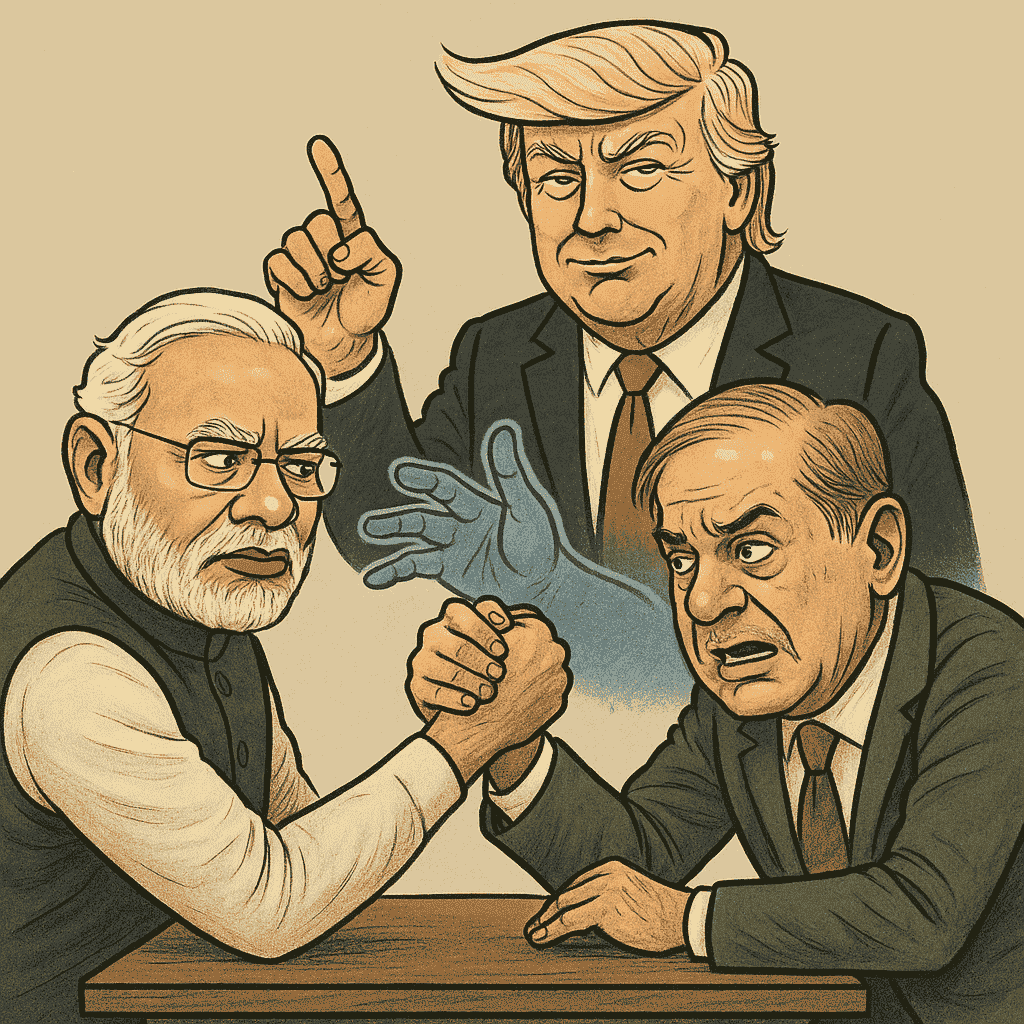
Marco Rubio, USA's Secretary of State addressed both the sides and trying to thread the needle between supporting India's counter terrorism arguments and raising a concern over Pakistani casualty. Such a role of America is usually invisible but active. It is this 'invisible hand' that is less about public intervention but more about influencing incentives and diplomatic space. In such an American tightrope policy, India introduces traction its desire to become Vishwaguru-world teacher or global guru in its quest against terrorism.
Yet, beneath the rhetoric lies certain challenges for India that need to be dealt with at the earliest - structural constraints, international tightropes, adversarial neighbours, and a US whose interests are multiple and shifting. At this stage, understanding how the USA’s policy operates and why Vishwaguru posture is as much a risk as an aspiration clear the clouds of doubt of where the India-Pakistan tensions are likely heading.
Historical and Strategic Context
Post WWII, the United Kingdom divided British India into two sovereign states - India and Pakistan. However, the division was done hastily through a boundary whose foundations were drawn up in less than six weeks by a man who had never visited the region before.[1] “The Partition established a Muslim-majority Pakistan and a Hindu-majority India and provided the diverse regions of Jammu and Kashmir the opportunity to choose which country to accede to. The maharaja (Kashmir’s monarch) initially sought independence, as Kashmir was neglected and subjugated for centuries by conquering empires. However, he ultimately agreed to join India in exchange for help against invading Pakistani herders, triggering the Indo-Pakistani War of 1947-48. The Karachi Agreement of 1949 temporarily ended violence in the Jammu-Kashmir region by establishing a cease-fire line (CFL) overseen by members of a UN truce subcommittee.”[2] However, the tensions have remained consistent till present leading to full-blown wars of 1965, 1971 and 1999. Through the Shimla Agreement in 1972 which established Line of Control (LOC), a new era of bilateral relations ushered in. However, the introduction of nuclear weapons raised the stakes of confrontation.[3]
“There has been a volatile ceasefire since 2003 with frequent violation of cease-fire. Momentum toward meaningful talks halted in September 2016, when armed militants attacked a remote Indian Army base in Uri, near the LOC. In response, India carried out ‘surgical strikes’ on terrorist camps inside POK. In February 2019, an attack on a convoy of Indian paramilitary forces in Pulwama, Indian-administered Kashmir, killed at least forty soldiers. India retaliated with an air strike targeting terrorist training camps within Pakistani territory.” In the month of August 2019, Indian government abolished Article 370 of the Indian Constitution scrapping the special status to the state of Jammu and Kashmir and thus requiring Kashmiris to abide by Indian property and customary law. This led to a series of targeted killings against Hindus in the region. In response, the Indian government took a proactive response through militarized response. However, violence continued in Kashmir in which travelers and workers were specifically targeted by the militants. This unfolds into the recent targeted attack on Hindus on April 22, 2025 in Pahalgham, Jammu and Kashmir.
Strategic rivalry over Kashmir, nuclear deterrence and asymmetric warfare have been constant. External powers - the United Kingdom, Russia, China and the United States of America among others have long influenced this rivalry with an eye for profit. This is undertaken through aids, arms supply, diplomatic pressures or by mere tacit acceptance of certain behaviours.
The ‘Invisible Hand’: Interests, Tools and the Recent Shifts
An Overview
Modern interests of the United States in South Asia are complex. These include counterterrorism, countering China’s growing influence, maintaining nuclear stability, preserving supply chains, access to critical minerals, countering the expansion of communism and maintaining its trade growth. The tools at the disposal of the United States are varied. These include diplomatic calls, intelligence sharing, public narrative setting, military and economic leverages, tariffs, sanctions, internal instability and signaling via third party countries. It also relies upon strategic ambiguity to further its interests. Strategic ambiguity, in international relations means being unclear by leaving open multiple, coexisting reasonable interpretations of one’s message. To capture the idea that a lack of clarity in communication may benefit its speaker, we explicate the concept of strategic ambiguity.[4]
Strategic Ambiguity: Kashmir Issue
The policy of strategic ambiguity of the United States can be observed at numerous instances. On the Kashmir issue, since 1947, the US has never taken a clear and consistent position. “Throughout the 1950s, the US maintained a cautious stance on Kashmir, navigating between Indian and Pakistani sensitivities.”[5] The US, by and large, accepted the view, following the UN Resolution of 1948, that the accession was incomplete and Kashmir was a disputed territory.[6]
The US was quick to realise the potential of having Pakistan as a geographically strategic ally in the region for balancing the Soviet influence as well as to counter Communist uprising in China. As a result, it established air bases and other critical infrastructure in Pakistan. Bruce Riedel, who served as a senior advisor to the last four U.S. President has elaborated in his book ‘JFK’s Forgotten Crisis’ on how the US had two clandestine operations in the USSR and China through Pakistan.
Added to this, due to Pakistan’s proximity with the Persian Gulf, the US ensured protection of Middle East oil fields in case of hostilities in Asia. Gradually, the relations between US and Pakistan strengthened. This caused much pessimism in India. It was only natural that an American-armed Pakistan would encourage closer Indo-Soviet ties. By the time of the Korean War (1950), India, despite no active initiative on its part, had begun to be identified as a Soviet ally.[7] However, India-US relations improved during the second tenure of President Eisenhower.
The most consistent aspect of the US policy on Kashmir is its inconsistency. This is evident through the prompt aid by the US to India during 1962 India-China war, much to the discontent of Pakistan. “Stemming the tide of Communism remained the ultimate objective of US foreign policy… President Kennedy firmly believed that a strong India was important for a free and politically stable Asia. The US sought to utilise its status of donor by pressuring India for settling the Kashmir dispute.”[8]
Economic Tactics
Through the decisions and discourse of the current US administration it is evident that it finds Pakistan an important player in the region, especially its role in West Asia and Middle East. Added to it, Pakistan is home to some of the world’s largest underdeveloped copper and gold reserves, which are currently being developed by a Canadian mining company. The US does not want the Chinese flag over those resources. Added to this, the US recognises that China, today, is a peer competitor with significant economic, strategic, diplomatic and technological capabilities. With greater technological and economic advancement and resources at its disposal, China has steadily expanded its footprint. This has led to China getting closer to the nations that were once pro-US. The debt-trap tactic of China further compels a nation to deal with China, even if it does not intend to.
Thus, the US as a calibrated strategy or sometimes with an impulse to punish, imposes trade tariffs on the nations as in the recent cases of India, China, Russia, Ethiopia, Cuba, IRan, etc. The imposition of tariffs go hand in hand with selective outreach and direct public message. This highlights a shift in the US foreign policy that can be sensed as ‘perceived utility rather than fixed alliances. At the same time, the United States’ policymakers realise that a more stable India-Pakistan relations are useful to its broader regional strategy to effectively counter China and ensure access to strategic locations and market for the US products and services.
Artificial Intelligence
Artificial Intelligence is another domain which is stemming up as the future of human beings. This is evident through increasing number of discussions and legislation on the same. The US has strategically used AI as a geopolitical tool in South Asia. By controlling emerging technologies like drones, surveillance AI and cyber capabilities, the US keeps both India and Pakistan dependent. On one hand, the US shares advanced AI-enabled defense systems with India under QUAD cooperation. However, simultaneously it gives limited AI military support and funds to Pakistan. Here again, the policy of strategic ambiguity is reflected through the US narrative of declaring India as a tech partner while at the same time it does not fully cut off Pakistan from AI-linked defense cooperation. Even the narrative that the recent cross-border military offensive and counter-offensive between India and Pakistan between 7-10 May 2025, were stopped through US’ mediation over trade, speaks volumes of how the US uses trade as a means to influence the relations in the regions.
Vishwaguru
The term Vishwaguru is derived from the Sanskrit term, wherein ‘Vishwa’ signifying ‘world’ or ‘universe’ and ‘Guru' meaning a ‘teacher’. In the contemporary political and cultural scenario, it signifies India’s aspirational role as a normative leader and moral preceptor in global affairs. Ian Hall, in his study of PM Narendra Modi's approach to foreign policy, usefully defines ‘world guru India’ as ‘the notion that India has a unique mission in the world and unique wisdom to convey’.[9] Kate Sullivan de Estrada defines Vishwaguru as “ambitions for India to enact the role of Vishwaguru or ‘world teacher’… a conspicuous feature of foreign policy discourse under contemporary Hindu nationalist rule in India.”[10]
The Vishwaguru project does not stem solely from a desire to bring glory to India’s ancient civilisation but also to play the role of a world teacher that seeks to transform global hierarchies through civilisational pedagogy. Assertions about India's civilizational antiquity, democratic character and self-reliant stance resonate in addresses at different platforms such as the United Nations. Nevertheless, there are actual geopolitical and structural challenges to India's success.
First, institutional capacity is still limited for India. This includes bureaucratic inefficiencies, legal and infrastructural shortcomings, and pervasively entrenched social inequalities that limit India's capacity to project itself as a viable model for imitation, especially in the context of continuous internal criticism. Second, regional dynamics make it challenging for India to achieve aspirational leadership. Neighbors like not only Pakistan and China but also Bangladesh, Myanmar, Maldives and Sri Lanka are proof against the assertion of India being Vishwaguru. It is generally viewed as geopolitical rivalry and not as pedagogic guidance.
Third, strategic imperatives are accompanied by a chain of limitations. The nuclear deterrence equations, cyclical border tensions, and fiscal and military costs of remaining prepared on all fronts necessitate ongoing hedging, thereby undercutting India's posturing for impartial moral stewardship. Finally, there are issues of international credibility because through the repeated reporting in the media, human rights reports and internal security problems are created about human rights practices, communal tensions, and cross-border violence events. This once more deflates India's claim of being Vishwaguru.
The Paradox of Amplification-Restraint
The Paradox of Amplification-Rest
It can be called 'invisible hands' what the US imposes in South Asian geopolitics by both amplifying and restraining India's aspiration of being Vishwaguru at the same time. At the other end, the US gives India strategic assistance specifically in relation to China's ascendance. This is evidenced through endorsements of counter-terrorism, defense collaborations, and alignment within multilateral platforms like the Quad. Yet this enhancement is tempered with restraint. American policy makers repeatedly emphasize India's attempts whether through subtle signaling in diplomatic interactions or by overt announcements derogating India's reputation and also thwarting aspirations of being the Vishwaguru. This duplicity displays the paradox of the US power. While enhancing India's ability to be the world leader it restrains those behaviors which could destroy liberal international norms.
Apart from this, US military aid to Pakistan is still one of the US' key goals. Military aid supports Pakistan's foreign policy. Apart from this, Pakistan also utilizes it as a tool to create disruption in India through terrorism. It is the US 'carrot and stick' policy that dictates regional dynamics. It pits Pakistan's option between escalation and recalibration with serious spillover outcomes for India-Pakistan relations.
Complex Risks and Implications and Policy Reactions
Strategic Blunder:
In case of India, if it is a too aggressive Vishwaguru role played in the form of cross-border raids or military deployments draining India's scarce resources, it might encourage escalation with Pakistan or China. These would encourage the US to prioritize neighborhood management over India's ambitions. This would be a price paid by India in the form of a trade-off between neighborhood management and its own ambitions.
India must now find a balance between restraint and aspiration. It must utilize the role of Vishwaguru via the deployment of soft power, diplomacy and institutional reorganization.
Dependence on the US
India also has a structural vulnerability in dependence on US strategic sanction. Washington foreign policy is subject to the whims of election politics, shift in international crises and balance of economic reordering. Overt dependency upon America makes India susceptible to a lack of stability and weakens independence in international leadership.
As a result, diversification of alliances is what India requires. It is about increasing cooperation with the European Union, ASEAN, African Union, SCO, BRICS and individual nations of the Global South. India is already on par with other institutions of the world. "By declaring that India is not "anti-West" but "non-West", Jaishankar opened up more domestic space for manoeuvre on relations with great powers." The new redefinition gives Delhi the option of looking for closer engagement with the United States and Europe without being blamed back home of being pro-West.
Conclusion
India's ambition to be Vishwaguru speaks of a strong yearning for moral, civilizational, and global leadership. Unless matched by corresponding capabilities, institutional coherence, strategic flexibility, and acceptance of external constraints the posture will turn out to be more performance than power. It is beyond any question that America's hidden hand in the form of its diplomatic coercion, public posturing, strategic realignments, and conditional assistance—is refashioning India-Pakistan tensions and the regional dynamics in subtle but meaningful ways. It now rests with India and Pakistan to spot the lines of influence since the coming decade will reward those who harmonize sky-high rhetoric with sober policy, and who distinguish quickly that while playing geopolitics, there are unseen hands behind the scenes that can move the chess pieces even when not in view. The role of the USA in shaping India's Vishwaguru approach is typified by the amplification-restraint paradox. The threat of strategic mistake and dependence on the USa proves the weakness of South Asia's security scenario. However, India will need to go through the hot water with credibility. Multilateral grouping for India would be the most optimal strategy currently to navigate through these hot waters.
References
[1]“Anmol Singla, How a British Judge Divided India and Pakistan in Just 5 Weeks, Firstpost (Aug. 14, 2025), https://www.firstpost.com/explainers/india-pakistan-borders-cyril-radcliffe-divided-history-explained-13922328.html.”
[2]“Conflict Between India and Pakistan, Global Conflict Tracker, Council on Foreign Relations (May 12, 2025), https://www.cfr.org/global-conflict-tracker/conflict/conflict-between-india-and-pakistan.”
[3]“Conflict Between India and Pakistan, Global Conflict Tracker, Council on Foreign Relations (May 12, 2025), https://www.cfr.org/global-conflict-tracker/conflict/conflict-between-india-and-pakistan.”
[4]“Parker Bach, Carolyn E Schmitt, Shannon C McGregor, Let me be perfectly unclear: strategic ambiguity in political communication ( February 19, 2025), https://academic.oup.com/ct/article/35/2/96/8024232?login=true.”
[5]“US Reluctance to Pressure India on Kashmir, Kashmir Times (January 7 2025), https://kashmirtimes.com/news/us-reluctance-to-pressure-india-on-kashmir.”
[6]“Josef Korbel, Danger in Kashmir 171-73 (Princeton Univ. Press 1954).”
[7]“Josef Korbel, Danger in Kashmir 171 (Princeton Univ. Press 1954).”
[8]“Parama Sinha Palit, The Kashmir Policy of the United States: A Study of the Perceptions, Conflicts and Dilemmas, Strategic Analysis (Vol. XXV, No. 6, Sept. 2001), The Kashmir Policy of the United States: A Study of the Perceptions, Conflicts and Dilemmas, CIAO-Test (Sept. 2001), https://ciaotest.cc.columbia.edu/olj/sa/sa_sep01pap01.html#txt16.”
[9]“Kate Sullivan de Estrada, What is a vishwaguru? Indian civilizational pedagogy as a transformative global imperative (March 6, 2025), What is a vishwaguru? Indian civilizational pedagogy as a transformative global imperative | International Affairs | Oxford Academic.”
[10]“Kate Sullivan de Estrada, What is a vishwaguru? Indian civilizational pedagogy as a transformative global imperative (March 6, 2025), What is a vishwaguru? Indian civilizational pedagogy as a transformative global imperative | International Affairs | Oxford Academic.”
Journal Volume
You should always try to find volume and issue number for journal articles.

Nyayavimarsha
No. 74/81, Sunderraja nagar,
Subramaniyapuram, Trichy- 620020