

"Justice cannot be for one side alone, but must be for both"
Accountability In Crisis: How Sovereignty And War Crimes Expose The Failiures Of International Order
Published on : 05/10/2025
View Count : (18)
Accountability In Crisis: How Sovereignty And War Crimes Expose The Failiures Of International Order
Accountability In Crisis: How Sovereignty And War Crimes Expose The Failiures Of International Order
Author Details
Mr. Ishaan Choudhary
B. A. LL. B, 3rd Year
Amity University, Noida
Abstract
Recent trends in geopolitics highlight the mass destruction and gross violation of human rights as states transgress their power and defy the international legal framework. The crisis in Europe and West Asia particularly Russia-Ukraine and Israel-Palestine marked watershed movement in the international arena. Meanwhile, the India-Pakistan rivalry over territorial disputes and recurring hostilities continues to undermine the regional peace in South Asia. Similarly, escalating tensions between Israel and Iran has amplified the fragility, revealing the ideological and historical conflicts. Together these conflicts indicates that how the states, as the prime actors in international law, escape the accountability for blatant breach of international norms. This essay critically examines the functioning of global governance and the inefficacy of international institutions in addressing such violations. It argues that the resurgence of Westphalian ideology justifying the genocide of innocent civilians in the name of territorial integrity and national autonomy, pushed the modern nation- states towards renewed bipolarization and bloc politics. Revival of the regional groups like NATO and shifting alliances in South Asia expose the failure of international institutions to mediate and negotiate effectively. This is to highlight the urgent need for reforms to restore accountability and uphold international peace.
Introduction
The Geopolitical dimension of international relations has undergone the rapid transition in twenty-first century. Historically, nation-states have resorted to violence and brutal killings for the pursuit of power and political dominance, often at the expense of human rights and humanitarian concerns. These overt acts against humanity at global level poses the challenge before international governance to balance the principle of states sovereignty and the protection of human rights and global security.[1] The contemporary developments in geopolitics have once again raised the dilemma before international stakeholders, scholars and academic circles. The territorial crises have re-emerged with greater intensity with the start of Russia-Ukraine conflict. This has further escalated with Isreal and Palestine war with later involvement of Iran. This has reshaped the global discourse on war, sovereignty and accountability in West Asia.
On the other hand, in South Asia, the unresolved territorial dispute and the cross-border hostilities gave rise to dispute between India and Pakistan. This has further highlighted the historical rivalries along with mass destruction and potential humanitarian crises. Together these conflicts exposed the fragility of the international law and the limitation of existing international mechanism to ensure accountability for war crimes.
The end of Cold War in 1991 marks the beginning of ‘New World Order’, with the disintegration of USSR and emergence of the United States as the global hegemon. Scholars like Francis Fukuyama optimistically argued that this period symbolizes “the end of history as such: that is the end point of mankind’s ideological evolution and the universalization of Western liberal democracy as the final form of human government.”[2] His assertion that Western liberal democracy can reduce all kinds of conflicts and clashes in Europe and ensure peace worldwide, however, presented an overly idealistic picture of international relations. While the globalization foster interdependence through trade, communication and technology, however it exposes the world into new vulnerabilities and rivalries. The non-state actors gained prominence and international institutions such as United Nations were formed with the objective of resolving the dispute and safeguarding peace.
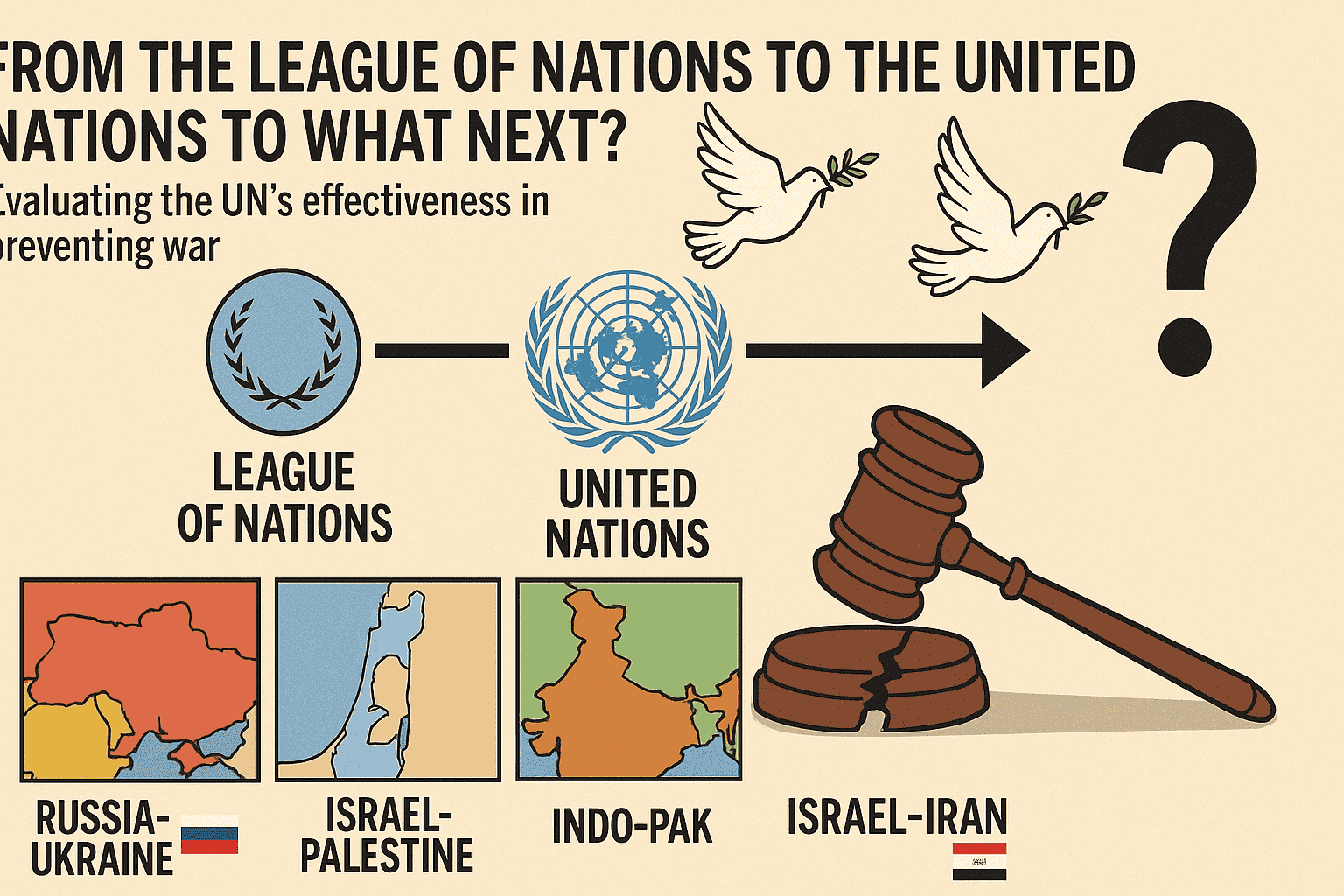
Despite these developments, the capacity of UN and other multilateral bodies has consistently undermined. The present structure of UN Security Council with P5 members, has paralyzed the effectiveness of institution in resolving the conflicts among states. There is violation of deterrence with failure of sanctions, while negotiations and diplomacy are often sidelined in the wake of unilateral military strategies. Simultaneously, the regional blocks like NATO, and rival alliance in West Asia has intensified the polarisation rather than fostering reconciliation. Hence, this demonstrates the failure of global governance to adapt to the shifting power dynamics.
The post-COVID era signifies the resurgence of nationalism and absolute sovereignty, which reflects the notion of Westphalian principles, where the protection of state integrity is of prime importance which invoked to justify widespread violence against the civilians.[3] Due to this trend the global community is again facing the bipolarisation and proxy wars. It is further eroding the trust international community on collective security mechanism. The failure of global governance is particularly evident in its inability to prevent humanitarian crises, violence, genocide and war crimes, which are committed under the pretext of territorial integrity and national autonomy.
Accordingly, this essay examines the contemporary geopolitical crisis within West Asia and South Asia, particularly focussing on Russia-Ukraine, Isreal-Palestine-Iran and India-Pakistan. This is to illustrate the grave failure of global governance, which lead humanitarian sufferings. The scope of this article is to emphasise on the recent development in international relations among nation states. This is to critically analyse the role of United Nations and other global institutions, in managing these conflicts and highlight the urgent need for structural reforms to ensure the accountability, strengthen diplomatic ties and to uphold the balance between state sovereignty and human rights.
From the Cold War to Globalization: A Historical Evolution
The end Cold War in 1991, marked the end of long-standing ideological conflict and intense rivalry between United States and Soviet Union. This gave rise to ‘New World Order’, defined by the disintegration of USSR and rise of US as global hegemon. This period had marked the drastic change in geopolitics. There was the complex interplay between politics, military and ideological confrontation. This gave rise to two ideological blocs i.e. US led capitalist and USSR led communist. The world witnessed bipolarization with the rise of alliances like NATO and Warsaw pact. However, the direct confrontations were avoided among superpowers but it arose the necessity of shaping efficient institution to ensure international security.
The dawn of ‘New World Order’ as claimed by President, George H.W. Bush symbolized the collapse of Soviet Union and rise of liberal democracy and free market economy, which could play a great role in maintaining world peace and order.[4] Further, this optimistic idea was also reflected in the work of Fukuyama, who argued that universalization of liberal democracy is inevitable and has the potential to curb the existing ideological conflicts. Hence, this helps in creating stable international relations and ensure global peace. Later, this vision of the West, turned into reality with the fall of Berlin wall, unification of Germany and the spread of democratic ideals in Eastern Europe.[5] The Expansion of NATO and European Union in 1990s was to ensure the stable world order through these liberal institutions. However, the critics argued that Fukuyama’s idealist vision was unable to see the other persistent factors such as religious and cultural rivalries.
The period of 1990s, alongside also witnessed the rapid spread of Globalization. The phenomena of Globalization have interconnected the economies, societies, cultures etc. There was advancement in science and technology, communication and liberalisation of trade. Later, the internet brought revolution in various fields. Subsequently, it also gave birth to institutions like World Trade Organization (WTO) in 1995. Moreover, the expansion of International Monetary Fund (IMF) and World Bank were another milestone during this period. This gave rise to multinational cooperation reflecting the dominance of market driven economy. The financial markets became volatile, attracting foreign investments. The countries facilitate their soft power through cultural exchanges, tourism, media and migration.
The whole idea of a Globalized world, to reduce the likelihood of war or regional conflict. This was to establish peace across the world. Nevertheless, this phenomenon has also open the floodgates of vulnerabilities with instances like global terrorism, pandemic, climate change etc. As a result, this has highlighted the limitation of traditional state-centric governance. During this unprecedented scenario the UN took the central stage as an international institution for global governance. The primary role of UN is to mitigate violence and establish peace and order during post-cold war period. This indeed saw the rise of UN peace keeping operations from Somalia to Rwanda to Bosnia. However, this has also revealed the limitation of the UN system. As UN was failed to prevent genocide in Rwanda in 1994.[6] Later, US led invasion in Iraq in 2003 was justified on the pretext of possession of weapon of mass destruction.[7] They bypassed the UN Security Council and even eroded the idea of rule based international order. Similarly, NATO’s intervention in the Kosovo in 1999, again sparked the debate on legality and humanitarian crises.[8]
The globalisation also marks the rise of new powers like China, which saw unprecedented economic growth and India, which evolved as the regional power. Russia on the other hand reclaiming its position as superpower on the global pedestal. This has further created a new playing field for conflicts and magnified the vulnerabilities. Though the international institutions like UN is responsible for global governance but its structural weakness has limited its effectiveness. Thus, the post-cold war era reveals the paradox. On one hand globalization is committed towards integration and interdependence of nations, communities and societies to ensure peace and cooperation. Contrary to this the persistent nationalism, unresolved territorial disputes and inefficiency and incapacity of international institutions, resulted in grave humanitarian crises and violence in the world. This paradox has changed the dynamics of contemporary geopolitics where the territorial sovereignty, accountability and failure of global governance is still central point of debate.
Geopolitical Conflicts: A Challenge in the Post-Covid World
The 2020s have been marked by significant upheavals in the international arena — first with the outbreak of the COVID-19 pandemic and subsequently with the rise of geopolitical conflicts and violence, which have resulted in widespread war crimes among nations. These developments have once again brought nation-states to the threshold of a new Cold War era. The emphasis on national identity and territorial integrity within international relations has consistently been a root cause of violent conflicts between states.
Russia-Ukraine War
This war which started in the year 2022 with Russian invasion into Ukrainian territory, is the most defining conflict. On the day of 24th February, 2022 Russian President Vladimir Putin launched a special military operation against Ukraine. This attack is a consequence of a long simmering dispute between them over the Ukraine’s unwavering will to join North Atlantic Treaty Organisation (NATO).[9] Though this dispute has its root in annexation of Crimea in the year 2014. Crimea was the part of Ukrainian peninsula with the majority Russian population, which was invaded by Russian troops with the support of Pro Russian separatists in Ukraine. Later, in the same year Russia ordered ‘peacekeeping operation’ in the disputed region of Donbas. Further, on February 2022, it came as a blatant shock for the world, with the invasion of Russian troops in the territory of Ukraine.
Many believed that the origin of this dispute is embedded in the shared cultural ties between them, Russia’s ongoing tension with NATO, west ideology and the ambition of one man i.e. Putin. Russia has started growing its military presence around Ukraine and Belarus which is a close Russian allay to the north of Ukraine in the late 2021.[10] UN called the session of security council to address this crisis which was joined by US and other NATO members. They tried to put pressure on Russia to de-escalate or to face some kind of retaliation but in vain. Ukraine with the support of its western ally including US gave befitting reply to Russia and even took back the control of some of its region. This attack is not only a regional conflict but also signify the demolition of the Ukrainian identity and statehood.
This invasion caused largescale destruction of human lives and property. Millions of people have fled from the country. The UN has termed this as most serious global peace and security crisis in recent years. As per the data provided for UN High Commissioner for Refugees (UNHCR) indicated by June 2022 there were around 4.7 million refugees from Ukraine present across the Europe, over 7.1 million people displaced by the war and estimated 15.7 million people were in urgent need of humanitarian assistance and protection.[11] According to the reports of UNHCR most of the civilian causality was the result of explosive weapons including shelling, missiles and airstrikes. In July, 2024 there were reports of missile strike on children’s hospital in Kyiv though Russia denied the allegation.[12] There were other reports suggesting the gross violation of fundamental human rights especially in those areas which are under the control of Russia. Overall, this conflict had an adverse impact on human rights with killing of civilians including women and children who were most vulnerable among them.
This war has violated the principle of territorial sovereignty and non-aggression, which are the founding stone of the UN Charter. It has defied the international law, particularly Article 2(4) of UN Charter, which prohibits the use force against the territorial integrity and political independence of any state. Russia being one of the P5 member of Security Council has paralyzed the whole UN system. Despite numerous economic sanctions by United States and other European Nations, it failed to deter its military operations. This war led to development of bloc politics such as China, North Korea and Iran supporting Russia, on other side NATO members and other allied nation providing military support to Ukraine. This led to the crisis of accountability in global governance.
Isreal-Palestine-Iran: A Tripartite Struggle
Isreal-Palestine conflict is the long standing and most contentious dispute of the modern international relations. The world saw the mass devastation in this region in 2023, with the surprising missile attack of Hamas on Isreal. Hamas, which is an armed group currently active in Palestine. It has its origin from Muslim Brotherhood in 1987. It emerged as Islamic Resistance Movement, opposing the existence of Isreal on what they called as land of Palestinian. Currently it has the sole control on Gaza strips, but still has the dream of independent historic Palestine land. This burning point has always plunged the relationship between Palestine and Isreal into turmoil. Same happened on the day of 7th October, 2023 when Hamas surprised attack on Isreal has once again brought the world on the verge of war. The Hamas led gunmen breached the security barriers and barrage of rockets fired from Gaza during the Jewish holiday of Simchat Torah. Palestinian fighters infiltrated in Isreal; initial targets were airport and strategic location of military base. As per Israeli reports over 2500 rockets were launched by Hamas.[13] This unfortunate event has shaken the world to the core.
The attack was condemned by various countries including USA and International Organisation such as UN. This deadly attack has killed more than 700 people in Isreal, some of them were held hostages and others were injured, as per reports by Israeli media.[14] Isreal responded to this attack through airstrike followed by military operation, the aim was to destroy Hamas and deter such kind of attack on Isreal in near future. This prolonged war has forced around 2.3 million population to remain homeless and there is catastrophic level of food insecurity in Gaza, as per the reports of UN.[15] Later, Isreal has intensified the attack by cutting the supply of food, water, electricity, medicine etc, in the region of Gaza. This has aggravated the catastrophic humanitarian crisis.
By the end of May 2023, in Gaza alone 1.9 million Palestinian were displaced due to Israeli offensive action, state backed settler violence has also increased and hospitals were also targeted.[16] There had been killing of more than 20000 children in Gaza within one year this attack.[17] On the other hand, Iran launched attack to support Palestine to claim their right over historic land of Palestine. The UN Peacekeeping force was also attacked, which attracted mass condemnation from all over the world.
This tripartite struggle has left the imprints of genocide in Gaza, Westbank and Lebanon killing more than 43000 people mostly civilians. This figure only signifies the number of bodies that were counted in hospitals. The toll of death is more than this as estimated by The Lancet around 1,86,000.[18] The intensity of these attacks or the war has shaken the world at present. This drastically pushed the world towards the brink of destruction and raising the concern about functioning of global governance in maintaining international order.
India-Pakistan Rivalry
The rivalry between these two nations traces its origin from the partition of 1947. This partition led to the emergence various unresolved territorial disputes such as in Jammu & Kashmir. Despite various diplomacy, mediation and international invention to establish peace in this region remains futile. This region frequently sees the rise in cross-border terrorism and military standoff in sensitive border areas. There are various instances of violation of ceasefire along the Line of Control (LoC). This has resulted in mass civilian casualties and migration.
The dispute between these two nations is not restricted to territorial boundaries but is also ideological in nature. India being the secular country with democratic setup, contrary to this Pakistan is the homeland for Muslim population with frequent military upheavals. The mistrust due to rise in cross border terrorism between the nations, is difficult to negotiate on the tables. The Recent tension escalated between these two powers in South Asia, following a terrorist attack in Pahalgam, a town in India-administered Kashmir. Subsequent to this deadly attack India launched ‘Operation Sindoor’ on May 7, 2025, against Pakistan.[19] This operation has again pushed the world on the brink of nuclear warfare. With two weeks of confrontation between these nations ended with announcement of ceasefire. Alongside India has also suspended Indus Water Treaty with Pakistan.
This is also the first time India and Pakistan have engaged in drone warfare in their rivalry, indicating a new era of technological conflict in the region. India claimed that the operation was launched as to counter Pahalgam attack. Therefore, it only targeted terrorist in Pakistan. However, Pakistan alleged that India failed to prove the involvement of Pakistan in that attack. Further, it demanded an independent probe into this. This demonstrates a failure of diplomacy as a tool to resolve the dispute between nations. The dialogue process such Lahore Declaration of 1999 and Agra Summit of 2001 has collapsed repeatedly in the wake of terrorist attacks, domestic and political pressure and military escalation.[20]This has caused grave humanitarian crises with the death of thousands of people, displacement, famine, atrocities due to weak accountability mechanism.
Global Mayhem: The Collapse of International Institutions
The concept of global governance is embedded in the foundation of United Nation established in 1945. The aim was to create the new world order through international institution that could maintain peace and security, protect human rights, provide humanitarian assistance, promote sustainable development and uphold international law.[21] The primary goal is to deter any kind of potential warfare which can lead the world towards another World War. Although the UN has successfully prevented a third World War, it has failed to deter violence, arm conflict, nuclear race, cold war and genocide still occurring among nation states.
The UN’s inability to maintain mutual cooperation among nation states and facilitate dialogue and diplomacy to mitigate conflicts repeatedly highlights the power tussle within the organisation. The five permanent members or P5 of the UN comprising USA, Russia, China, France and UK with veto power always have upper hand in decision making. The recent example of Russia’s use of its veto against UNSC resolution proposed by US and Albania reflecting the abuse of power. Furthermore, the UN framework has adopted Eurocentric approach in international system, which makes the international institution like UN underrepresented. As the current structure of UN is not efficient to accommodate the aspiration of developing countries from Asia, Africa and South America. This has repeatedly fuelled the demand of expansion of United Nation Security Council (UNSC) with inclusion of more permanent member from third world nations.
The present framework of UNSC has even failed to facilitate the negotiation during Russia and Ukraine conflict. Russian President Putin announced ‘special military operation’ against Ukraine while an emergency session of Security Counsil was underway, exposing the body’s helplessness.[22] Moreover, the sanctions imposed on Russia were relatively weak and ineffective with no immediate outcome. This conflict has also given rise to nuclear threat and potential usage of weapon of mass destruction. This marked a watershed moment in international relation, particularly when the European Union financed the purchase and delivery of equipment to the country under attack and Germany lifted its ban on the international delivery of lethal weapons. Thus, these developments underscore the need to reform the United Nation, to mitigate the escalation of war crimes and to held P5 nations more accountable for safeguarding international peace and order.
The US, once the primary architect and supporter of international institutions has begun shifting away from the very order it has created. The first move is to shift away from the rule based international order; the question arise who makes these rules are still unclear. This can be evident in Isreal and Palestine conflict, the umbilical relationship between US and Iseral undermining the UN resolution against Isreal’s barbaric act in Gaza. On 18 October 2023, US vetoed against the resolution stating it as “humanitarian pauses” and Isreal’s right to defend itself.[23] Now the UN has shed off the objective with which it came into existence and in reality, it only remains the coalition of willing partnership mostly allies which is universally accepted by other nations.
Meanwhile, the regional blocs like NATO have again gained prominence in international relation and shaped the global politics. However, it has intensified the conflict instead of mitigating it. As Russia cited that eastward expansion of NATO is the catalyst for the ongoing conflict Russia and Ukraine. As it poses serious security threat and violation of territorial integrity, which provoke this aggression. Hence, these alliances in these regions has deepen the geopolitical rift and created new fault lines of confrontations.
The International Criminal Court (ICC) and International Court of Justice (ICJ), which propose the judicial system at international level. Unfortunately, these Judicial institutions also lack the efficiency to curb heinous crime at global level. As ICJ doesn’t have ‘Suo Moto’ power to take the cognizance on the matter of greater importance. Though it has condemned Isreal for obstructing humanitarian assistance and bloodshed in Gaza, Westbank and reiterated the violation of Genocide Convention 1948, by Isreal, but in vain.[24] The warrant issued by ICC has even failed to deal with the humanitarian crisis, which has flouted the international laws. Isreal defies the warrant stating it is not a member of ICC and it even failed to abide the orders of ICJ. Hence, it marks the failure of global governance to mitigate the human right violation and ensure the peaceful coexistence with mutual cooperation among nations.
Conclusion: The Urgent Need for Reform
The post-Covid world has intensified these conflicts in the pretext of national integrity, nationalism, economic competition, unilateralism. Instead of focusing on global cooperation and mutual interdependence to ensure peace and order, the world is retreating towards regressive Westphalian notion of power politics, where might often makes right. The ongoing wars, in these regions justifying in the name of safeguarding territorial sovereignty and integrity along with the preservation of cultural essence, leading the world towards civilizational clashes and ethnic massacres. The collective failure of international governance highlights the urgent need to reform the traditional UN framework. Unless urgent reforms are undertaken in UNSC and broader UN framework to enhance accountability, democratize representation, and strengthen diplomatic mechanisms, international law will remain powerless against war crimes and the collapse of global governance may soon become inevitable.
References
[1] Jinseop Jang et al., Global Governance: Present and Future, 2 PALGRAVE COMMUNICATION 1-5 (2016).
[2] Francis Fukuyama, THE END OF HISTORY AND THE LAST MAN 70-73 (1992).
[3] Florian Bieber, Global Nationalism in Times of the COVID-19 Pandemic, 50 NATIONALITIES PAPERS 13-25 (2016).
[4] September 11, 1990, George Bush Declares “New World Order,” Begins Endless Wars, WebLine News (Sept. 10, 2016), https://www.weblinenews.com/september-11-george-bush-new-world-order/.
[5] The fall of the Wall and German reunification, deutschland.de (Aug. 13, 2012), https://www.deutschland.de/en/topic/politics/germany-europe/the-fall-of-the-wall-and-german-reunification.
[6] Sathisha M, The United Nations and the Rwandan Genocide (1994): Success and Failures, 5 IJRAR 336-337 (2018).
[7] Silas Nyamweya, Was America Justified in its 2003 Invasion of Iraq?, Hub Pages (Sept. 16, 2023), https://discover.hubpages.com/politics/an-examination-of-the-american-invasion-of-iraq-in-2003.
[8] Edward Newman & Gëzim Visoka, NATO in Kosovo and the Logic of Successful Security Practices, 100 INTERNATIONAL AFFAIRS 631-635 (2024).
[9] Jeffrey Mankoff, Russia’s War in Ukraine: Identity, History and Conflict, CSIS (Apr. 22, 2022),
[10] Elliott Davis Jr, ‘Explainer: Why did Russia Invade Ukraine?’, US News & World Report (Feb. 24, 2022), https://www.usnews.com/news/best-countries/articles/explainer-why-did-russia-invade-ukraine.
[11] Ann Neville, Russia’s War on Ukraine: Investigating and Prosecuting International Crime, EPRS https://www.europarl.europa.eu/RegData/etudes/BRIE/2022/733525/EPRS_BRI(2022)733525_EN.pdf.
[12] Ibid.
[13] What happened in Isreal? A breakdown of how Hamas attack unfolded, Al Jazeera (Oct. 7, 2023), https://www.aljazeera.com/news/2023/10/7/what-happened-in-israel-a-breakdown-of-how-the-hamas-attack-unfolded.
[14] Ibid.
[15] What is Hamas and why is it fighting with Isreal in Gaza, BBC (Oct. 21, 2024), https://www.bbc.com/news/world-middle-east-67039975?0=utm_source=ground.news.
[16] Isreal and the Occupied Palestinian Territories 2023, Amnesty International, https://www.amnesty.org/en/location/middle-east-and-north-africa/middle-east/israel-and-the-occupied-palestinian-territory/report-israel-and-the-occupied-palestinian-territory/.
[17] Suhashini Haidar, Is Isreal’s War in Gaza putting global order at peril?, The Hindu, (Dec. 6, 2024), at 11.
[18] Ibid.
[19] Monir Ghaedi, What's at stake as India-Pakistan tensions rise in Kashmir, DW (July 5, 2025), https://www.dw.com/en/whats-at-stake-as-india-pakistan-tensions-rise-in-kashmir/a-72337273.
[20] Dr. Divya Dwivedi, India-Pakistan Relations Since 2000: A Delicate Dance of Tensions and Diplomacy, 10 JETIR 347-348 (2023).
[21] Jacques Fomerand & Cecelia M Lynch, United Nation: International Organisation,’ Encyclopaedia Britannica (digital.edn.,1999), https://www.britannica.com/topic/United-Nations.
[22] Aldo Zammit Borda, Ukraine and the failure of the United Nations Security Council, City University (Feb. 28, 2022), https://www.city.ac.uk/news-and-events/news/2022/02/ukraine-and-the-failure-of-the-united-nations-security-council.
[23] Shakeeb Asrar & Mohammed Hussein, How the US has used its veto power at the UN in the support of Isreal, Al Jazeera (Oct. 26, 2023), https://www.aljazeera.com/news/2023/10/26/how-the-us-has-used-its-veto-power-at-the-un-in-support-of-israel.
[24] Sondos Asem, Isreal’s War on Gaza: What the International Court have said, Middle East Eye (Oct. 9, 2024), https://www.middleeasteye.net/explainers/israel-war-gaza-international-criminal-court.
Journal Volume
You should always try to find volume and issue number for journal articles.

Nyayavimarsha
No. 74/81, Sunderraja nagar,
Subramaniyapuram, Trichy- 620020